13th Sunday in Ordinary Time, Year A – Homily

13th Sunday in Ordinary Time, Year A
2 Kings 4:8-11, 14-16a
Psalm 89:2-3, 16-17, 18-19
Romans 6:3-4, 8-11
Matthew 10:37-42

The Fourth Commandment tells us to “honor our father and mother” but today Jesus says, “Whoever loves father or mother more than me is not worthy of me.”

Are these two in conflict?  Absolutely not.  Jesus does not tell us that we shouldn’t love our mother or father.  He says we should not love them “more than” him.  Remember, elsewhere Jesus tells us the greatest commandment is to love God and the second is to love our neighbor.  We are to love all but God should be first.

Jesus goes on say, “Whoever finds his life will lose it and whoever loses his life for my sake will find it.”  What does it mean to lose our life?

We have busy lives.  Work or school can be a full-time effort.  Every retirees can have a lot of commitments with grandchildren or their generous volunteering.  There can also be sports, music, and plays, or whatever your (or your children or grandchildren’s) favorite activities are.  Just caring for little children or elderly parents can take a lot of time.

These things can be important and at least some of them should be important.  Some of them help us to have happy lives but are they what we are created for?  They are part of life but are they our whole life?

The life we are created for is life with God.  Spending time with the people we love can help us understand God’s love for us.  For instance, being a parent and struggling with a disobedient child might help us reflect on our own relationship with God as his child.

God gives us gifts like the gift of music.  God wants us to use our gifts to help others be happy and to know God.

Baptism marks a beginning of life with God but the Sacrament of Baptism is not an end.  Through Baptism we are forever marked as a child of God but being baptized does not guarantee our salvation.

In this precious sacrament, we are “baptized into Christ Jesus…baptized into his death…in newness of life.”  In his death on the Cross Jesus took away the sin of the world so that we might have newness of life.

We must put God at the center of our lives if we truly want to live with him in eternity.  This means God must be our greatest priority.  This is not easy.  We have to work to be able to food on the table.  We have to take care of the children.  God wants to do these things but to do them with his love.

Sometimes coming to Church for Sunday Mass can just seem like one more thing on an already busy schedule.  It can be easy to think that missing one Sunday isn’t a big deal.  Then one Sunday becomes two and….

Bishop Matano spoke in his pastoral letter for the Year of the Eucharist about the importance of Sunday Mass.  The rules about coming to Mass every Sunday and Holy Day have not changed (we do recognize sickness and significant snow as reasons not to make it).  The Third Commandment to keep the Sabbath holy remains.

We need to realize that the Third Commandment is not for God’s benefit but for our benefit.  We need what the Mass offers us.

Here someone is probably thinking but I don’t feel like I get anything out of Mass.  The Mass is never meant to be a magic potion that instantly makes us feel good.  Celebrating Mass is about praising God.  In the way we pray at Mass, we pray not for ourselves as individuals but for all of the God’s people.  Yet, in hearing God’s Word and receiving the Eucharist, we cultivate and nourish our own ongoing relationship with God.

Who do we normally have our closest relationships with?  Is it not the people we interact with often and engage in conversation?

Every week at Mass we hear God’s Word.  In Ordinary Time, the gospel is read in sequence (so is the second reading).  Missing weeks sometimes breaks up the flow of the readings or leaves us without critical components to understand the gospel as a whole.

Of course, the Eucharist is offered to us as the Bread of Life each week.  It truly is the Body and Blood of Jesus.  We may not always appreciate this to gain the full value.

We also might not always understand what goes on at Mass to appreciate it.  That’s why Bishop Matano has called for this Year of the Eucharist, to help us understand and appreciate what we celebrate.  That’s what we are going to work on this year.
A Year to Bear Fruit

As I began reflecting upon today’s gospel and the idea of “bearing good fruit” I thought about how it takes time to bear fruit.  If we plant a seed we know it will take time for the seed to grow before it ever bears fruit.  On the other hand, if we walk into an orchard that has been established for years and it is the season for fruit we expect to see fruit.

How soon do we expect to see people bear fruit?  When someone new comes into our life do we expect to see them do good things right away?  My reflection led me to realize that today is the first anniversary of the day I came to St. Michael’s.  I wonder what people think of me know compared to one year ago.  I would imagine that some people were very excited when I first arrived, maybe because of something I said or just the first impression they had.  I would also imagine that others weren’t so excited, perhaps because they just don’t like change, others still wishing Fr. Felix hadn’t passed away, while still others heard something different from me than those who liked me.  To each his own.  Now, after one full year here, I’m sure some people’s opinion of me has changed.  Some who didn’t like may have to like me more.  On the other hand, some who liked me initially may not be so sure.

Jesus was not liked by everyone so I don’t expect everyone to like everything I do.  While, like most humans, I like to know I am appreciated, my role as pastor is not to be liked.  I do feel generally appreciated and valued here but I know my role is to do the work that Christ has sent me to do.  As I said Mass this morning, I thought about today as the Memorial of St. Irenaus, the Bishop of Lyons who was martyred in 202 A.D. because he stood for the truth of our faith.  That’s what I want to do.  No, I don’t want to be martyred but I do want to always stand for the truth of our faith that God has given us through Christ our Lord.

Peace,

Fr. Jeff


Stop Judging

Stop judging, these are the first words Jesus says to his disciples in today’s gospel.  Jesus goes on to tell us that we will be judged by the same standard by which we judge others.  He also tells us we must look at our own sins before the sins of others.

All of this is true.  It is what Jesus taught but how well do we understand it?  Many today take Jesus’ words to stop judging to mean we can’t talk about any behavior as wrong.  This leads us into relativism.  Relativists say you can believe and do whatever you want as long as it doesn’t hurt anyone else.  To relativists there is no absolute truth.

But there is a Truth and God is the source of the Truth!

Our psalm today contains the words, “Blessed the nation whose God is the Lord.”  What does it mean to call God “Lord”?  I believe it means that it means that we accept God as our leader and will follow what he teaches.  It isn’t always easy.  We have the Bible to guide us but the New Testament was written 2,000 years ago and the Old Testament even longer ago.  So, the situations in which we live are different.  That doesn’t mean the Bible isn’t relevant today.  It just means the we need to rely on the Holy Spirit that has been guiding our Church for 2,000 years to help us know how to apply what Jesus said today.

Jesus clearly said “stop judging” but he also said to his disciples “Follow me.”  To follow Jesus is live as he lived, to follow his teaching.  It isn’t always easy but may we always be like Abram (who will become known as Abraham) in the first reading who “went as the Lord directed him.

Peace,

Fr. Jeff

12th Sunday in Ordinary Time, Year A – Homily

12th Sunday in Ordinary Time, Year A
Jeremiah 20:10-13
Psalm 69:8-10, 14, 17, 33-35
Romans 5:12-15
Matthew 10:26-33

Jesus says “Fear no one.”

What do you fear?  For our new graduates, they can be happy and excited to have graduated but life transitions can bring the unknown and new things.  Whether it be a new school, new job, or new stage of life in retirement, uncertainty can bring us some fear.  I know from me personally my one fear is probably fear of the unknown.

Another fear might be “failure.”  We don’t want to fail but we must not let that fear stop us from acting.

Another fear might be “rejection.”  We might fear speaking up lest we become as our psalm says, “an outcast to my brothers, a stranger to my children.”

Jeremiah faced similar issues.  He was a prophet of God in a time when many people were not living as God commanded.  God called Jeremiah to be a prophet to tell them to change their ways.  They didn’t like that.  So they were plotting to kill him.  These were the same people who had been friends with Jeremiah.  One should note that if you read the entire book of Jeremiah, the people never say they disagree with Jeremiah and we are never told they attempt to prove him wrong.  They don’t argue what he is saying.  They just don’t want to have to do it.  So they plot to get rid of him.

Like Jeremiah, we live in a society today where many people are not living as God has taught us.  Today they are even bolder than in Jeremiah’s day insomuch as many today will argue against Church teaching or deny that God even exists.

There are some today that will freely speak publicly in favor of things that go against church teaching like same sex marriage but if someone speaks in against it, they label it as hate speech.

Today we even see the government trying for force people like pharmacists to prescribe drugs against their faith, medical staff to participate in procedures that violate their faith, and religious employers to provide insurance for medications they don’t agree with.  We are not talking here about whether something should be legal or not.  We are talking about people being forced to violate their conscience and their faith.

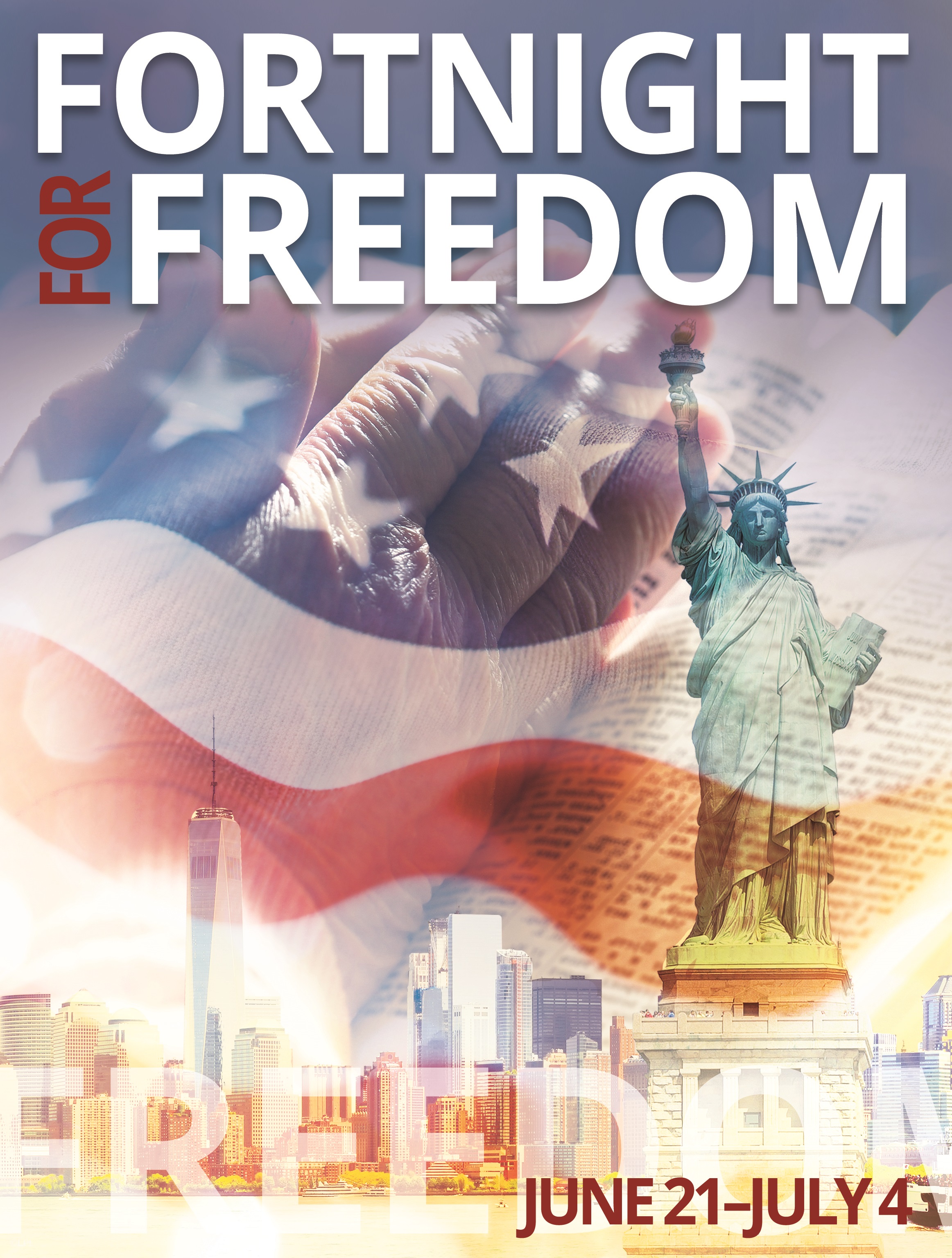
With this in mind, a few years ago our United States Conference of Catholic Bishops (USCCB), began an annual “Fortnight for Freedom” as a time to stand and pray for religious liberty.  It hasn’t received much attention in the news or in the church.  It begins on June 21st, the vigil of the memorial of St. John Fisher and St. Thomas More and continues until July 4th when we celebrate our independence.

St. John Fisher was the Bishop of Rochester in England in 1535 (and hence with the connection of the name of the diocese is the patron saint of our diocese) while St. Thomas More was the chancellor of England under King Henry VIII.

Henry VIII had asked the Catholic Church to grant him an annulment from Catherine because she had not borne him a male heir.  The Church denied the annulment as not having male children doesn’t affect the validity of the marriage.  Henry VIII decided to split the church in England from the Catholic Church and named himself head of the church in England.  He ordered the bishops and his court to sign a statement accepting this.

Saints John Fisher and Thomas More refused to follow the king’s order.  They held to their faith over the king’s order.  King Henry VIII ordered their execution and today they stand as martyrs in our Catholic Church.

The Fortnight for Freedom ends on July 4th, the day our nation celebrates its independence.  Our Declaration of Independence refers to rights given by God.  The First Amendment to our Constitution establishes the freedom of religion.

During these Fortnight for Freedom let us pray that we always be able to speak up for what we believe and for the courage to do so even when it is not popular opinion.

St. John Fisher and the Fortnight For Freedom

Today, June 22nd, is the Optional Memorial of St. John Fisher and St. Thomas More.  In the Diocese of Rochester (United States), St. John Fisher is the patron saint of our diocese.  That means for our diocese today is a feast day.

St. John Fisher was the Bishop of the Diocese of Rochester in England (Hence, with the same name of the diocese, he was chosen as the patron saint here).  On this date in 1535 he was martyred (St. Thomas More was martyred a few days later on July 6th).  They were both executed by the order of the king for the same reason.

Many are familiar with the story of King Henry VIII and how he was married multiple times but never a male heir to succeed him as king.  When Catherine to whom he had married did not bear a son, Henry VIII asked the Vatican to grant him an annulment but it was denied as having no grounds.  As king, Henry VIII decided to split the church in England from the Vatican and named himself as head of the church so that he could grant his own annulment.

The clergy and king’s court were ordered to sign a statement recognizing the split in the church and the king as head of the church in England.  Saints John Fisher and Thomas More (a layman and right hand man to the king) refused to sign the statement so Henry VIII ordered their execution for disobedience against the king.

So we see how 500 years ago the government was trying to tell the church how to run its affairs.  In our present day we see this in the government ordering religious organizations to provide insurance for contraception, support same sex parent adoptions, and for religious hospitals to perform abortions.

Our country was founded, in large part, by people seeking religious freedom.  Our Declaration of Independence speaks of rights from God and the First Amendment in the Bill of Rights guarantees the freedom of religion.  

Part of the problem with religious freedom and the government laws and regulations I spoke of above is is the compartmentalization of faith.  Many people have no faith.  Others profess to have faith but they see faith as something you do in private as one small part of our lives.  Our Catholic faith teaches us that faith is no just one part of our lives.  Faith is meant to be part of our whole lives.  That means we must live out our faith in all we do.  That includes birth control and marriage.  Our Church does not say that we should force our faith on others but we must live in our own lives.

Recognizing that we must speak up for religious freedom, a couple of years ago, our United States Conference of Catholic Bishops (USCCB) started what is called the Fortnight for Freedom.  It has never received much media attention and, depending on your parish, it hasn’t gotten a lot of attention in the church either (You can find out more at http://www.usccb.org/issues-and-action/religious-liberty/fortnight-for-freedom/index.cfm).

The Fortnight for Freedom begins on June 21st, includes today’s celebration of the Memorial of Saints John Fisher and Thomas More, and goes until July 4th, the day our Declaration of Independence was signed based on rights given by God.

May we be inspired by the examples of Saints John Fisher and Thomas More to live with the same courage that enabled them to willingly give their lives rather than reject our faith.  With this courage may we live out our faith publicly and stand up for what we believe in.

Peace,

Fr. Jeff

The Most Holy Body and Blood of Christ, Year A – Homily

The Most Holy Body and Blood of Christ
Deuteronomy 8:2-3, 14b-16a
Psalm 147:12-13, 14-15, 19-20
1 Corinthians 10:16-17
John 6:51-58

Moses speaks to the Israelites of how they were “afflicted with hunger” and God fed them “with manna, a food unknown” to them.  We identify the manna as “bread” but it was a type of bread that was previously unknown to the Israelites.  It was an earthly substance.  In their physical hunger, God provided this bread.

Today we are here to celebrate how God feeds our spiritual hunger with another “food unknown” before.  It is the Eucharist, the bread of life.  The Eucharist is offered to us in the form of bread and wine but through the consecration it becomes so much more, the Most Holy Body and Blood of Christ.

On Holy Thursday, we celebrate the Institution of the Eucharist but we also celebrate the Washing of the Feet and the Institution of the Priesthood.  Today’s solemnity focuses solely on the Eucharist.

I talked about the Eucharist on Holy Thursday and what it means to us.  I talked again about at the beginning of May as six of our children received their First Communion.  I’ve talked about it on other occasions and I will continue to talk about it.  The Eucharist is that important.  It is the source and summit of who we are as Catholics.

One of the ways we talk about the Eucharist is as a meal.  It is food that feeds our spiritual hunger.  We live in a culture that wants everything now.  This includes our food.  How many fast food restaurants are there?  Many families no longer sit down together to enjoy a meal together.  They are always on the go.

The Eucharist is not meant to be fast food.  We receive the Eucharist in the context of Mass.  The whole Mass takes maybe an hour (we make even shorter in the summer).  We take time to enter into God’s presence with prayers and readings.  We need to reflect on what it means to participate in the Blood of Christ, to participate in the Body of Christ.

As I said before, the Eucharist is the source and summit of who we are.  In recognition of this and realizing people don’t always understand this, you may have read in the Catholic Courier that Bishop Matano has called for a Year of the Eucharist for us to grow in our understanding of the Eucharist.

In the coming year I will speak more often about the Eucharist and the Mass in my homilies.  I will offer some presentations on the Eucharist and the Mass to talk about the Real Presence and to help us understand and appreciate what goes on at Mass.  We will also work towards some times for Adoration with the Exposition of the Blessed Sacrament.  We will reflect on the Eucharist that empowers us for the ministries we do.

Now, I want to talk about our postures at Mass.  At times we stand, others we kneel, and at times we sit.  The postures we take are not random but are meant to reflect our attitude.

For instance, at the beginning of Mass we stand as the procession comes in to welcome God coming into our presence.  We sit for the readings not just for comfort but so that we might remain still to hear the readings (if we were all standing we might fidget and cause distraction to others).  We stand again for the Gospel as Jesus comes present among us in the Words of the Gospel.

As we enter into the Eucharistic Prayer we kneel as a recognition of the holiness of what is going on.  We stand for the Our Father recognizing that through the sacrifice we celebrate in the Eucharist we have been made worthy to rise.

With this in mind, back in 2003 Bishop Clark decreed that we remain standing after the Lamb of God.  The General Instruction of the Roman Missal clearly stated that this was for the Bishop to decide.  There are theological and historical arguments for both.

If you read Bishop Matano’s Pastoral Letter in the Catholic Courier, you know that he has now decreed that after the Lamb of God we will return to the practice of kneeling until we come forth for Communion.  So we will begin doing that today.  Everything else will remain the same, we will bow just before we receive Communion, receive standing, and then return to our pews and kneel.

Let us pray that this Year of the Eucharist help us deepen our Eucharist of what the Eucharist is for us.

The Most Holy Trinity – Homily

The Most Holy Trinity
Exodus 34:4b-6, 8-9
Daniel 3:52-55
2 Corinthians 13:11-13
John 3:16-18

Last week we celebrated Pentecost and the gift of the Holy Spirit and that brought our Easter season to a close.  That means we are now in Ordinary Time but for this Sunday and next we celebrate two feasts that our Church considers important enough as to celebrate on Sunday so that many people experience the meaning of these feasts.

Next week we will celebrate the Body and Blood of Christ and begin the Year of the Eucharist in our diocese but that’s for next week.  Today we celebrate the Most Holy Trinity.

The Trinity is in one sense basic to our faith.  We invoke the Trinity every time we make the Sign of the Cross, Father, Son, and Holy Spirit.  How much more basic can you get than that?

While the Trinity is basic to our faith, it is also difficult to understand.  That’s why we call it a “mystery”.

What is a mystery?  Probably most times when we hear the word “mystery” it is in the context of solving a crime.  In this sense of mystery, it is a problem to be solved or an answer to be found.

If we look at the mystery of the Trinity as something to solved or answered, we might begin by turning to the Bible, the very Word of God.  However, I will let you know that if you go looking for the word “trinity” in the Bible you will not find this exact word.

Does that mean the Trinity isn’t real?  Absolutely not!  I said you can’t find the exact word “trinity” in the Bible but the concept of trinity is very much there, three persons but one God.

Think of the story of Jesus’ baptism.  As Jesus is baptized, we hear the voice of God our Father say, “This is my beloved Son.”  Then the Holy Spirit comes down upon Jesus at his baptism in the form of a dove.

Looking elsewhere in the Bible, we can read Jesus’ Farewell Discourse in chapters 14-17 of John’s Gospel.  Here Jesus talks about how he and the Father are one.  He talks about how the Holy Spirit will come after him, sent by the Father.  This discourse speaks of the unity of the Trinity.  Such a perfect unity is hard for us to imagine because our human faults make that level of unity a huge challenge for us.

Jesus himself uses a Trinitarian formula when he tells the disciples to go out and baptize all nations in the name of the Father and the Son and Holy Spirit (Matthew 28:19).

Paul invocates the Trinity in our second reading today, “The grace of the Lord Jesus Christ and the love of God and the fellowship of the Holy Spirit be with all of you.”  (This is the basis for the greeting I use at the beginning of Mass.)

What about our other readings today?  To be honest, they do not include all three persons of the Trinity.  What they do include is something about God’s identity.

Today’s gospel tells us of God’s love, so great “that he gave his only Son” not to condemn us but to save us.  There is nothing God won’t do to save us.  That is his perfect love for us.

The first reading tells us God’s name.  The text uses the word “LORD” in all capital letters to tell us it is not simply the word “lord” but that is God’s name, God who is “merciful and gracious, slow to anger and rich in kindness and fidelity.”

It is difficult for us to put in human words an adequate description of God and the three persons of the Trinity.  It is a mystery.  The first reading has God coming down upon the mountain “in a cloud.”  Think of the cloud as mysterious and hidden.  Hidden not because God doesn’t want us to see him but hidden in the sense that we can’t fully comprehend God.

It is a mystery but God gives us the gift of faith.  We can’t solve the mystery of the Trinity.  We don’t have too.  God gives us the gift to believe.

Pentecost Homily

Pentecost
Acts 2:1-11
Psalm 104:1, 24, 29-30, 31, 34
1 Corinthians 12:3b-7, 12-13
John 20:19-23

Our Easter Season draws to a close today with our celebration of Pentecost but we should never think of Pentecost as simply an end to Easter.  Pentecost is an “event” in our church.  It is often referred to as the “birth of the church.”

Why call it the birth of the Church?  It is the day that the disciples first received the Holy Spirit that empowered and invigorated them to them to go out and proclaim the good news.

The first time the Holy Spirit descended upon disciples was marked with vivid imagery.  The Holy Spirit arrived as a “strong driving wind.”  The use of the word “strong” symbolizes the awesome power of God.  The “wind” reminds of how God “breathed” life into Adam (Genesis 2:7).  God gives us life and the Holy Spirit brings us eternal life.

Continuing with the symbolism, the Holy Spirit came down upon the disciples as “tongues of fire.”  Fire is used as image of God’s divine presence such as in the story of the burning bush (Exodus chapter 3) and the column of fire that led the Israelites out of Egypt into the desert (Exodus 13:21-22).

I’ll add here that sometimes that we use the expression “they’re on fire” as a way of saying a person is filled with excitement and passion.  That’s what happens to the disciples when they receive the Holy Spirit.  They become “on fire” to proclaim the gospel.

The symbolism of the tongues is also important to us.  Language can be a barrier to people coming together.  The Holy Spirit transcends that by enabling each person is able to hear the disciples speak in their own language at Pentecost.  Our faith is not just for the Israelites or those of white European descent.  The gospel is for all whether it be Hispanics and Latinos, Africans, Asian, South Americans, or the whites. God’s love and mercy transcends language, geography, and ethnicity.  God’s love and mercy is for each and every person.

In our psalm response today, we sing, “Lord, send out your Spirit and renew the face of the earth.”  The Holy Spirit renewed the disciples with a new and powerful mission.  In our baptism we receive the Holy Spirit and we are sealed with it in Confirmation.  The Holy Spirit gives us gifts to empower us to proclaim Jesus to the world.

Now, as Paul writes to the Corinthians, the Holy Spirit gives us “different kinds of spiritual gifts” for “difference forms of services.”  Paul speaks of how the body is one but has many parts.

In Baptism we become part of the Body of Christ.  Through the Holy Spirit we are united as one but we are not all the same and are not all called to do the same function.  Our hands do a different role than our feet.  Our eyes do a different role than our ears but using them all together we accomplish far more than any one part of the body can do on its own.

You might remember a couple of weeks ago when I talked about how we have different roles at Mass that people help with.  We have altar servers and musicians, readers and Extraordinary Ministries of Holy Communion just to name some.  As we go out into the world, we need to work together.

This can be a challenge for us.  We can be afraid of what lies ahead of us.  In that fear we turn to the Holy Spirit for the gift of “courage.”

When Jesus appeared to the disciples in the locked room, they were afraid and he said to them “Peace be with you.”  When we open ourselves to the Holy Spirit, the Spirit bears fruits in us.   One of those fruits is peace.  Having the Holy Spirit helps us to see what is truly important and to trust in God.  This brings us peace.

This change is the Holy Spirit giving us real life.  This change is the Holy Spirit renewing us of us.  The renewal comes not just at Baptism or Confirmation.  The Holy Spirit can renew us each time we seek God’s forgiveness and gives us the mercy to start anew.

NASCAR Driver Johnny Sauter and Faith

Last night I was watching the NASCAR truck race.  Johnny Sauter won the race and in victory lane on national TV said it was great to win in the month of June, the month of the Sacred Heart of Jesus, and he thanked the Virgin Mary.  There was no grandstanding.  I searched his name on the Internet and found that he is known to have a devout faith.  He said what he did because he really believed it.  As we celebrate Pentecost this weekend, may we embrace the gifts of the Holy Spirit and have the courage to publicly profess our faith.

Here is a link that should show you the video on the interview (after an ad.)

http://www.foxsports.com/nascar/video

Peace,

Fr. Jeff

The Visitation and Life

Today we celebrate the Feast of the Visitation of the Blessed Virgin Mary.  The gospel reading (Luke 1:39-56) for today tells the story of Mary going to visit Elizabeth.  In this story there are four living people taking part in the story (Zechariah, Elizabeth’s husband is also mentioned by name).

The first of the four is, of course, Mary.  Mary has just experienced the Annunciation where the angel Gabriel has told her that she has been chosen to be the mother of Jesus, our Lord.  Mary accepts the gift of life in her womb.  She rejoices at this life.  The angel Gabriel also tells her that Elizabeth, her relative, is pregnant.  Mary goes to Elizabeth so that they can share their joy.

Elizabeth is the second of the four we will discuss.  She has never had children and is now beyond the years for child-bearing.  She could have thought why now?  Today some medical people would say the pregnancy is too risky because of her age.  She could have said herself that she was to0 old to raise a child but her response is to embrace the gift of life in her womb (see Luke 1:25).

The third person we will talk about is John the Baptist.  He is inside his mother’s womb.  When the angel Gabriel told Mary that Elizabeth was pregnant, he said, “this is the sixth month for her who was called barren.” (Luke 1;36b)  Sixth month… that means 24 weeks.  In medical terms of today, that means John would be considered viable.  He would look like a human being with a head, body, arms, and legs with all the body parts there.  I take today’s reading as proof that he also had a soul at that point.  Why?  Inside his mother’s womb, he could not see Mary and certainly could not “see” in Mary’s womb yet he reacts to Jesus’ divine presence as he leaped in Elizabeth’s womb.  How could he have reacted to Jesus’ divinity if he (John) did not himself have a soul to perceive the divinity.

That brings us to Jesus, the fourth living person in this story.  At this point, he would have just been conceived by the Holy Spirit in Mary’s womb.  He would not have been considered “viable” by today’s medical standards but he was very much alive.  Both Elizabeth and John react to Jesus’ presence in Mary’s womb.  Elizabeth refers to Mary as the “mother of my Lord” (Luke 1:43) so she is aware, “filled with the Holy Spirit” (Luke 1:41) that Jesus is present,  John the Baptist reacted by leaping in her womb.  Clearly Jesus is present in his divinity.  Does that not mean that he, in his humanity, has a soul at that point?  So the soul is present upon conception and we are alive.

Peace,

Fr. Jeff