31st Sunday in Ordinary Time, Year A – Homily

31st Sunday in Ordinary Time, Year A
Malachi 1:14b-2:2b, 8-10
Psalm 131:1, 2, 3
1 Thessalonians 2:7b-9, 13
Matthew 23:1-12
November 5, 2017

The Lord said to his priests through the prophet Malachi, “You have turned aside from the way and have caused many to falter by your instructions.”  The priests were chosen by God to help the people in their quest to follow God.  The priests were not following what God asked of them.  Even worse, they were causing others to falter.

That was in the 5th century B.C.  The same problem existed in Jesus’ day.  The scribes and the Pharisees are not doing what they are supposed to.  “They tie up heavy burdens hard to carry and lay them on people’s shoulders but they will not lift a finger to help them.” They, like their predecessors before them, are falling short of what God asks of them.

In fact, they did things just for the honor.  They looked for seats of honor where they went.  They wanted to be called by titles because of pride in their hearts.  They were more concerned about their status than helping others.

Does this mean the people should stop listening to them?  No, as Jesus said, “The scribes and the Pharisees have taken seat on the chair of Moses.  Therefore, do and observe all things whatsoever they tell you but do not follow their example.

One of the Pharisees was a man named Saul who would become Paul the Apostle.  At first, he rejected Jesus as a false messiah and persecuted those who follow him.  But God did not give up on him.  Paul encountered the risen Jesus and underwent a conversion.

After his conversion, he continued to serve the Lord bringing the gospel to many people but he was not like those who wanted honor for themselves.  Paul wrote to the Thessalonians, “we were determined to share with you not only the gospel of God, but our very selves as well.”  Paul was not looking for status for himself.  He was not just doing a “job.”  He gave of his very self to help others know the gospel.

So, where does this leave us today?

Do we have good priests or bad priests?

Of course, I have a bias in answering this.  I like to think that most priests see their role as priests not just as a job but as a calling from God.  I like to think most priests are trying to do the right thing.  Some are more ambitious than others.  Some are closer to being all that Christ calls a priest to be.

Yet, none are perfect.  At least I know I am not perfect.  I try to do my best but I have to admit I can fall short.  Sometimes I try too hard and overwork myself.  Then I weaken or lose my connection to God.  I lose the sense of peace that God offers.

It’s that connection to God that is so important to each of us.  We come to Mass each week but is that really enough if we want to stay connected to God?  For me, it is not enough.  I need to pray more frequently.  In fact, I try to pray multiple times in a day.

You might say, “Well, Father that is good for you but we don’t have that kind of time.”  Sometimes, I don’t either.  I am going here and there, preparing for this meeting or that visit.  Honestly, even when I do pray, sometimes it is rushed and disconnected.

That’s why I try to take a retreat each year.  Just a few days ago I went on retreat at the Abbey of the Genesee.  Retreats there are silent.  You can join the monks for prayer and Mass.  The rest is quiet.  I read.  I walked, I prayed.  I get back in touch with God.

Why am I saying all this?

Well, looking at today’s readings, I want you to know I do my best to be your priest and your pastor but I am human.  I can fall short.

I don’t do this for the honor.  I don’t do it for the title.  Quite honestly, being an engineer was easier than being a priest.  Please pray that I serve you in the way that God wills and I will pray for you and do my best to serve you.
30th Sunday in Ordinary Time, Year A

30th Sunday in Ordinary Time, Year A
Exodus 22:20-26
Psalm 18:2-3, 3-4, 47, 51
1 Thessalonians 1:5c-10
Matthew 22:34-40
October 29, 2017

Last week we heard how the Pharisees “plotted how they might entrap Jesus by asking him a question about paying the census tax.  If you look at the Gospel of Matthew, you will see next comes the story of the Sadducees questioning him about the resurrection, citing the example of a woman married sequentially to seven brothers.  They too want to test him but also were not successful in their goal to trap him.

Today, once again a Pharisee who was a scholar of the law sought to test him by asking, “Teacher, which commandment in the law is the greatest?

The scripture is clear that the scholar did this to test him.  Thus, the scholar’s motives are not pure.  Nonetheless, he asked a question we might all like to know, which commandment is the greatest.  Why do we want to know the answer?  What is our motivation?

Our motivation in seeking the answer might be to take a minimalistic approach, which is the greatest so that we could follow just that one.

Or our motivations might be more pure.  We intend to follow God’s will, but it isn’t easy, so we look to grow in stages and desire to know which is most important to start there.

We think in terms of the Ten Commandments (as found in Exodus 20:1-17 and Deuteronomy 6:6-21).  Ten might not seem too difficult but we might each find at least one or two particularly challenging for us.

Now, take the list of Ten Commandments and expand it to 613 for that is the number of commandments based on scripture listed in the Talmud (Jewish civil and ceremonial law).  Among these 613 are what we hear in today’s first reading that comes shortly after the giving of the Ten Commandments.  You shall not molest or oppress an alien,…You shall not wrong any widow or orphan,…you shall not act like an extortioner.

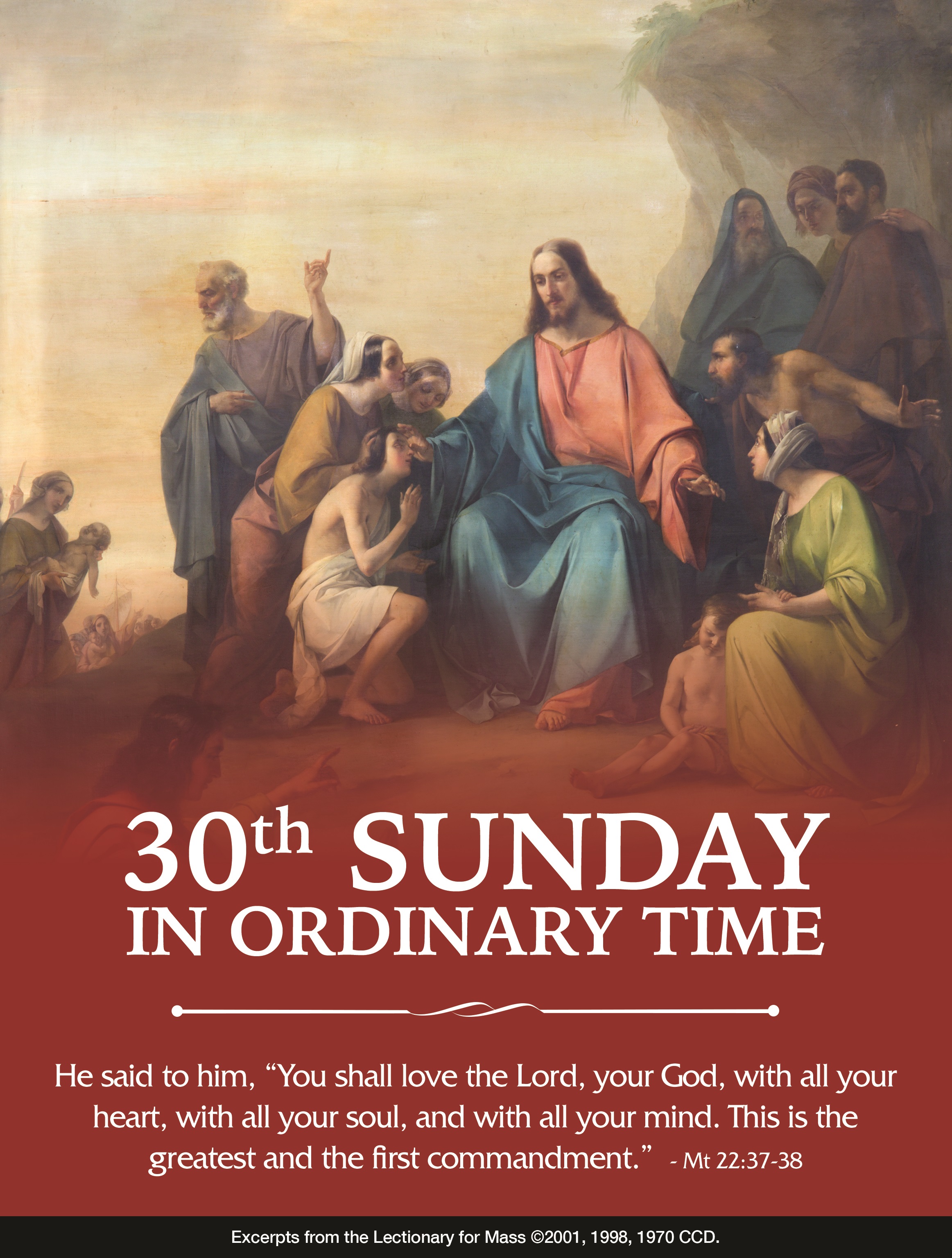
Now, knowing which is the greatest commandment becomes all the more important.  So, what does Jesus say the greatest commandment is?  “You shall love the Lord, your God, with all your heart, with all your soul, and with all your mind.

Hum…won’t you think the greatest commandment would be found in the Ten?  Jesus goes on to provide the second greatest commandment, “You shall love your neighbor as yourself.”  Likewise, we don’t see this listed as one of the Ten Commandments.

While neither is listed in the Ten, both are found in the Bible.  The first, love God, is found in Deuteronomy 6:5 (not far after the listing of the Ten in the previous chapter).  The second, love your neighbor is found in Leviticus 19:18.

I want to note that I said neither of the two greatest commandments are listed in the Ten.  I said listed because these two really sum up the Ten.  Love your God encapsulates the first three commandments while love your neighbor gets to the heart of commandments four through ten.  If we want to follow God, we need to love God.  If we want to love God, we must love our neighbor (That’s why Jesus provided a second commandment even though he was only asked for one.  You can’t have one without the other.).

What does it mean to love?

We don’t see a lot of love between politicians.  We don’t see love from terrorists or violent offenders.  Where do we find love?

We love in different ways.  There is the love between family members.  There is the love that happens between a man and a woman coming together as husband and wife.  This is a different sort of love than between family members or close friends.  It’s not just that we love a spouse more.  It’s different.  It’s hard to understand.  Perhaps that is why we struggle in relationships like marriage or even general friendships.  We are even called to love strangers.  How can we love someone we don’t know?

If we love someone, then we should want them to be happy but it isn’t just about making them happy.  Even with strangers we should have high regard for them, treating them as God’s children.

At times, love can mean forgiving.  Forgiving isn’t always easy.  In the first reading we hear the Lord say, “I will kill you” if we break the commandments.  That certainly doesn’t sound loving or forgiving.

Does God really kill us for our sins?  First, we need to think about what sin is.  It is turning away from God to do what we want.  That means WE ARE separating ourselves from God.  Separation from God is death.

God does not want to kill us.  We do it to ourselves.  God wants to give us true life, not death.  That’s why God sent Jesus to die for us, to take away our sins so that we might live.

If we love God, we will not take his name in vain.  If we love our neighbor, we will not steal from them or covet their property.  We will not bear false witness against them.

Moving from a list of don’ts for those we love, let us turn to some positive do’s.  Do keep the sabbath holy.  Do show your love for God by coming to Mass and hearing his word.

Do show your love for the gift of faith by sharing that faith.  For parents and grandparents, it means sharing your faith with your children and grandchildren.  For others, we can share our faith by helping in our children’s and youth faith formation program.  Or you might help teach our RCIA to adults who wish to join our faith.

Maybe teaching is not your thing?  How about helping in our Martha Ministry that hosts our funeral luncheons to offer support to the families of the deceased.  You can help cook or serve.

How about contributing to our Poor Fund that we use to provide gift cards for food and gas to those in need?

How about beyond our parish?  I know we have several parishioners involved in Catholic Charities as well as Habitat for Humanity and Laurel House.  There’s CareNet.  Participating in any of these parish or community groups can help demonstrate your love for your neighbor.

Lastly, but always important, we need to pray for everyone to receive what they need.

Going back to the topic of motivation, don’t do any of these to get into Heaven.  Do them because your love God and your neighbor.

The Feast of Saints Simon and Jude

Today (October 28th) we celebrate the Feast of Saints Simon and Jude.  In the gospel reading for this morning’s Mass, we hear both Saint Simon and Saint Jude named among the twelve that Jesus had chosen to be Apostles.

Simon is identified as a zealot.  In those days, there was a particular group of Jews known as zealots who opposed the Roman occupation but if we look at the meaning of the word “zealot,” it refers to one with a great enthusiasm for their faith and they desire others to share their enthusiasm.  Isn’t this a great quality in an Apostle?  (Actually, it’s a good quality in all of us.)  We don’t want them to be fanatics but we want them to have a strong desire to go out and share the gospel.  Simon himself is thought to have preached in Egypt and Persia after Jesus’ death, Resurrection, and Ascension.  St. Jude is thought to have preached in Palestine and Persia.

St. Jude is listed as the first Judas in today’s gospel.  He is known as the patron saint of hopeless causes.  Spreading the gospel today might seem like a hopeless cause.  St. Jude and the other Apostles might have felt like they faced a hopeless cause when they gathered in the locked room (John 20:19-29) after Jesus’ death.  Their messiah had been killed through the actions of the chief priests and the Romans.  They might have felt hopeless.  In their grief, Jesus appeared to them risen giving them new hope.

In the locked room they might have felt the situation seemed impossible but nothing is impossible for God (Luke 1:37, cf. Matthew 19:26, Mark 10:27, Luke 18:27).

Peace,

Fr. Jeff

29th Sunday in Ordinary Time, Year A – Homily

29th Sunday in Ordinary Time, Year A
Isaiah 45:1, 4-6
Psalm 96:1, 3, 4-5, 7-8, 9-10
1 Thessalonians 1:1-5
Matthew 22:15-21

Last week we heard Jesus tell a parable about a wedding banquet for the king’s son.  There were many who were invited that, for one reason or another, chose not to come or even attacked the servants who invited them to come.

The Pharisees that we hear about in today’s gospel would be among those who rejected Jesus as the Messiah.  They “plotted how they might entrap Jesus in speech.”  They did not accept Jesus as God’s son.  Instead they look for ways to denounce him by getting him to say something that would lead others to reject and attack him.

This is not good.  The Pharisees were among those who had extensive education in the Jewish faith and customs.  The Jews were a chosen people and the Pharisees were supposed to be the “best” among them.  Yet, they reject Jesus.

Jesus is not deterred.  Last week we heard how, after those who had been invited to the banquet refused, the servants were sent out to invite whomever they found.  This is the gospel offered to the Gentiles.

While the Jews were a chosen people, this is not the first time that God has reached out to the Gentiles.  Our first reading refers to Cyrus as “his anointed.”  Here, “anointed” means that Cyrus has been specifically chosen by God for a particular mission.

For Cyrus, God has chosen him to bring the Israelites out of exile in Babylon and to return them to their own land in Israel.  God will also give Cyrus the task of seeing to the rebuilding of the temple.

In the scope of the stories we read in the Bible, this might seem normal.  We can read about numerous people in the Bible were chosen by God for a specific mission.  Moses was called to lead the people from slavery in Egypt towards the promised land.  David was chosen to become king.  Peter was chosen as the leader of the Apostles.  Paul was chosen to go on missionary journeys to bring the gospel to new people.

However, there is one big difference between Cyrus and the others I just mentioned.  They were all Jews.  Cyrus was not a Jew yet he is the one who would answer God’s call at that point in history.

Cyrus will do great things because God makes it possible even though Cyrus “did not know the Lord.”

Today we celebrate World Mission Sunday.  We will take up a second collection that will go to support young mission dioceses in Africa, Asia, the Pacific Islands, Latin America, and Europe.  Your generosity to the missions as well as your prayers are greatly appreciated.

We might tend to think of “missions” as something done in places where the gospel message has not been heard.  So, we think of remote parts of the world.  400 years ago, the United States was officially considered as “mission territory.”

If we think of missions as something done in remote lands, it’s pretty easy to think of missions as something done by a few people with a particular calling.  Among these are priests and religious but the laity also play an important part in such missions.  It begins not with teaching doctrine.  It begins with caring for the local people in their need.  It begins with showing them God’s love and our love.  Doctrine comes after love.

Now, I want to back up for a minute.  At the end of the list of lands I gave before was Europe.  We would hardly think of Europe as remote and the gospel message was taken there in the first centuries after Christ died for our sins.  How can it be “mission territory”?

I also mentioned that 400 years ago, the United States was officially considered mission territory.  We can thank people like the North American Martyrs who bought the gospel to the Native Americans in what we now call New York.  Since then, the gospel has spread across our nation to a point where the United States (along with Europe) was not considered mission territory.

However, while the church grew for years, today we are aware of the shrinking numbers in our churches.  It’s even worse in Europe.  Even fewer people practice their faith there and some are trying to remove Christianity from Europe’s history.  I suspect there are some Americans who would like to do the same.

So once again, our country needs to hear the gospel message.  I might sound like a broken record repeating myself because I have spoken about this before.  We need to learn more about our faith so we can live it and bring it to others but first we must show them God’s love.  This is our Mission, to share what God has given us with our neighbors and the whole world.


The Eucharist as the Source of Summit of Our Faith – Homily for October 2017 Holy Hour

Homily for October 2017 – Year of the Eucharist
1 Kings 19:9-13a
Psalm 116:12-13, 15-16bc, 17-18
Romans 12:1-8
John 15:1-17

One of the phrases that Bishop Matano used in his pastoral letter proclaiming our Year of the Eucharist was to describe the Eucharist as “the source and summit of the Christian life.”

The quote as Bishop Matano wrote it comes from the Catechism of the Catholic Church paragraph 1324.  You can find the entire quote on the inside front page of tonight’s program.

We have seven sacraments, all of which are very important ways of receiving God’s grace.  Baptism is the first sacrament we receive.  In baptism, we become children of God and receive the Holy Spirit.

Baptism is received just once in a lifetime.  The Eucharist is to be received over and over to repeatedly give us strength.  It is through what we receive in the Eucharist that we receive over and over the grace we need to live as Christian disciples.  Thus, the Eucharist is the source of what we do from the strength it gives us.  It is the summit as they most important thing we do.

We consume physical food in many different forms but it the Eucharist as the Body and Blood of Jesus that “satisfies the hungers of the human family” (quote from opening prayer, Order for the Solemn Exposition of the Holy Eucharist, paragraph 109).

When we talk about “receiving” the Eucharist, we are generally referring to “eating” the Body of Christ and “drinking” the Blood of Christ as we do at Mass.  This is the same way we receive nourishment for our bodies.  Eating and drinking is a normal part of human life.

Tonight, we will not receive the Eucharist in the form of eating and drinking but tonight is still about receiving Jesus.  Tonight, we receive by what is called “ocular Communion.”

Ocular refers to what is perceived by the eye.  We see Jesus in the form of the Blessed Sacrament in the monstrance.  In placing ourselves before the Blessed Sacrament we allow ourselves, as Paul writes to the Romans, to “be transformed by the renewal of your mind.

We do this so that we “may discern what is the will of God, what is good and pleasing and perfect.”  To aid in this, our holy hour includes readings from the Bible as the Word of God to provide us guidance but this hour also will include quiet time as a way of letting God provide direction in our lives.

Our lives can be filled with many different activities.  It can be work or attending events that your children are involved it.  Even in retirement people often find themselves busier than they expected in activities ranging from their grandchildren’s lives to church or simply being with friends.  When we get busy, sometimes we forget Jesus.

When we forget Jesus, we forget that the gifts that we have been given, our talents, are not giving to us for selfish gain but to be used as a living sacrifice for the building up of God’s kingdom.

Sometimes we feel like the little that we can do doesn’t really make a difference.  That’s because we aren’t meant to do it all ourselves.  As Paul wrote, we are many parts meant to come together as one body in Christ.  It is only in working together that we accomplish what God asks of us.

To do this we need to remain in Jesus because without Jesus we can do nothing.  God is the vine grower.  Jesus is the vine.  We are the branches.  We need to be pruned.  Sometimes pruning means going to the Sacrament of Reconciliation to have our sins removed.  Pruning can also be removing unnecessary parts of our lives that keep us from knowing Jesus.  Here you might think of what you gave up to be here tonight.  In choosing to be here tonight you gave that up because you knew you needed Jesus.

Our first reading tonight picks up at a point where Elijah is fleeing for his life.  By God’s grace he had just defeated the 450 prophets of the false god Baal and people are trying to kill him.  He goes to a cave to find shelter.

Hopefully, no one is trying to literally kill us but we do come tonight with our struggles and our fears.  We come to find shelter in the Lord.

God chose to come to Elijah in that moment.  At Pentecost, God, as the Holy Spirit comes down as a “strong driving wind” (Acts 2:2) but for Elijah was not in the “strong and violent wind.

At the time of Jesus’ death and resurrection there were earthquakes but at the time for Elijah, God was not in the earthquake.

God appeared to Moses as a burning bush (Exodus 3) but to Elijah God was not in the fire.

For Elijah, God came as a “light silent sound,” a tiny whisper.  Now let us spend a few minutes listening to the silence.

28th Sunday in Ordinary Time, Year A – Homily on the Eucharist

28th Sunday in Ordinary Time, Year A
Isaiah 25:6-10a
Psalm 23;1-3a, 3b-4, 5, 6
Philippians 4:12-14, 19-20
Matthew 22:1-14

Throughout our readings today we hear of feasts “of rich food and choice wines,” how the Lord will spread the table before us, and supply whatever we need.

Isaiah speaks of “God to whom we looked to save us!  This is the Lord for whom we looked.”

Jesus speaks in the context of a wedding feast.  The context of the wedding goes with the image of Christ as the bridegroom who marries his bride, the church.

Going back to what Isaiah said about the “Lord to whom we looked,” the Israelites were waiting for a messiah.  Jesus is the Messiah and the bridegroom.  Now is the time for the wedding feastbut not all accept Jesus.  Some of the Israelites simply seem to “ignore” Jesus while others attack him.

So, in turn, God invites “whomever” his servants can find to the feast (but we still need to be ready).

The Book of Revelation provides imagery of a great banquet in Heaven.  One day we will share in that banquet but we do not have to wait for Heaven to receive “rich food and choice wines.”  The Lord provides a feast for us right now, a feast that strengthens us with the Bread of Life.

This feast is, of course, the Eucharist!  It is the gift we celebrate in our Year of the Eucharist.  It is the bread and wine that become for us the Body and Blood of Jesus.  As a little piece of bread, it offers little earthly nourishment.  As a sip of wine, it does little to quench our earthly thirst.  Yet, as the Body and Blood of Jesus it gives us grace in abundance.

We can’t see the bread and wine change but we know it to be so because of the words of Jesus at the Last Supper that we hear every time we celebrate the Eucharist, “THIS IS MY BODY, THIS IS THE CHALICE OF MY BLOOD.”

What we celebrate in the Eucharist is not just a play that remembers a historical event nor is it a new event.  It is God making present today in a way only he can, what Jesus did for us 2,000 years ago as he celebrated the Passover together with the sacrifice of his life on the Cross for us.

Recognizing the sacredness of what is going on, we celebrate the Eucharist with a reverence that shows our recognition of the sacredness of what we celebrate in the Eucharist.

We kneel throughout the Eucharistic Prayer to show our recognition of the sacredness of the sacrifice we celebrate as the bread and wine are transubstantiated into the Body and Blood of Jesus.

We stand during the Lamb of God as a sign of how we are raised up by the sacrifice that Jesus makes on the Cross for us.

Then we again kneel to show our humility and surrender before God as we say “Lord, I am not worthy that you should enter under my roof, but only say the word and my soul shall be healed.”

Then we stand to come forward for Communion.  Our physical action of coming forward indicates our desire to come to Jesus.

Then, we bow just before we receive Jesus as one final sign that we recognize it is Jesus our King that we receive.

The minister holds up the consecrated host and says, “The Body of Christ.”  We reply “amen.”  The word “amen” means “I believe” so we are professing that we believe it is the Body of Christ.

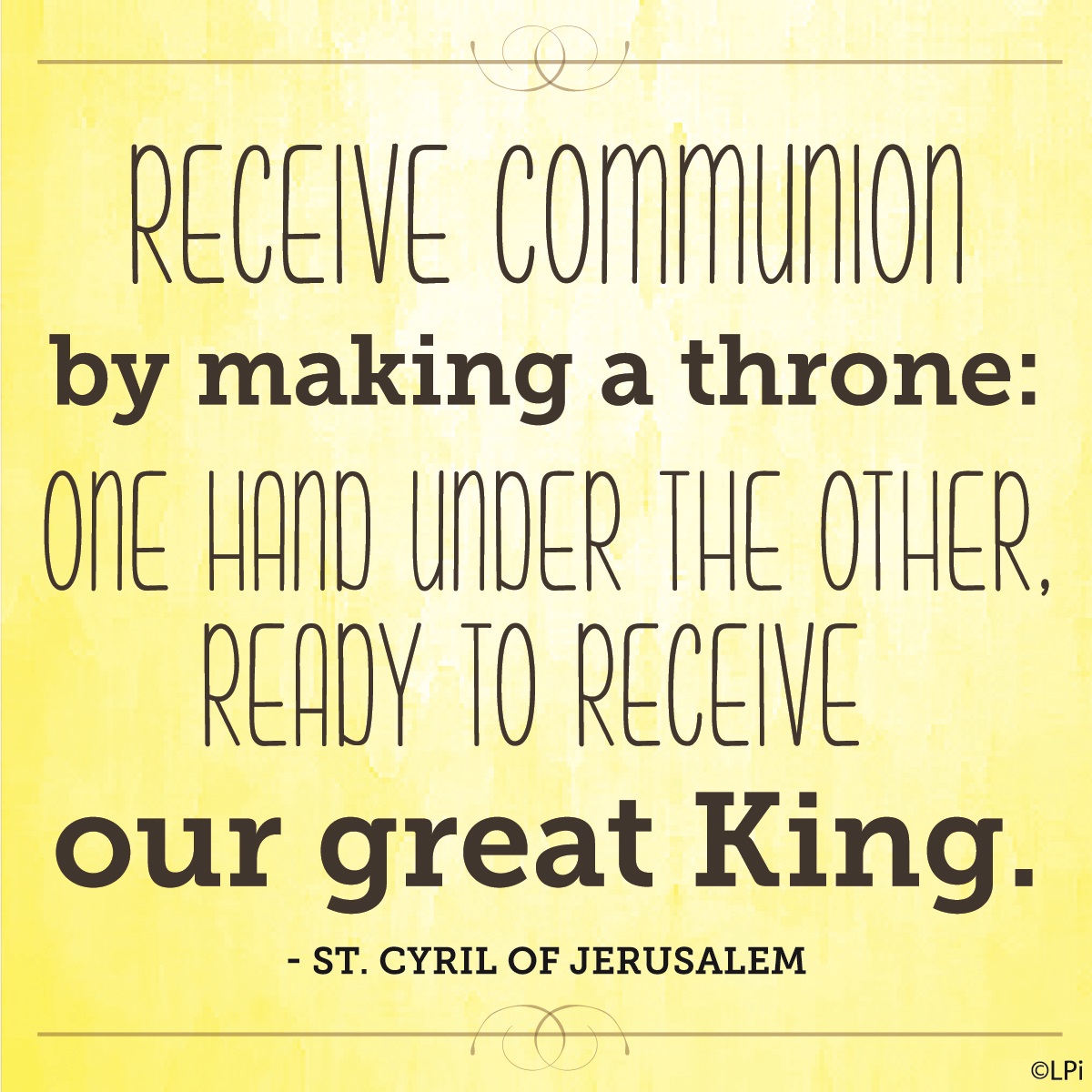
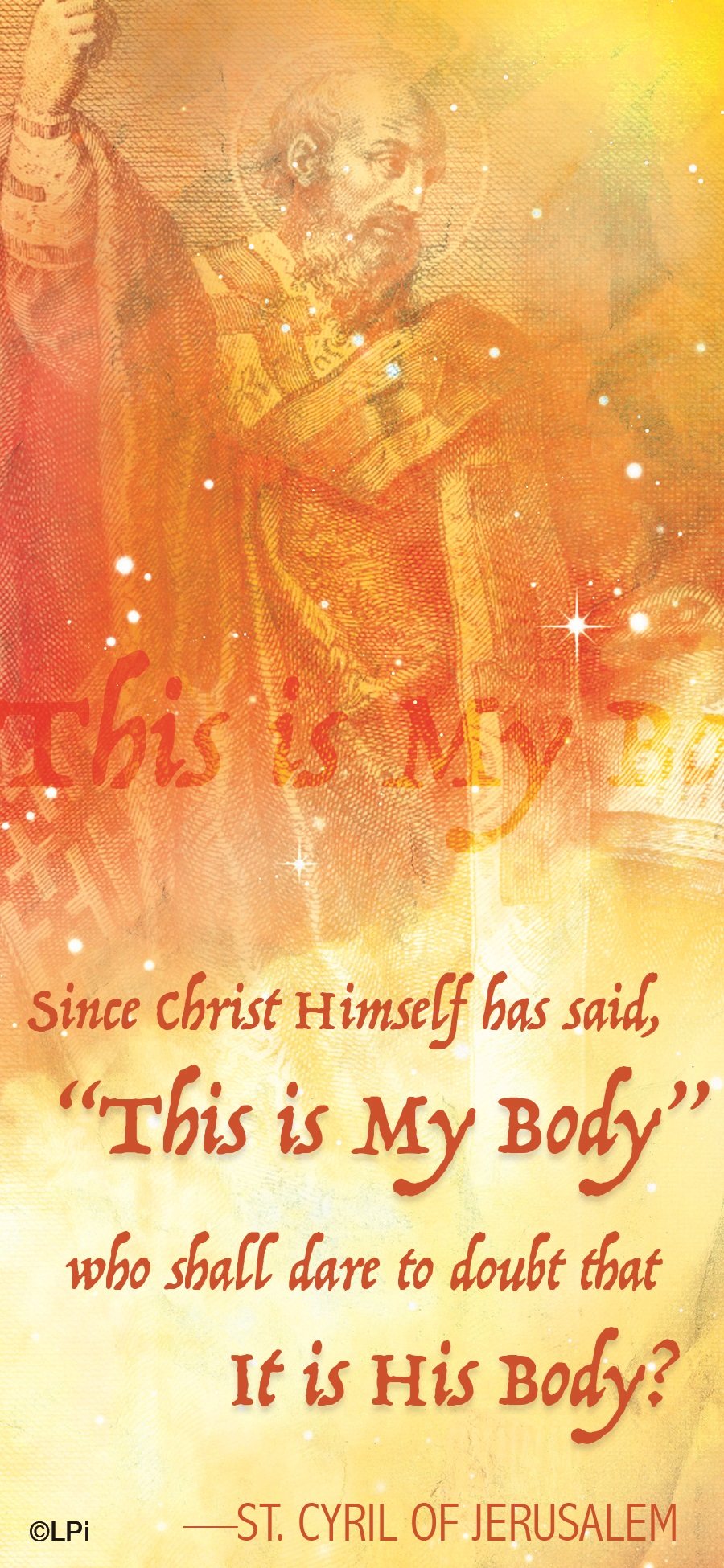
To receive we hold our hands one over the other to make a throne to receive Jesus.  Receiving on the hand was not new with the changes of the Second Vatican Council.  It is the way the early church offered Communion.  The symbolism of making a throne with our hands to receive Jesus is found in the writings of St. Cyril of Jerusalem in the fourth century.

If one chooses to receive on the tongue, one shouldn’t just open their mouth a little like one might to receive medicine that we can’t stand the taste of.  One is to open their mouth wide to welcome Jesus in.

Whether we receive on the hand or the tongue, we consume the consecrated host immediately without taking any steps to help ensure we don’t drop the host or any crumbs.

Then, the Blood of Christ is offered in the chalice.  The minister says, “The Blood of Christ” to which one receiving says “Amen” again signifying belief that it truly is the Blood of Christ.  We do so carefully so as not to spill any of the Precious Blood.  The cup minister wipes the cup after each person with a purificator, a cloth that is used for this alone and no other purpose (again recognizing the sacredness).

Recognizing our desire to avoid dropping any of the Precious Blood is why we do NOT intinct.  Intinction is to lower the consecrated host into the consecrated wine.  This can result in spillage of the wine.  There are Eastern Rite churches that receive by intinction but it is the priest who does the intinction and then gives Communion on a spoon in the mouth.  (Incidentally, it would also mean anyone who can’t receive the gluten in the host would not be able to receive the wine for fear of a small piece of the host remaining.)

Then, we return to our pews and kneel, humbly offering a prayer of thanksgiving.  It is important for us to take this time (avoiding the temptation to leave immediately to rush off somewhere else) to offer our gratitude for what God gives us in the Eucharist.

Then, we sit after the distribution of Communion before standing (rising) for the final prayer, recognizing how God lifts us up in what we receive in the Eucharist.  Then, we have the final blessing as we are sent out into the world to glorify the Lord by our lives.

27th Sunday in Ordinary Time, Year A – Homily

27th Sunday in Ordinary Time, Year A
Isaiah 5:1-7
Psalm 80:9, 12, 13-14, 15-16, 19-20
Philippians 4:6-9
Matthew 21:33-43

For the Israelites, the use of the image of the vineyard in relation to God was a familiar one.  Isaiah speaks of the vineyard owner who planted his vines “on a fertile hillside; he spaded it, cleared it of stones, and planted his choicest vines; within it he built a watchtower, and hewed out a wine press.”  The vineyard owner did everything expected of an owner and he did it well.  What did it get him?  Wild grapes.

Of course, the point is to see God as the vineyard owner.  God is the creator of the world.  He set the universe as we know it in motion.  He brought order to chaos.  He has provided his people with everything needed.

At the time Isaiah wrote the first reading, (c. 8th Century B.C.) the Israelites would have seen the vineyard as the kingdom of Israel.  The problem was that many of the people had fallen away from the one true God and were worshipping either no god at all or false gods.  They had in effect become wild grapes that bore no fruit.

This is where things are at when Isaiah writes as a prophet of the Lord, “What more was there to do for my vineyard that I had not done?”  God had done everything needed but the people had not done their part.

So, the Lord says he will let the vineyard become a ruin.  Why should God do all the work that goes into a vineyard, if the people are not going to do their part?

So, God withdraw his divine protection and allowed the Israelites to be defeated by their enemies.  God didn’t switch sides.  He just let the Israelites make their own choice and suffer the consequences.

Those who had fallen away failed to realize that they continually needed God’s care.  They wanted complete freedom.  God gave it to them but if they wanted to live a life that ignored God’s ways, they were on their own.

Yet, God never really completely abandoned them.  He kept sending prophets and religious leaders.  How did many of the people respond?  We see it in today’s gospel.  They “seized the servants and one they beat, another they killed, and a third they stoned.

The people in the parable became greedy.  The vineyard owner had down everything expected of him to establish a vineyard before leasing it to tenants.  As was standard business of the day, in payment for their use of the vineyard, he was to receive a fair portion of the produce.  There is no mention that he wanted more than his due but the tenants got greedy and wanted it all for themselves.

God has given us this awesome world with the light and the dark, the plants, the trees, and the animals.  He made it all ordered and beautiful.  He has given us, as humans, dominion over it all.

Have we made good with what we have been given or are we wild grapes?

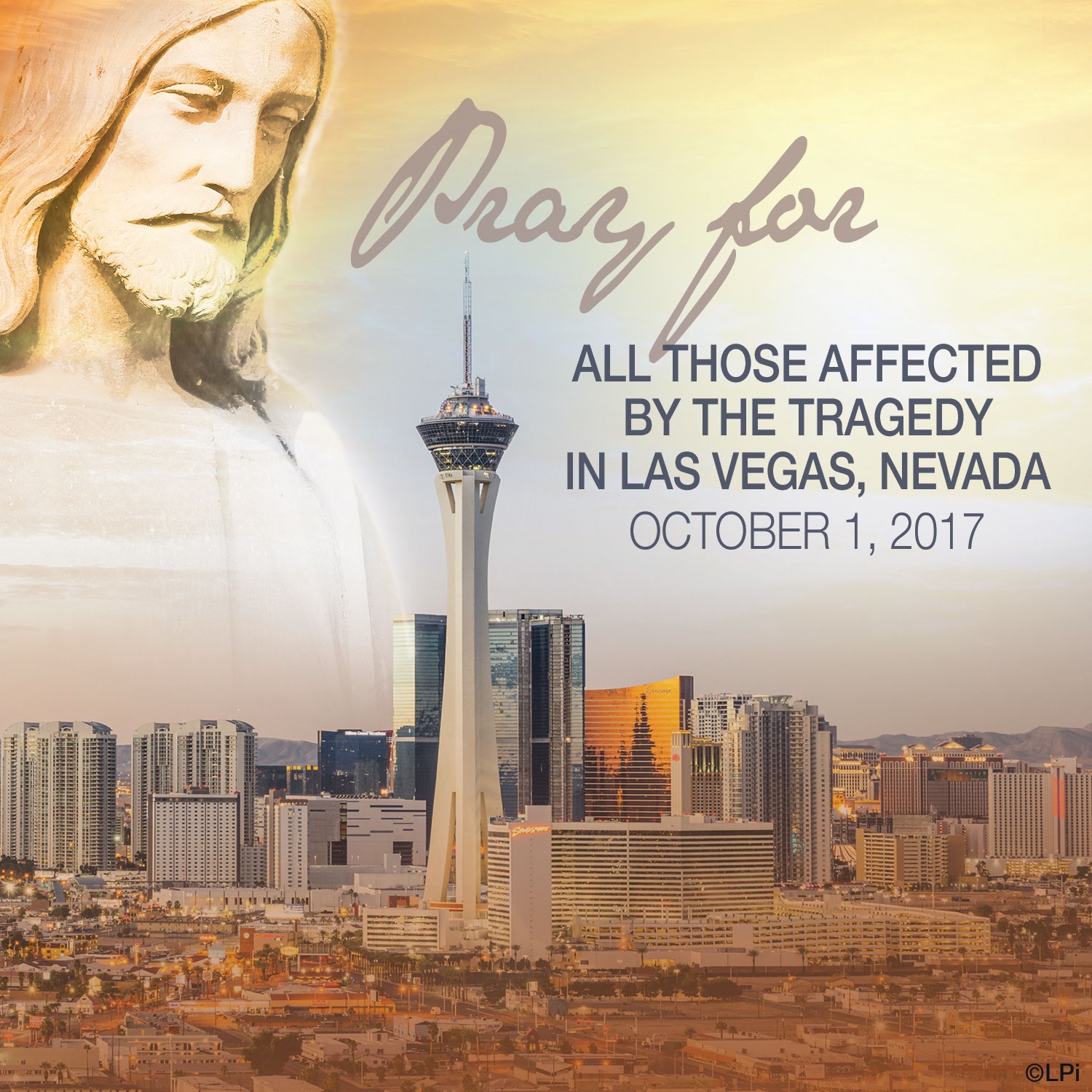
There definitely are wild grapes today.  There are people who do not do as God asks of us.  In a violent way, we see a wild grape in the shooting in Las Vegas this week.  58 people killed and over 400 injured.  What happened is not what God wanted but the assailant was a child of God, one who had gone astray, but still a child of God.  His behavior made him a wild grape.

We don’t know why he shot all those people.  We may never know.  Maybe he was mentally ill.  Maybe he was misguided.  Maybe he was harboring a grudge that filled his heart with anger that kept him feeling God in his heart.

The same can be true in any other mass shooting, stabbing, bombing, or vehicular attacks.  Nothing justifies what these assailants do.  What we need to work on is to do what God asks of us.  What is God’s will for us?

What is it that God asks of us?  God has given us the scriptures and the prophets to help us know what he asks of us.  Are we listening or are we like our ancestors who beat and killed the prophets?

Ultimately, the vineyard owner sent his son thinking “they will respect my son” but they did not.  They killed him too.  They crucified him.  His name was Jesus.

I really wish I had some answers as to why these attacks happen but I don’t.  The shooting in Las Vegas was the worst shooting ever in the United States and we have no idea why it happened.

So, what are we supposed to do now?

The same thing we should have always been doing.  Live as Jesus teaches us.

This means following the two greatest commandments, to love God and to love our neighbor.

In the midst of what happened in Las Vegas (and any other violent attack), we can experience a range of emotions.  For the people in the crowd that night, fear was probably the most powerful emotion at the time and rightly so.  They feared for their lives.

Now there is sadness at the loss of life and for the wounded.  And it is not just those struck by bullets.  Those present in the crowd but not shot may live with post-traumatic stress.  They might even feel guilt, asking themselves why they were not injured when so many others were.

There are also the families of the victims, forever effected by this.  What about the people working security at the concert or the hotel staff wondering if they missed something.

Even people who were nowhere near the concert may experience fear when they go to similar events in the future.

What can we do to try and make sure violent attacks like this happen?  We need to live like Jesus and we need show Jesus to others.  Hate won’t help here.  We need to love like Jesus.  We need to forgive like Jesus.  When there is hurt in our hearts, rather than to respond to the anger, we need to bring Jesus to the world.

The Bible is the Word of God

In today’s (Thursday, 26th Week in Ordinary Time, Year 1 – Oct. 5, 2017) first reading from the Book of Nehemiah we hear how Ezra read to the people from the book of the law of Moses from daybreak to midday.  A great crowd had gathered there.

What it refers to as the “book of the law of Moses” may be the Book of Deuteronomy but it could be more from the beginning of the Hebrew Scriptures that, as Christians today, we call the Old Testament.  We see them hold it in high regard.  They both rose in praise to the word and prostrated themselves in response to what it told them.  Even the fact that they listened from daybreak to midday shows a great reverence for the Word of God.

Where is reverence for the scriptures today?

Many people today do not read the Word of God.  As Catholics, we don’t have a good reputation for knowing the Bible yet we have multiple readings from it at every Mass and several of our prayers at Mass are composed of quotes from the Bible.

Some people today see the Bible as a “guide” book on good behavior at best.  It is not simply a guide book.  It is God’s Word.  They will reject what they don’t agree with as outdated.  Sometimes, they use modern psychology as their justification.  Psychology can help explain human behavior but it does not make it right or wrong.  God determines what is right and good.

Do we still do everything in the Bible as Christians today?  No, for instance there are the animal sacrifices prescribed in the Book of Leviticus.  However, we don’t omit these sacrifices today by human decision.  No, those sacrifices have been replaced by the sacrifice of Jesus on the Cross (see chapter 10 of the Letter to the Hebrews).  Likewise, the Old Testament forbid certain foods like pork which we eat today because Jesus declared all foods clean (Mark 7:19).

We may not understand every word of the Bible but we can revere it as the Word of God.

Peace,

Fr. Jeff

26th Sunday in Ordinary Time, Year A – Homily

26th Sunday in Ordinary Time, Year A
Ezekiel 18:25-28
Psalm 25:4-5, 6-7, 8-9
Philippians 2:1-11
Matthew 21:28-32

The man says to his two sons, “Son, go out and work in the vineyard today.”  The statement is clear and simple.  It probably came as no surprise to them.

The first son says he will not.  No reason is given but his response is as clear and simple as his father’s directive.  However, later this son changes his mind and does what his father directed.

On the other hand, the second son says he will do as directed by the father but he doesn’t.

Do we do as God directs or don’t we?

Jesus offers this situation as a teaching lesson to the chief priests and elders.  He equates them to the second son who says he will do his father’s will but doesn’t.  They profess to be God’s disciples but they fall short.

On the other hand, Jesus says the tax collectors and prostitutes, who the priests and elders know to be sinners, have realized the error of their ways and turned to Jesus.

So, who gets into Heaven?

The scene that Jesus described today is offered in the context of a specific day when the father gave his directive.  To think in terms of God’s directive, how do we evaluate a lifetime of decisions in light of our faith?

We would like to be evaluated based on the good we have done and have the bad overlooked.  Or perhaps our judgment could at least be done on the basis that we have done more good than bad.

Through the prophet Ezekiel, the Lord warns us that even if we do good most of our lives but then turn away from virtue, we will die.  On the other hand, if we have been living in wickedness but turn to what is “right and just,” we will live.  To live is to be with God.  To die is eternal separation from God.

The reality is that we probably have all done something that we regret.  We are sinners.  Hopefully, we have all also done something that is good but doing good is not always easy.  The choice between good and evil is just that, a choice.

We would like it to be easy to always choose good but we know that what is evil can be pretty tempting.  It can bring short term pleasure or immediate gratification that we seek.

We might say what’s wrong with having a little fun or pleasure.  We can become selfish in the moment and not see the bigger picture.  If we do this often, we look not just the little things in selfish ways but the big decisions too.

But to be selfish can lead to not loving our neighbor as Jesus teaches.  It can lead to not loving God because we think we know what is best.

“What’s in it for me” is not a Christian question.  It might seem natural.  It can be the question that society tells us to ask but Jesus shows us another way.

Jesus was with God in Heaven.  He “was in the formed of God” but “did not regard equality with God something to be grasped.  Rather, he emptied himself…he humbled himself, becoming obedient to the point of death, even death on a cross.

Jesus could have chosen to be selfish and said, “I have nothing to gain for myself by becoming human.”  He had nothing to gain for himself but he didn’t become human for himself.  He became human for us.  He was obedient to God our Father for our sake, not his.

Are we willing to be obedient (like Jesus) to God?

We don’t like to be obedient.  When we are teenagers and our parents tell us to do something we don’t want to, instead of being obedient, we sometimes say to them that you just don’t want me to have any fun, even when what our parents are saying is what it is best.

We do the same thing with God.  We just want to have a little fun, right?  It can’t be that bad.  Then we journey down the slippery slope away from God to sin.

How often do we involve God in the choices we make?  I’m willing to bet that many make a lot of choices without any consideration to what God would want us to do.  We think that we generally have the answers and we only turn to God when we are stumped.

Then, do we ever ask God what to do?  Or we turn to him only when we are in trouble and can’t fix it ourselves?

Now, we can’t always stop and have a long conversation with God about what we are supposed to do in every situation that comes up.  That’s why we need to be in regular conversation with God.

Here I want to say that by “regular conversation” with God, “regular” begins with being at Mass every week but it doesn’t end there.  We need to need to humble ourselves like Jesus did in becoming human and pray in the context of the first stanza of today’s psalm, “Your ways, O LORD, make know to me; teach me your paths, guide me in your truth and teach me for you are God my savior.

It starts with Mass and the homily but we need to read the Bible, attend opportunities to learn more about our faith, listen to CDs like the ones we have available in back of church, or do some spiritual reading.

I hope most of us could list the Ten Commandments but can you go deeper and talk about how they fit with how Jesus calls us to live today?  Jesus doesn’t just want us to follow rules.  Yes, God desires our “obedience” but not as a legal code but from what is in our hearts.

Homily for the Feast of Sts. Michael, Gabriel, and Raphael at St. Michael’s

Feast of Saints Michael, Gabriel, and Raphael, Archangels
Revelation 12:7-12a
Psalm 138:1-2ab, 2cde-3, 4-5
John 1:47-51
September 29, 2016

Today is officially called the Feast of Michael, Gabriel, and Raphael, Archangels.  They are the three angels found by name in the Bible.

Raphael appears in the Book of Tobit, one of the seven books in our Catholic Bible that are not part of the Protestant Bible.  In the story of Tobit, Raphael appears as a travelling companion to Tobit’s son, Tobiah.  After the journey is over, Raphael is the instrument of the healing of Tobit’s eyesight.  The name “Raphael” means “God heals.”

Gabriel is best known to us as the angel who appeared to Mary at the Annunciation to tell Mary she had been chosen to be the mother of Jesus.  Before that, Gabriel appeared to Zechariah, the father of John the Baptist to tell him that his wife Elizabeth was pregnant.  Both of these stories are found in the Gospel of Luke.  Gabriel is also mentioned in the Book of Daniel.  Gabriel means “man of God.”

Both Gabriel and Raphael serve important roles as servants of God but now I want to focus on Michael, the third archangel, who is the patron saint of our parish.

Michael is named in the Bible in the Book of Daniel, the Letter of Jude, and the Book of Revelation.  The last one is probably the most familiar one to people.  It is the story that we heard in the first reading today.  Michael, by the power of God, is the one who led the other angels in the triumphant victory against Satan.  “Michael” means “who is like unto God.”

With this in mind, Michael is often depicted as a warrior.  If you look at the statue to your right, you see Michael depicted with a sword.  If you look at the statue of St. Michael out in our garden behind the rectory, you see him standing on the serpent, symbolizing the defeat of Satan.  This is also the role focused on in the traditional Prayer of St. Michael.

I think this image of Michael is very important to us today as we struggle against the increasing temptations of our world.  We need St. Michael’s intercession and protection if we are to win the battle against temptation.

In recognition of his role in protecting us, St. Michael is the patron saint of soldiers and police officers.

While this role of St. Michael as warrior against evil is his most well-known role, it is not his only role.  There are stories of St. Michael serving in miraculous healings.  Following these healings, he is also known as a patron saint for doctors and for those facing sickness.

He is also known as one who leads the soul of the deceased to judgment.

There is one more role of St. Michael I would like to include here.  He is also known as the Guardian of the Blessed Sacrament.

The Blessed Sacrament, of course, is one of the names given to the Eucharist, the Body and Blood Jesus.

We know St. Michael as an archangel.  We tend to view angels as beings who always do the work of God and this would be true for Michael but we need to understand it as a choice he made.  Not all angels do the work of God.  Satan is a fallen angel who rebelled against God and had other angels follow him.

The choice between good and evil is always just that, a choice.  While Satan turned against God, Michael always remained loyal to God and serves as his warrior.  St. Michael has seen God in the heavenly kingdom.

We won’t experience God as St. Michael has until we pass from this life to the next.  That doesn’t mean God isn’t present in our world.  Ultimately, we know God is everywhere but there is a special way in which God becomes present to us that we see with our human eyes.

This is, of course, the Eucharist.

So, going back to what I said about St. Michael as the guardian of the Blessed Sacrament, I think is fitting that he serves in this role.  St. Michael is the protector of God’s kingdom and he protects Jesus in the Blessed Sacrament.

We come here on the Feast of St. Michael and the archangels but we do so during our diocesan Year of the Eucharist and the approach of the 150th anniversary of the beginning of our diocese.

On this, our parish feast, we come together as a community hearing God’s Word and strengthened by the Eucharist as the source and summit of our faith and we are as a Church.

Let us know come together to say the St. Michael prayer together, always asking for his aid against evil.

St. Michael the Archangel,
defend us in battle.
Be our defense against the wickedness and snares of the Devil.
May God rebuke him, we humbly pray,
and do thou,
O Prince of the heavenly hosts,
by the power of God,
thrust into hell Satan,
and all the evil spirits,
who prowl about the world
seeking the ruin of souls. Amen.