Homily for January 2018 Holy Hour – Unity in Faith

Homily for January 2018 – Year of the Eucharist
Isaiah 60:1-6
Psalm 25:1, 4-5, 8-10, 14
1 Corinthians 1:10-17
Luke 10:25-37

The Jews were called to be the people of God.  What we call the Old Testament was the Hebrew Scriptures to them.  What they called the Torah, what we know as the Pentateuch (the first five books, attributed to Moses), held the highest status.  There are also the prophetic writings as well as the narrative books that tell the story of God and his people from the time Joshua led them across the Jordan River leading up to the time of Jesus.

The scriptures revealed God’s way to them.  Our psalm tonight is the 25th psalm and it refers to God’s ways (paths/truth) no less than six times in thirteen lines.  If one is to be faithful to God, one must learn God’s ways.

Of course, we know that the truth is the Jews didn’t always follow God.  They strayed numerous times.  God allowed to them to choose their own way but when they strayed, they faced consequences.

One of the times the Jews strayed was in the 7th & 8th century B.C.  So, God allowed them to be defeated by the Babylonians.  Many were taken into Exile.  Our first reading is written at the end of the Exile.

It is the same reading we heard recently on Epiphany.  Isaiah speaks to the Jews of how the light of the Lord again shines on them as God forgives them and sets them free.

They are to live as children of God and be examples to others.  Isaiah writes, “Nations shall walk by your light, kings by the radiance of your dawning.”  They were to show the light they had received to others.

I mention the Epiphany because visit of the magi is the part of the Christmas story that reveals the gospel message will ultimately be for all, not just the Jews.  From the Epiphany story, we recall how it was the Magi who were Gentiles rather than King Herod, a Jew, who recognized the grace of what was going on.

Jesus Christ came first to the Jews but then the gospel was taken to the Gentiles.  Our whole Christian Church is founded upon Jesus as its one foundation.  We are to unite through Jesus as “One Lord, one faith, one birth!” (quote from the hymn “The Church’s One Foundation.)

Beginning with the Apostles, the Church as we know it began to grow and spread the gospel message.  It was centered on Christ but people’s different views caused some division.

We see this in Paul’s first letter to the Corinthians.  He calls them to “agree” and “that there be no divisions among” them.  Yet, there are “rivalries among” them.  Some say they belong to Paul, others Apollos, and still others Cephas.

Now, while there is also going to be differences of human opinion, we need to put the focus on God’s ways.  Are we living as Christ calls us?  Jesus refers to Deuteronomy 6:5 when he says, “You shall love the Lord, your God, with all your heart, with all your being, with all your strength, and with all your mind” and Leviticus 19:18 when he calls us to love our neighbor as ourselves.

Who exactly is our neighbor?

For the Jews, it was narrowly defined and centered on other Jews.  To lead us to understand that everyone is our neighbor, Jesus tells the parable of the Good Samaritan.  Samaritans were despised by the Jews.  Yet, it was not the priest or the Levite who stopped to help the man who had falling victim to the robbers.  It was the Samaritan who showed love for his neighbor.

2,000 thousand years later are we doing any better about divisions?  First, while gone are the Roman and Greek “false” gods, there are still numerous religions besides Christianity.  There are the Jews and the Muslims who share the God of Abraham with us.  There are also Buddhists, Hindus, and various tribal religions to name a few.

Even within Christianity we have Catholics, Episcopals, Methodists, Presbyterians, Baptists,….the list goes on.

And let us not forget the agnostics who question the existence of God as well as the atheists who deny the existence of God.  We have moved from Psalm 25 where God’s ways were desired to what we call “relativism” today that says there is no one truth.  Anything goes as long as you don’t hurt someone else.

I can’t possibly address all these differences tonight.  Tonight, I want to focus on Christian unity.  Tomorrow is January 18th when we began a Week of Prayer for Christian Unity that will end on January 25th, the Feast of the Conversion of St. Paul.  We ask God to bring us together in unity.

In a society where relativism is growing and many say religion is solely a private matter, it is hard to have genuine dialogue about our faith, our commonalities as well as our differences, but dialogue is exactly what we need.

We need to ask ourselves what is the goal of Christian dialogue.  Some might seek more understanding of other denominations without expecting any real change.  Others might want to say we should dialogue and then reach a “compromise” on a common belief.

We should not and must not water down our faith.  Genuine dialogue is not about proving who is right.  The purpose of dialogue goes back to Psalm 25 where God’s ways are what we seek.

I firmly believe our Catholic Church flows from the days of the Church that began at Jesus’ Resurrection.  Central in our belief is the Real Presence of Jesus in the Eucharist.  Our belief that the bread and wine are changed into the Body and Blood of Jesus is based on what we read in the Bible of the Last Supper.  Jesus himself says “this is my Body…this is my Blood.”  While we find this is found in the Bible and has been the teaching of the Church from the beginning, it is not a common belief to all Christian denominations.

As Catholics, we believe in transubstantiation where the bread and wine are permanently changed into the Body and Blood of Jesus.  I’ve heard of denominations that speak of “consubstantiation” where Jesus becomes present in the bread and wine during the prayers but does not remain present afterwards.  And, of course, there are Christian denominations who see Communion only as a remembering of the past.

As we come here for this holy hour with Exposition of the Blessed Sacrament, our belief in the Real Presence of Jesus in the Eucharist is at the very center of why we are here tonight.  In fact, the document Lumen Gentium from the Second Vatican Council describes the Eucharist as the source and summit of who we are as Catholics.

So, out of genuine love for God and for our neighbor, let us pray for genuine dialogue between Christians and that all may know the presence of God that we find in the Blessed Sacrament that we see on our altar.
2nd Sunday in Ordinary Time, Year B – Homily

2nd Sunday in Ordinary Time, Year B
1 Samuel 3:3b-10, 19
Psalm 40:2, 4, 7-8, 8-9, 10
1 Corinthians 6:13c-15a, 17-20
John 1:35-42
January 14, 2018

What are you looking for?

What are you looking for?”  These are the very first recorded words of Jesus in John’s gospel.  Jesus directs these words to the two disciples that come to him from John the Baptist.

If the question was “who are looking for?,” the answer would be obvious, Jesus.  Jesus knows they come to him because John the Baptist has pointed to him as the one he had been preparing them for.  John does so as he points to Jesus with a short but profound proclamation, “Behold, the Lamb of God.

Jesus knows what John has said to them.  Jesus knows they have been waiting for a messiah.  His question, “What are you looking for,?” is a much deeper question.  Yes, Jesus is the Messiah.  Yes, he is the Lamb of God but what do they expect from him.  Jesus will bring them freedom but not freedom from the Romans.  Jesus will bring them, as he brings us, freedom from our sins.

Jesus offers us freedom.  He offers us eternity in Heaven but I ask you as you come here today, “What are you looking for?

Are you looking for something that makes you feel good for one hour (perhaps less)?  For example, do you want music that makes you want to dance but as soon as it is over, you go right back to feeling the way you did when you came in or do you want music that draws you into a deeper relationship with Jesus?  What makes us feel good for a few minutes is often not what we need to hear in the long haul?

How about the readings and the homily?  What are you looking for here?  Is the most important thing to you that the readings and homily are short?  Do you want readings and a homily that tell you the way you are living your life is okay?  Or do you want readings and a homily that helps you become a better Catholic?

The Lord called Samuel but Samuel assumed it must be Eli calling because he was the only one around.  Samuel was not familiar with the Lord to recognize his voice.

This should seem odd because Samuel was sleeping in the temple.  How could he be sleeping in the temple, and not just for one night but regularly, and not be familiar with the Lord?

What does it mean to be “familiar with the Lord”?

Now, I assume everyone here wants to end up in Heaven.  Are we willing to do what it takes to enter Heaven?  Do we come here thinking that the fact that we come to church makes us “familiar with the Lord” and that is enough to get into Heaven?

If sleeping in the temple is not enough for Samuel to be “familiar with the Lord,” then we should realize that we need to do more than show up at church once in a while.

The prayer that I will say over the gifts in a few minutes will begin, “Grant us, O Lord, we pray, that we may participate worthily in these mysteries…”

I put emphasis on the words “we” and “participate” because we are not just here as spectators.  You are not here just to listen to the words I say.  I am not here just to say the proper words.  We are here to participate.  We need to actively engage ourselves in what is going on.  In praying for the Lord to help us participate in these mysteries, we need to let the Lord change us.

This begins in opening ourselves to God’s words from scripture.  Think about how once Samuel realizes it is the Lord speaking to him, he says in reply, “Speak, LORD, for your servant is listening.”  For me, this listening is not just with our ears.  When I dismiss the RCIA group at the 8:15 Mass or the children at the 10:30 Mass, I offer a blessing that includes the words to ask the Lord to help them open their lips AND their hearts.

If we want to be real disciples, when we listen to the Lord, we need to do the same thing.  This requires some effort.  For me, it means that my preparation to preach today began last Sunday afternoon when I spent about 30-40 minutes reflecting on the readings. Then, almost every day during the week I spend forty minutes to an hour looking at commentaries on the readings and thinking about what the words mean for us today.  I don’t expect you to spend as much time as I do but to help bring the readings alive in your own life I strongly encourage you to spend at least one time during the week, looking at the readings.  That’s why we give out books like the At Home With the Word books.  You can also go online to the USCCB website (www.usccb.org) where you can click on the calendar on the right to see the readings each day.  You can find video reflections on the readings there or in written reflections in booklets.

Of course, there is more to Mass than sharing God’s Word from scripture.  We also celebrate the Eucharist.  As we celebrate the Eucharist, we are to remember the sacrifice that Jesus made on the Cross giving his life for us.  This should lead us to be willing to make sacrifices in our lives for our relationship with God.

I know that sacrificing for the Lord isn’t easy.  Part of the challenge is that we may not see the benefit of the sacrifice until we die.  Meanwhile, things like the benefits of money are much more apparent.  Likewise, there can be things going on at the same time church is that seem much more enjoyable in the moment but gain us nothing for eternity.

Earthly things can bring immediate happiness but how long does it last?  When we come to know the Lord, it is for eternity.  It is worth the effort.


The Epiphany of the Lord – Homily

The Epiphany of the Lord
Isaiah 60:1-6
Psalm 72:1-2, 7-8, 10-11, 12-13
Ephesians 3:2-3a, 5-6
Matthew 2:1-12
January 7, 2018

As the Babylonian Exile ends, Isaiah told the people, “Rise up in splendor, Jerusalem!  Your light has come, the glory of the Lord shines upon you.”  They have been set free by the Lord.

The Israelites were a chosen people but were supposed to share the light with others, “nations shall walk by your light, and kings by your shining radiance.”  The light is meant for all, Gentile or Jew.

Paul writes to the Ephesians of his mission to the Gentiles who are coheirs to the promise of the gospel.

The Magi are drawn by a star to the newborn king of Jews.  They are not Jews but Gentiles yet they are open to what is going on.  On the other hand, there is King Herod who is a Jew but it seems he is a Jew in name only.  He sees Jesus’ birth not for the grace it brings but as a threat to his power.

Are we open to grace?  Are we open to light of Christ guiding us?

The Magi were guided by a star.  Prior to GPS and modern maps, navigation by the stars was coming, especially at sea, but what wasn’t coming was the star moving to guide them!  Clearly, this was something very special.  The Magi travelled some distance and brought gifts because they were open to what was going on.

King Herod was not.

Are you open to God guiding you?  How much do you go about your life, finding your own way instead of asking God to guide you?

What about our leaders?  How many people in position of leadership do we wish to reject because they want to do their own thing?

Do we pray for them?

The first verse of our psalm says, “O God, with your judgment endow the king.”  We must ask God to guide all leaders.  This includes our government leaders who take the place of kings but it is not just our political leaders that we need to pray for.  We should pray for all leaders, in government, in business, and in our church.

What is it that we are to pray for our leaders?  We might be tempted to pray that they do what we want.  This might seem reasonable but it is not what the verse from our psalm speaks of.  This verse asks God to endow our leaders with God’s judgment.  God is the one who knows what is best.  We need to let God lead.  We need to pray for God to guide all our leaders.

We can all have our own opinions.  Sometimes the different opinions are based on personal preferences.  For instance, when I first got here it was summer and we were “saying” the Lord’s Prayer at Mass.  As we moved into Fall, some people asked when we going to start “singing” the Lord’s Prayer again because they liked to sing it.

Then, shortly after we started singing the Lord’s Prayer, other people came to be asking if we could just say the Lord’s Prayer instead of singing it.

There are always going to be different preferences.

Some things will always be a matter of personal preference but on things of significance, we need to ask for God who knows what is best and has a plan to show us the way.

With this in mind, I encourage you to pray for our church leaders, for our pope, our bishop, as well as myself.  Pray for all in leadership positions in our parish to follow God’s will.

Singing or saying the Lord’s prayer seems pretty simple but there are bigger things we need to work on.  For instance, we struggle to find volunteers and leaders for our parish festival.  One might ask what does the festival have to do with God’s work.  It helps fund the ministry and it can build community.  On Monday, we have a meeting about the future of our festival.  Please pray for this meeting to be led by God’s Spirit.

In terms of funding ministry, there is also our parish deficit that we spoke about in our annual report in August.  We will be offering a six-month update in the coming weeks but collections have not risen much.  If you are able to increase your parish contributions, it would help.  Whether you can contribute more or not, please pray for all to give within their means.

As you pray for our parish, please also pray for more volunteers, not just for the festival but the rummage sales, and for our ministries to help poor and for new ministries if that is what God wants.

Please pray for myself and all our parish leaders as we discern what to do with our school building.  It’s a big building that needs work and costs a lot to heat.  Pray that God leads us.

As we think about declining numbers in the parish, please pray that we follow God’s lead to awake faith in more people.

Many of these issues are not unique to our parish.  Please for all our area parishes, that we might find ways to work together to strengthen our churches to bring the gospel to all.

God led the Magi by the star to Jesus.  May the Lord lead us as individuals, as a parish, as a diocese, and a universal Church to accomplish his will.


From Too Many Priests to Too Few Priests

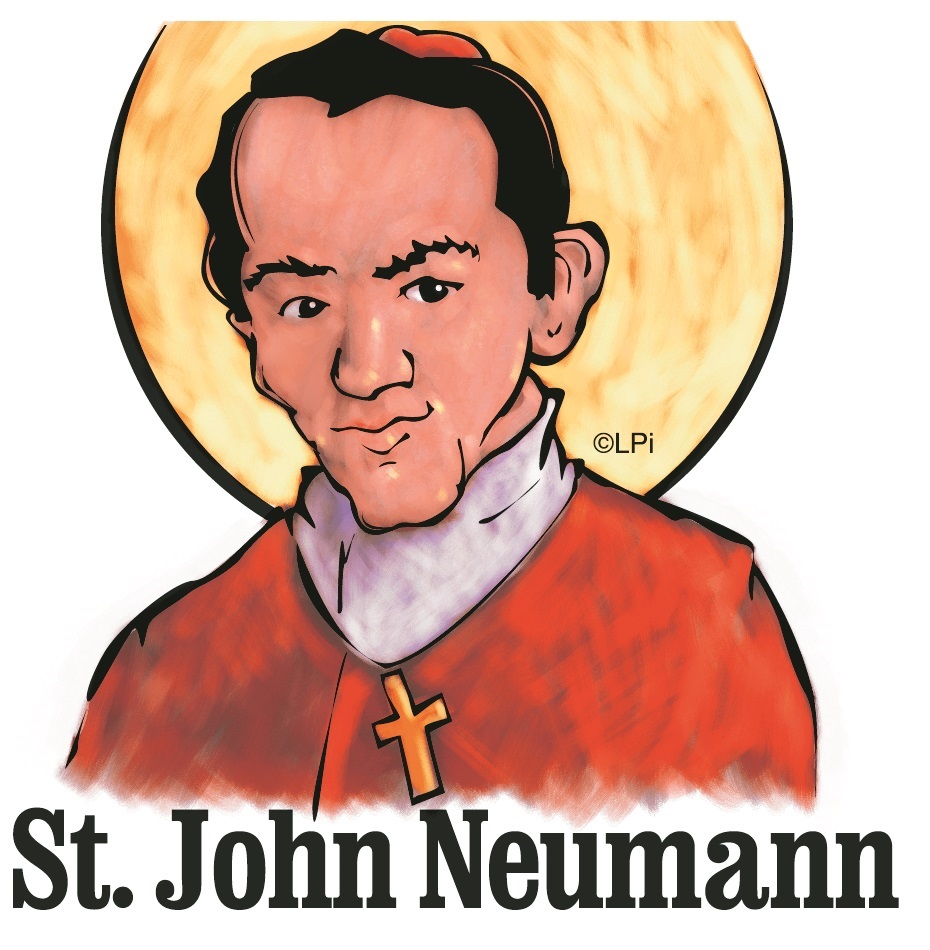
Today we celebrate the Memorial of St. John Neumann, the first American to be canonized.  He was born in 1811 in Bohemia in Europe.  He was studying to become a priest there when the bishop there announced there would be no further ordinations as there were too many priests.  Today, this might seem impossible for us to believe but John Neumann found it to be the case throughout Europe.

He learned English and was interested in mission work.  So, he wrote to bishops in America.  The bishop in New York offered to ordain him to serve here.  He became one of thirty-six priests serving 200,000 Catholics.  He served an area stretching from Lake Ontario to Pennsylvania.  So, I would imagine at least some of that was in what became our Diocese of Rochester in 1868.  He later joined the Redemptorists priests until he was ordained Bishop of Philadelphia.  As bishop, he served in a time when the Catholic Church was not widely accepted in America but the Catholic population was growing.  He was a great promoter of the Catholic school system.

While there were “too many” priests in Europe in St. John Neumann’s day, there were “too few” in America.  He came to America when it was still considering mission territory for the Catholic Church.  In the years following his life, the Catholic Church grew in America to as much as 25% of the population.  Much of the growth came from immigrants who established communities of people speaking the same languages centered in the parish.  The culture in America continued to look down on Catholics for many years.  For example, when Catholics tried to run for president, many thought a Catholic should never be president because of their ties to the pope.  It was not until 1960 when John F. Kennedy was elected President before a Catholic would serve as president.  Our parishes had more than enough priests.

While the Catholic church grew for decades in the United States, we are now facing large declines in church attendance.  For some it is a rejection of the existence of God.  Others think they can be spiritual on their own without needing any church institution.  This is true for all religions in America. From fewer people coming to church, we again have “too few” priests.

God exists!  We can pray on our own but we need the help of our churches to persevere in a world that is turning away from God.  We need help to grow to a deeper relationship with Jesus.  In the decades since the death of St. John Neumann, the way our world functions has changed greatly from modern transportation and communication.  The gospel does not change but we need to find new ways to bring our faith to the world and show what Jesus taught is still relevant today.

We have much ministry to do to restore growth in our church.  Knowing St. John Neumann served in a time when the Catholic Church was small and growing, let us pray for his intercession to help us in our ministry of evangelization.  We also pray for more priests to serve like St. John Neumann did.

Peace,

Fr. Jeff

*Bibliography – The above biographical information is largely based on short biographies of him available online

Mary as Mother of God and New Year’s Resolutions – Homily

Mary, the Holy Mother of God
Numbers 6:22-27
Psalm 67:2-3, 5, 6, 8
Galatians 4:4-7
Luke 2:16-21
January 1, 2018

January 1st is associated with various things.  In our secular society, it is the beginning of the new calendar year.  The beginning of a “new” year is seen as an opportunity to make changes with the hope of improving our lives.  In this context, we call them New Year’s Resolutions.

Whenever we try to improve our lives, we should turn to God for guidance on what improvements we need to make and for God’s blessing upon us as we strive to become what Christ calls us to be.

In this context of seeking God’s blessing, our first reading is an offering of God’s blessing to the Israelites through Moses.  In the psalm today we ask God to “bless us in his mercy.

However, the fact that today is New Year’s Day is not the reason that today is a holy day.

Today marks the eighth day of Christmas.  According to Jewish custom, this was the day that the Jewish males would be circumcised and given their name.  Of course, as good Jewish parents, Mary and Joseph followed this custom with Jesus.

So, today we honor Mary for her role as Jesus’ mother.  We celebrate this day as the Solemnity of Mary, the Holy Mother of God.

Our second reading today tells us, “When the fullness of time had come, God sent his Son, born of a woman, born under the law.”  Jesus become flesh, born of the woman we know as Mary.  Scripture is clear that Mary is the mother of Jesus.

Yet, today’s feast does not refer to Mary as “Mother of Jesus” but “Mother of God.”  How could Mary, a human being herself, give birth to God who is eternal, without a beginning?

We need to understand that calling Mary “Mother of God” rather than “Mother of Jesus” is not about her status.  It’s about Jesus.

In the early church there was much debate about the human and divine natures of Jesus.  Speaking in merely human terms, we cannot understand how Jesus could be both human and divine but that is our faith, given to us through the Holy Spirit.  From this, Mary was given the title of “Mother of God” to remind us that Jesus is both human and divine.

We may not understand the two natures but we accept it in faith.  Mary herself did not understand all that was said of her son Jesus but she believed.  As the shepherds told her what the angel had said to them, she “kept all these things, reflecting on them in her heart.

One of Mary’s other titles is “Queen of Peace.”  Mary was a thoughtful woman, reflecting on all that she heard.  Recognizing Mary in this way, January 1st in our Church is a World Day of Prayer for Peace.

When we think of praying for “peace,” the first thing that comes to mind might be peace in the sense of the absence of war and violence.  Indeed, we must pray for this type of peace but when we proclaim today as a World Day of Prayer for Peace, we need to go deeper.

It is not simply about ending our wars but looking for peace in our hearts that is freedom in our hearts from the things that can lead to war, greed, desire for power, and injustice.

Greed and desire for power can lead us to sins that build up our own earthly wealth and power at the expense of others.  Some wars start when someone or some group chooses to use military power to take what does not belong to them.

Injustice, meaning everyone not receiving their fair share, can also lead to wars and violence, because people who do not have enough come to think they must fight just to have enough.  We might feel far removed causing such injustice but it can begin with us simply consuming more than we need, leaving others without enough.

So, what might you change in your lives to become more peaceful and thoughtful in your lives?

The Feast of the Holy Family, Year B – Homily

Holy Family, Year B
Genesis 15:1-6, 21:1-3
Psalm 105:1-2, 3-4, 5-6, 8-9
Hebrews 11:8, 11-12, 17-19
Luke 2:22-40
December 31, 2017

Abraham had answered God’s call to follow his lead to a land that God had prepared for him.  However, while Abraham was a man of some wealth, he felt lacking in one thing, he had no children to be his heir.

While Abraham expressed his concern in terms of who would receive his inheritance, I think his concern about an heir goes deeper than material inheritance.  Material wealth can be nice but perhaps our real contribution to this world is not material but in how we strive to make God’s kingdom known in this world.

God promised Abraham that his descendants would be as numerous as the stars.  Abraham and Sarah would have a son, Isaac.  From him will come many biological descendants.  Yet, when the Lord speaks of descendants, I think God speaks not just of biological descendants but all who follow in the faith of Abraham.

Descendants come in various ways.  There are biological descendants.  There are also those, some by choice and some because they are not able to have biological children of their own, who choose to adopt children.

Lest anyone think adoption is a lesser form of having descendants all we have to do is look at Joseph and Jesus.  Jesus was not Joseph’s biological child yet it is through adoption into Joseph’s line that Jesus is heir to the throne of David.  So, clearly in God’s eyes, adoption is as valid a form of being a family as biology.

Being a family is more than biology.  Today we talk about blended families with step-children.  Sometimes relationships with step-parents and step-children can be difficult relationships but I have also seen cases where the step-parents or children have as good a relationship as biologically related people.

Family is more than blood.  It involves what we put into the relationship.  Marriage involves sacrifice.  Being a family involves sacrifice.

Relationships can be challenging.  Being a family can be a challenge.  In my own family, there is divorce, including my own parents.

Today we celebrate the Holy Family of Jesus, Mary, and Joseph.  They are an example of trusting in God and working through the challenges that come.

It might seem easy to think that everything was perfect for them but it wasn’t.

Mary gave birth to Jesus in a stable, not what one would desire.

Joseph and Mary were not a rich couple.  We see evidence of their “poverty” as the gospel tells us that when they went to the Temple for purification, they offered a sacrifice of a “pair of turtledoves,” the sacrifice prescribed in the Book of Leviticus for poor families.

Joseph was instructed by an angel to take Mary and Jesus to Egypt for safety because Herod sought to kill Jesus.  So, the Holy Family was driven from what they called “home” to a strange land.

Jesus would suffer greatly in his passion and Mary, as his mother, would be there at the foot of the Cross, not an easy thing for a mother to see, but as his mother, Mary was there for her son.

Mary endured suffering to be there for her son.  We need to ask ourselves are we willing to make sacrifices for those who are dear to us.

Jesus, Mary, and Joseph serve for us as an example of what it means to be a family.  Family is more than biological relationships.  It is more than adoption.

I want to go back to God’s promise to Abraham that his descendants would be as numerous as the stars.  Over three millennia have passed since then.  Many biological generations have come and gone so Abraham would indeed have countless descendants but not just in terms of biology.  All who believe in the God of Abraham and live lives of faith are spiritual descendants of Abraham.

What about spiritual children for us?  I am celibate priest.  I do not have and never will have any biological or adopted children.  What I do have is a whole lot of spiritual children, meaning you, that I try to lead to our true Father in Heaven through our spiritual brother, Jesus.

Here I want to point to one other type of spiritual relationship, godparents and godchildren.  I think many people today see being a godparent as a purely honorary thing today.  That is not what the Church intends.

Godparents are meant to help the parents raise the children in the ways of Jesus.  This means encouraging the family to come to church.  It means encouraging them to receive the sacraments.  It means encouraging them to bring the children for faith formation.

This is why a godparent needs to be someone who comes to church themselves.  Even when a person is baptized as an adult, the godparent is to encourage them to actively live their faith.

All this requires sacrifice.  Sometimes being Catholic means missing a sporting event or practice, a concert, or some school activity.  What are you willing to sacrifice to live as a child of God?


Christmas 2017 Homily

Christmas 2017
Readings from Mass during the Night
Isaiah 9:1-6
Psalm 96:1-2, 2-3, 11-12, 13, (Luke 2:11)
Titus 2:11-14
Luke 2:1-14
December 25, 2017

Today we celebrate something very special.  It is so special that people come in great numbers.  Some of you are here every week.  Some are in town visiting.  Some may be from neighboring parishes.  Some are simply moved by what we celebrate today.  Whatever category you fit in, we are very glad to have you with us.

What does draw us in large numbers today?  After all, it is a busy time of year with so much to do.  Why make Church part of the busyness?

I think some people are so tired of the busyness that they want to know there is “something more.”  Why put up with the busyness?  Is the busyness worth the effort?

The start of the answer to these questions is found in the name of this special time, Christmas.  It begins with “Christ.”  The word “Christ” means “messiah” or “anointed one.”

The Jews had waited a thousand years for the coming of a Messiah.  Through times of darkness and gloom, the promise of a messiah was the source of hope for them, hope that they needed to endure sufferings.

We still need “hope” today.  We live in a world where gloom is seen in acts of hatred and terrorism.  The hatred brings darkness, darkness that blocks out God.

Where do we find “light” in the darkness?

Jesus!

Jesus is the light that brings hope.  Jesus is the fulfillment of the prophecies of a messiah and so much more.

The Jews expected a messiah who would be a political king like David and get rid of their enemies, the Romans.  They expected a messiah who would be an ordinary human but also a great king just like David.  What they got was, what we get is, the Son of God!

Never before had God come in this way.  God had appeared at various times like the burning bush to Moses.  God had done great signs for them in the parting of the Red Sea and, later, the Jordan River.

Isaiah wrote prophesying, “For a child is born to us, a son is given us; upon his shoulder dominion rests.  They name him Wonder Counselor, God-Hero, Father-Forever, Prince of Peace.

This is Jesus.  He brings “abundant joy and great rejoicing.”  So, Jesus’ birth is “good news of great joy…For today in the city of David, a savior has been born for you who is Christ and Lord.

In the Old Testament times God watched over his people yet God could seem distant.  No one had seen God face to face.  God was among the “invisible” but in Jesus God becomes “visible.”

Jesus is fully human just like us yet Jesus is also fully divine, consubstantial with the Father (this alone is a mystery).  As heir to the throne of David, he is king.

As king, one would expect him to be born in a palace, separated from the people.  He was born in a stable and laid in a manger.

One would expect a king to be dressed in fine linens.  At his birth, Jesus was dressed in “swaddling clothes.”

The first to visit a king would be royal figures.  The first to visit Jesus were shepherds.

Why a stable?  Why “swaddling clothes”?  Why shepherds?

Our gospel story says, “the time came for her to have her child.”  Taken at face value, this means it was time for Mary’s pregnancy to end and for Jesus to emerge visibly into the world.

Taken at a much deeper level, the phrase “the time came” signifies that it was now the point in God’s eternal plan for our salvation to come among us.  No longer would God be a distant figure.

If Jesus had been born as a great king in a palace, dressed in fine linens, and visited only by royal figures, God might still seem distant and remote.  God wants each and every one of us to have a personal relationship with him.

To make this possible, God chose to have Jesus born in a stable.  Unlike a palace, the stable was accessible to all.

If Jesus had been dressed in fine linens, this would have said he was better than those who couldn’t afford such things.

The shepherds were considered a low cast.  They were chosen to be the first to hear the “good news of great joy” that a “savior had been born” and to hear that he was born for them, not just the elite to say that Jesus is accessible to all.

What about the manger?

Do you know what a manger is?  For most, if not all of us, the only time we use the word “manger” is describe where the baby Jesus laid.  The word “manger” actually signifies a trough that animals eat out of.  That means the manger had the food for the animals to eat.  Jesus is the food that we need to strengthen us.  Jesus feeds us in God’s Word and in the Eucharist we celebrate.

Jesus wants us to know him, to have a personal relationship with him.  This can seem difficult to us, especially in a world where many people think we should put Jesus in a box and not talk about him.  But it’s Christmas!  His name is in the very word we call this holiday.  Hearing the word “Christmas” leads us to think about him.

It can be hard to understand some of what the Bible says.  It might seem hard to connect to Jesus.  It takes effort.  It takes openness.  You show a desire to know Jesus by coming here today.  Let this desire be alive in your heart.  Read the Bible.  Come to church.  Enroll the young children in our faith formation classes.  For middle schoolers and high schoolers, we have our youth groups.  For adults, I try to do some sessions to help us better understand our faith more so that we can develop a relationship with Jesus.

It doesn’t happen overnight.  It means coming here often.  It takes effort but the effort isn’t all your own.  The most important thing you can do is to open your heart to Jesus and he will lead you to the Father.

Today we celebrate with “abundant joy and great rejoicing” for “today in the city of David a savior has been born for you who is Christ and Lord.”


4th Sunday of Advent, Homily – Year B

4th Sunday in Advent, Year B
2 Samuel 7:1-5, 8b-12, 14a, 16
Psalm 89:2-3, 3-5, 27, 29 (2a)
Romans 16:25-27
Luke 1:26-38
December 24, 2017

King David was a great king.  He is the king who built the kingdom of Israel but he knew he did it by God’s grace.  David had a great palace but the Lord still dwelt in the tent from the Exodus.  David decided it was time to make a great house (temple) for the Lord.  This makes sense.  After all, our God is an awesome God.

At first, the prophet Nathan agrees with David.  Again, it makes sense.  But it was not God’s plan.  God spoke to Nathan to set David straight.  It is not for David to do this.  God has a plan.  David’s son, Solomon, will build a great temple but ultimately it is Jesus who becomes the true temple.

Christmas is Jesus’ birth, his emerging visibly into our world.

It is almost Christmas but not yet.  We can see it in the decorations in church today.  The crèche is up with the animals but not Mary and Joseph.  They haven’t arrived yet.  Our Christmas trees are up but they are not lighted.  It’s not quite time yet.  We shouldn’t rush.  Christmas is worth waiting for.

As we get ready for Christmas, our gospel passage today reminds us of what was “necessary” for Jesus’ birth.  Mary had to say yes.

God had chosen Mary to be the mother of Jesus.  She was confused by Gabriel’s words but she said yes to God.  She asked, “How can this be?”  She trusted in Gabriel’s response, “The Holy Spirit will come upon you, and the power of the Most High will overshadow you.

Of course, God knew Mary would say yes.  So, God had already placed his favor upon her at the time of her own conception so that she would be conceived without sin to be worthy to carry Jesus in her womb.

Mary said yes to God and good things happened.

Do we say “yes” to God?

The reality is we don’t always say yes to God.  Advent is a time for us to think about how often we say yes or no to God.  What do we need to change in our lives?

We can and should always strive to conform our lives to Christ but the reality is we continue to fall short.  We cannot earn our way into Heaven.

That’s why we have Christmas.  It was God’s plan for his Son to come into the world to be our savior.

Part of many family Christmas traditions is the exchanging of gifts.  These are earthly gifts, some wonderful, some not so wonderful but no earthly gift can compare with the present that God gives us for Christmas, the gift of Jesus that makes salvation possible.

God does not give us this gift because of our merit.  He gives us this gift from his love and mercy.

God gives us the gift of Jesus but do we accept the gift?  One might want to say, “Of course I accept the gift” but we know what it means to accept it.

To accept the gift means opening ourselves to God’s way.  It means striving to live as God teaches.  Mary was open to whatever the Lord asked of him.  As we begin Christmas in a few hours, may we set aside earthly things and open ourselves to the gift of Jesus.

Holy Hour Homily – December 2017 – The Word Became Flesh

Homily for December 2017 – Year of the Eucharist
Isaiah 62:1-5
Psalm 98:1, 2-3, 3-4, 5
Titus 3:4-7
John 1:1-18
(all readings taken from readings for Christmas – various Masses)

In four days, we will begin our Christmas celebration but not yet.  Earthly preparations have been busy for Christmas but tonight is not about baking, wrapping presents, or planning parties.  Tonight is for us to reflect on what Christmas means.

I almost want to say that Christmas is not about the earthly but that’s not quite true.  It’s not about the earthly in the sense of presents, holiday treats, and parties.  These things are fine but they are not the purpose of Christmas.  They are tangible ways of expressing what Christmas is really about.

Yet, Christmas does involve the earthly in the sense that it is about Jesus becoming earthly, incarnate in the flesh, just like you and me.  Tonight is about the Word made flesh forever!

All of the readings I selected for tonight come from the readings listed as Christmas readings.  Our first reading from Isaiah comes from the readings suggested for a vigil Mass.  It speaks of the promised one to come and the vindication of Jerusalem to shine forth.  Jesus is the promised one.  He is our light in that he helps us see the world as God sees it.  Jesus helps us to see the truth.

Our responsorial psalm speaks of how God makes his salvation known and that “All the ends of the earth have seen the saving power of God.”  We see the act of our salvation in Jesus’ death on the Cross but it begins in his birth.  Right now, we can look at what will become our nativity scene in church.  We see the stable structure, the straw, and the animals as they would be when Mary and Joseph arrive but they are not here yet.

We know what is coming.  Soon Mary and Joseph will arrive and we will see the baby Jesus in the manger.  In the Old Testament, there are various stories of God appearing.  In Exodus 3, God appears in the burning bush to Moses.  In 1 Kings 19, God comes to Elijah in the tiny whispering sound but it is at Christmas that God becomes incarnate and we see Jesus.

If we look only at the Old Testament, it is easy enough to see that God is involved in the lives of his people but it might often seem distant.  One might think God is watching over us but yet distant.

Jesus’ birth changes that.  Now God has appeared so that we might see him as a brother and not just a distant God.

Jesus has always existed.  Our gospel reading tells us that “In the beginning was the Word, and the Word was with God, and the Word was God…All things came to be through him…the light shines in the darkness.”  Jesus is the Word that became flesh, the Word incarnate.  As we see Jesus, we see God.

As we see Jesus, we see hope.

Why does Jesus become flesh?  As Paul writes, “not because of any righteous deeds we had done but because of his mercy.”  We must try to live our best but salvation is a gift that comes from the mercy of God.

I mentioned before that God had “appeared” in various ways in the Old Testament period but it’s different with Jesus.  Jesus did not simply “appear” for a few minutes, offer a message, direction, and/or a miracle and depart.

No, Jesus “became” one of us for a lifetime.  Jesus was conceived as a human being in Mary’s womb just as we are conceived in our mother’s womb.  Jesus was born just like you and me.  Jesus experienced childhood just like us.  Jesus learned a trade (carpentry) just like we learn a job.  Jesus became like us in all things but sin.

I want to emphasize that I just said he “became” like us.  He did not just “appear” to look like us.  He actually became human in a physical body just like you and me.

And was not just for a moment in time.  He was human from the moment of his conception and throughout his life on earth.  Then, even in his death on the Cross, he did not cease to have a human body.

His body was laid in the tomb but after three days the tomb is found empty.  Then Jesus came to his disciples resurrected body and soul.  Even when he ascended to Heaven, Jesus did not simply disappear to return to the Father only in divine form.  Jesus ascended body and soul to the Father.  Once Jesus becomes human at his conception, he always has a body.

It is his body that we receive in the Eucharist.  It is his body present in the Blessed Sacrament that we can gaze upon in the monstrance on the altar right now.  It is the Word made flesh forever.

The Christmas Spirit

Christmas is important!  It is the birth of our savior.  God gives us the gift of his Son, Jesus.  There can be no greater gift!  People will spend much time shopping for the greatest gift but the greatest gift ever cannot be found in a store.  The greatest gift is FREE!  It is Jesus!

Christmas has become very commercialized.  Christmas can get taken over by materialism.  As a kid, I loved all the presents, Christmas cookies, and parties.  Now, there is just one thing I focus on for Christmas, being in Church and hearing the original Christmas story.

When I see people try to rush to Christmas at Thanksgiving, I want to say, “No, it’s not Christmas yet. First we need to spend Advent thinking about what the coming of Christ means for us!”  When Christmas does come I like the traditional Christmas songs like O Come All Ye Faithful, Silent Night, and Joy to the Word.  However, when I see the commercialization of Christmas and the lines it brings at the stores, there is one modern Christmas song that I turn to remember what line we really need to be in.  It is Where’s the Line to See Jesus by Becky Kelley.  You can watch the official music video at https://www.youtube.com/watch?v=OExXItDyWEY.

Peace,

Fr. Jeff

P.S. An ad will come up first but you should be able to skip it after a few seconds.