Our Ancestral Heritage

Today’s first reading (June 18, 2018) 1 Kings 21:1-16, begins with two people wanting the same property. The first, Naboth, is the owner of the property. The second is King Ahab. Ahab wants the property to be his “vegetable garden, since it is close by.” Ahab is willing to give Naboth a “better vineyard in exchange” or “its value in money.” There is nothing wrong in this so far. Ahab is interested in a piece of property and makes a fair offer.

Naboth will not sell Ahab the property because it is his “ancestral heritage.” Ahab is upset by this, lies down on his bed, and refuses to eat. He is consumed by his desire for the property. Is this greed, envy, or pride (in thinking because he is king he should have want he wants)? When his wife Jezebel hears of this, she has Naboth stoned to death based on false accusations simply so Ahab could obtain the property. Clearly, her sin is based in power.

The topic I want to turn to is “ancestral heritage.” Naboth refused to sell the property because it was his “ancestral heritage.” This would mean that it had been in his family for some generations.

Think about a family who has lived in the same home for generations. What gives the property its real value to the family? Is it the land? How about the house? Perhaps, but not in the material value. If the property has been in the family for generations is it not often the stories and the memories that are more valuable than the material value?

Where do we find the stories of God’s family? Is it not in the Bible? The Bible tells the story of Salvation History. The Bible tells the story of life between God and his people. It tells the story of God’s relationship with his people. However, it is not just their story. It is our story. We are all God’s people. The Bible tells the story of our ancestral heritage. How well do you know our heritage?

Peace,

Fr. Jeff

11th Sunday in Ordinary Time, Year B – Homily

11th Sunday in Ordinary Time, Year B
Ezekiel 17:22-24
Psalm 92:2-3, 13-14, 15-16 (2a)
2 Corinthians 5:6-10
Mark 4:26-34
June 17, 2018

Using a parable, Jesus speaks to the crowds about the farmer scattering seed on the land and then waiting for it to grow without knowing how it grows.  The farmer knew to plant the seed in good soil.  He knew to water and fertilize it.  He didn’t know how but he knew if he did these things, the seed would bear a good crop.

He understood this as happening by God’s will.  It was the beauty of nature.

Today, through science, we know more about the biology of how the seed becomes a plant, grows, and bears the crop.  Relying only on the science, many have lost the sense of God in it.  For me, God is still very much at the heart of it.  It is not some random scientific occurrence.  God brings order to creation.

If we were to look at the average seed without having any idea what it is, we would consider it small and insignificant.  Some seed would be seen as nothing but dust and thrown out but in even the smallest of seeds lies the origin of so much more than what is seen in the seed.

God has planted a great seed within us.  Do we allow the seed to flourish?  God is the source of not just our faith but all that is within us.  It is God who knows what fruit we are to bear.  It is in relying on God that we become, as described in the psalm, “vigorous and sturdy”.

Becoming the “largest” as Jesus speaks of is not simply a matter of making lots of money or gaining great notoriety.  To be a great “person” involves body and soul.  We need physical food to nourish our bodies and we need spiritual food (God’s Word and the Eucharist) to nourish our souls.

Do we seek nourishment for our souls?

Becoming all that God calls to be does not require us to do everything alone.  It means working together, pooling our gifts, to make God’s kingdom known.  In this way, God takes what we do and multiplies it with the work of others and with his grace.

We can look at the seed within ourselves.  We can also think about the seed in others.

Today is Father’s Day.  What does it mean to be a “father”?

Does it not mean to take the child that begins in its mother’s womb as a tiny cell, the smallest of all, and help the child grow to reach its potential?

This can include being a provider for the child, providing a home, food to eat, and caring for the child.  This goes beyond physical care to help your children become all that they are meant to be?  Faith must be part of this.  A person can only reach their full potential when they learn to look beyond themselves to see their place in God’s plan.

Fathers and mothers are to help their children be all they are meant to be.  This can be a challenge.  Children don’t always listen.  Parents aren’t perfect either.

Parents also don’t want to let go.  It’s graduation season.  For the graduates, it can be both exciting and scary in the unknown.  The same is true for parents as their children move to the next stage of life.  Be thankful for the joy of seeing the growth and rely on God to always watch over them.

May we be all that God means for us to be.

10th Sunday in Ordinary Time, Year B – Homily

10th Sunday in Ordinary Time, Year B
Genesis 3:9-15
Psalm 130:1-2, 3-4, 5-6, 7-8 (7bc)
2 Corinthians 4:13-5:1
Mark 3:20-25
June 10, 2018

As Jesus came home, a crowd once again gathered.  How we long to see great crowds come to church!  We see large crowds at Christmas and Easter.  If something terrible happens in the world, we might see more people here but, if it’s just an ordinary Sunday, our churches are not very full anymore.  Why?

Some people have abandoned any notion of faith and God.  They think we might be out of our minds for believing.  Sometimes they say it doesn’t make any sense to them to believe.  I would ask if they have ever really opened themselves to believe.

Perhaps the “serpent tricked” them just as with Adam and Eve.  I think today the serpent likes to spread confusion by telling us that no one believes everything that our faith teaches us.  So, the serpent says it’s okay for us to pick and choose what we believe.

This leads to relativism where people think it is okay to believe whatever one wants as long as you don’t hurt anyone.  They say this but then if we want to speak up for what our faith teaches, they tell us to be quiet.  They promote tolerance but they don’t tolerate what our faith teaches.  Thinking of what Jesus says in the gospel, Satan tries to tie us up so he can plunder our house.

I might point out here that if the relativists and atheists are so sure that we are not right, what reason do they have to not let us speak?  Do they know they cannot prove us wrong?  Do they know what our faith teaches is true?

What are some other ways that the serpent tries to trick us to not come to church?

Satan can use shame to make us feel unworthy to come to church just as Adam hid himself from God after the Original Sin.  Yet, it is exactly when we are discouraged and shamed by our sins that we need to cry out to God for forgiveness.  Knowing that Jesus laid down his life for us on the Cross gives us the perfect reason to trust that God will forgive us.

On other hand, Satan at times tries to mask our sins so we don’t see them.  This way we think we are good and that we don’t need to come to church every week.  Satan wants us to think it doesn’t matter if we miss church once in a while.

Next, while Satan likes to mask our sins so we don’t see our own sins, he likes us to the see the sins of those who do promote the faith to make them look like hypocrites.  The sex abuse scandal comes to mind.  Nothing excuses these past sins but we are all sinners in need of redemption who need to admit our need for God’s help.

Along with this, Satan likes to make sure we are busy with other things and that we think those other things are more important than getting to church every week.  Satan says who needs to go every week.

Then missing one week becomes two weeks.  Two weeks becomes three.  Then, it becomes I’ll go once this other stuff is done.  Then, we think we are doing okay (that’s what the serpent says anyway) and we find it has been a while since we have even acknowledged God.

Then, something bad happens and we have troubling finding God because we don’t have a relationship with Jesus.  We become distant from God.

This is why the serpent wants us to think it is okay not to go to church on a regular basis.  He knows the best way to lead us from God can be in little steps so we don’t even notice.

Satan knows that if we come to church every week to hear God’s Word, to be strengthened by receiving the Body and Blood of Jesus, and pray throughout the week, that we will develop a relationship with Jesus.  Satan wants to make sure that doesn’t happen.

Jesus laid down his life to save us.  Satan leads us astray not for our good but to win souls for himself.

We need to come to church to help build our relationship with God.  Choosing to come to church over other things says we put God first in our lives.

Are there reasons to miss Mass?  The Church says we can miss for serious illness of ourselves (or something we provide care for).  If there is three feet of fresh snow, that can keep us from getting to church.  If we can’t drive or walk to church or get a ride, God understands.  Otherwise, we need to come to know Jesus.


The Most Holy Body and Blood of Christ, Year B – Homily

The Most Holy Body and Blood of Christ, Year B
Exodus 24:3-8
Psalm 116:12-13, 15-16, 17-18 (13)
Hebrews 9:11-15
Mark 14:12-16, 22-26
June 3, 2018

As we celebrate today’s Solemnity of the Most Holy Body and Blood of Christ, our diocesan Year of the Eucharist draws to a close.

When Bishop Matano proclaimed this Year of the Eucharist, his pastoral letter called us to a deeper understanding of the Mass and the Real Presence of Jesus in the Eucharist.  Whether we are celebrating a Year of the Eucharist or not, the Eucharist is always the source and summit of who we are as a Catholic Church.

To celebrate the Eucharist is to celebrate the Crucifixion of Jesus for our sins.  To receive the Eucharist is to become more like Jesus.

Our gospel passage today comes from Mark’s telling of the Passion of Jesus which we heard on Palm Sunday earlier this year.  The passage as read today ends with Jesus’ words at the Last Supper instituting the Eucharist as he proclaims the bread and wine to be his Body and Blood.  Prior to that we hear of the disciples making preparation for the Passover.

How do we prepare ourselves to celebrate the Eucharist?  One thing we do is to fast for an hour before receiving Communion.  This is to be a witness of us saying what we are about to receive is important.

We are also called to think about our worthiness to receive the Eucharist.  Have we committed any mortal sins that need to be confessed in the Sacrament of Reconciliation?

Do we think about why we call it “Communion”?  In receiving Communion, we are saying that we want to be part of the Body of Christ.  We desire to live as Jesus teaches us.  Think of the first reading where it says Moses “related all the words and ordinances of the LORD” and they answered, “We will do everything that the LORD has told us.

Do we live as the Lord tells us?  Do we desire to become what we receive, the Body of Christ?

What does it mean to be a member of the Body of Christ?

For us individually, it begins with Baptism.  It continues with our reception of the Eucharist (and the other sacraments).  It calls us to live as Christ taught us.

Being a member of the Body of Christ is not just a matter for us as individuals.  Being part of the Body of Christ is to be part of the community of believers in our Church.  The Church is the Body of Christ.

This means coming together, each with our different gifts, working together as one body for the building up of God’s Kingdom (think of the words we say in the Lord’s Prayer, thy kingdom come).

How do we experience the Church as the Body of Christ?  Our most tangible way of experiencing “church” is in our parish building.  Yet, being “Church” is not solely about a building.  The building is important and needs to be a very reverent space to grow deeper with Christ.  The Church also involves the people but not just the people who come to St. Michael’s.

To speak of The Church is think universally, including every child of God.  As I said, the parish can be the tangible way in which we think of church but we need to think more broadly.  To discern what this means, we need to ask ourselves what is the best way to make God’s kingdom known in this world.

We have just celebrated the 150th anniversary of the establishment of our diocese.  When our diocese was established in 1868, it was a growing Church.  It continued to grow, establishing new parishes and building Catholic schools for several decades.  Now, we are a shrinking church.

In light of this, how are we called to be the Body of Christ to the world today?  To do this, Bishop Matano has called for increasing collaboration among parishes.  Near the end of February, we had an article in the bulletin to announce that he has called all of the Catholic parishes in Wayne County to be in dialogue to talk about our future.

In today’s bulletin you will find both an insert and an article about our planning process (Click here for more information).  There is information there to direct parishioners to a survey that we are asking all parishioners to do to help us assess what we are doing well and where we can be doing better.  You can take the survey online or we have paper copies in church.  Your opinion is important as we work to be the Body of Christ.

In the insert, you will also find some possible scenarios about how we can collaborate with one less priest in Wayne County.  I’m sure there’s going to be questions.  The article in the bulletin itself has the names of our parish representatives for this process.  Please feel free to ask questions and offer constructive comments always remembering that our goal is to be the Body of Christ as we work to make God’s kingdom known in this world.


Seeing With the Eyes of Faith

Today we celebrate the Feast of the Visitation of the Blessed Virgin Mary.  At the Annunciation, Mary found out she had been chosen to be the mother of Jesus.  Mary’s reaction is not one of pride.  She does not begin to brag that she has been chosen as Jesus’ mother.  She does not expect people to wait on her as the mother of Jesus.  Rather, hearing that her relative Elizabeth has also conceived by the grace of God, Mary goes to visit Elizabeth to share their joy at the life in their womb.

As soon as Elizabeth hear’s Mary’s greeting, the infant in her womb, John the Baptist, leaped for joy, and she cried out, “Most blessed are you among women, and blessed is the fruit of your womb.  And how does this happen to me, that the mother of my Lord should come to me?”  Elizabeth, “filled with the Holy Spirit,” recognizes the presence of Jesus in Mary’s womb.

This is only possible by the grace of the Holy Spirit.  Remember, Mary had only recently become pregnant.  She probably wasn’t even “showing” yet but even if she was, there would have been no way for Elizabeth to know that it was the Messiah in her womb except by faith.  Likewise, John, who leaped in his mother Elizabeth’s womb, could not see Mary with human eyes but also reacted with great joy at the presence of Jesus in Mary’s womb.

Do we recognize God’s presence in the things we do?  We call the Bible God’s Word but when we listen to the readings, do we treat it as such?  Are the stories just nice stories or do we see the stories as telling us about God’s love for his people, his love for us?  When we listen to the words of the prophets, do we hear the words only as wise words or do we hear them as God speaking to us?

Do we recognize God’s revelation to us?

I have been reading A History of Apologetics by Cardinal Dulles.  In it he traces how the Church has carried out the work of Apologetics (defense of the faith) in different ages since the time of the early Church.  One of the frequent topics is the quest of faith and reason.  Do we believe only because of faith?  What place does reason have in our faith?  The importance given to reason changes in different time periods.  In the end, I believe reason is always important to help us understand our faith but ultimately faith is a gift.

To illustrate this, let me go back to the fact that from his mother Elizabeth’s womb, John the Baptist recognized the presence of Jesus in Mary’s womb.  There is no way this could happen by human sight.  He was in Elizabeth’s womb.  He could not see Mary.  John recognized the presence of Jesus because the Holy Spirit revealed it to him.

We receive Jesus in the Eucharist.  Even after the consecration, it still looks like bread and wine.  In human terms (reason alone), there is no way to know it is Jesus.  We know it is Jesus because he chooses to reveal it to us in his words at the Last Supper when he says “This is my body…This is the my blood of the covenant.”  Jesus, thank you for revealing this to us and thank you for the gift of the Eucharist.

Peace,

Fr. Jeff

The Most Holy Trinity, Year B – Homily

The Most Holy Trinity, Year B
Deuteronomy 4:32-34, 39-40
Psalm 33:4-5, 6, 9, 18-19, 20, 22 (12b)
Romans 8:14-17
Matthew 28:16-20
May 27, 2018

Today we celebrate the Solemnity of the Most Holy Trinity.  It would be a wonderful time to fully explain the Trinity.  I can’t do that.  It’s not that’s it not allowed.  It’s a mystery.

When we use the word “mystery” to describe some aspect of our faith, it expresses that it is beyond our human comprehension but it is still real.

The Trinity is one of the most basic elements of our faith.  We use it at the beginning and end of our prayers when we make the Sign of the Cross and say, “In the name of the Father, and of the Son, and of the Holy Spirit.”

Doing so is not some human invention.  Jesus tells us to invoke the Trinity when he commands the disciples to “Go, therefore, and make disciples of all nations, baptizing them in the name of the Father, and of the Son, and of the Holy Spirit.

Some people say we can know everything by science.  I disagree.  We don’t have to know everything as scientific fact to believe.  Even the early disciples who saw Jesus risen and worshipped him, still had some doubts.  They didn’t know what it mean that Jesus had risen but they did believe because they opened themselves to something more than human knowledge.

So, instead of trying to “explain” the Trinity, let’s shift and talk about what it means for us.  Today’s Prayer After Communion speaks of the Trinity as “undivided unity.”  Today’s Preface to the Eucharistic Prayer speaks of the Father, the Son, and the Holy Spirit as one God, “a Trinity of one substance.”

This can prove difficult for us to understand.  Unity as described in the Trinity can seem impossible.  Division is more familiar to us.  We celebrate Memorial Day on Monday to honor those who have died while serving in our military.  They die because there is disunity in our world.

The disunity we see in wars or more simply in own families does not mean that there can’t be perfect unity in the Trinity.  We think based on human experience.  Unfortunately, sometimes we subconsciously think that God is just like us.  This would lead to think that since we don’t have perfect unity as human beings, it can’t be achieved.  This leads some to think the Trinity can’t be “undivided unity.”

We need to turn this around.  Instead of thinking God is like us, we need to make God our model and seek to become like him.  We are not God but we are created in God’s image and so are called to strive to be like him.

God is one, three person (Father, Son, and Holy Spirit) each acting with one will, which is based on love.  It is about relationship.

Look at the terms we use in faith.  We call each other brothers and sisters.  We call the first two persons of the Trinity as Father and Son.  Paul speaks of us received “a Spirit of adoption.”  We are “children of God.”

These are all terms that speak of relationships.  The love God has for us begins our relationship with him.  Our love back to God shows that the relationship means something to us.  Our love for our neighbors speaks of our relationship to them.

Love draws us into relationship with God.

In love, God has always cared for his people.  The story of the Exodus from Egypt is the story of God’s love for his people.  Jesus shows us just how far his love for us goes when he lays down his life for us on the Cross.  Really, the whole Bible is the story of God’s love for his people, how God blesses “the people the Lord has chosen to be his own.

One of the things that makes us difficult to image the “undivided unity” of the Trinity is all the disagreements we have.  It is a fact that there are people we don’t agree with.  It can start with our own families.  It’s no secret that parents and teenagers don’t always agree.  That doesn’t mean they don’t love each other.  Love is the very thing that keeps them together.  Brothers and sisters don’t always get along but they can still love one another.  In this way a family becomes a domestic church, where the love within the family serves as an image of God’s love.

What I just said I do in the context of “everyday” family life.  I admit that sometimes the situation is far worse involving perhaps abuse or theft on the level of mortal sin.  These things should never happen.  Forgiveness can seem difficult, especially when the sin is denied.  Such families can be broken but while it happens, it is never the ideal.  It is never what we are to seek.

The disunity and the brokenness we can see in the world today is real but it is not what we are created for.  What seems common in the world is not to be our model.  Our model is the love God shows to use.  Our model is the unity of the Trinity of the Father, the Son, and the Holy Spirit, three persons but one God.


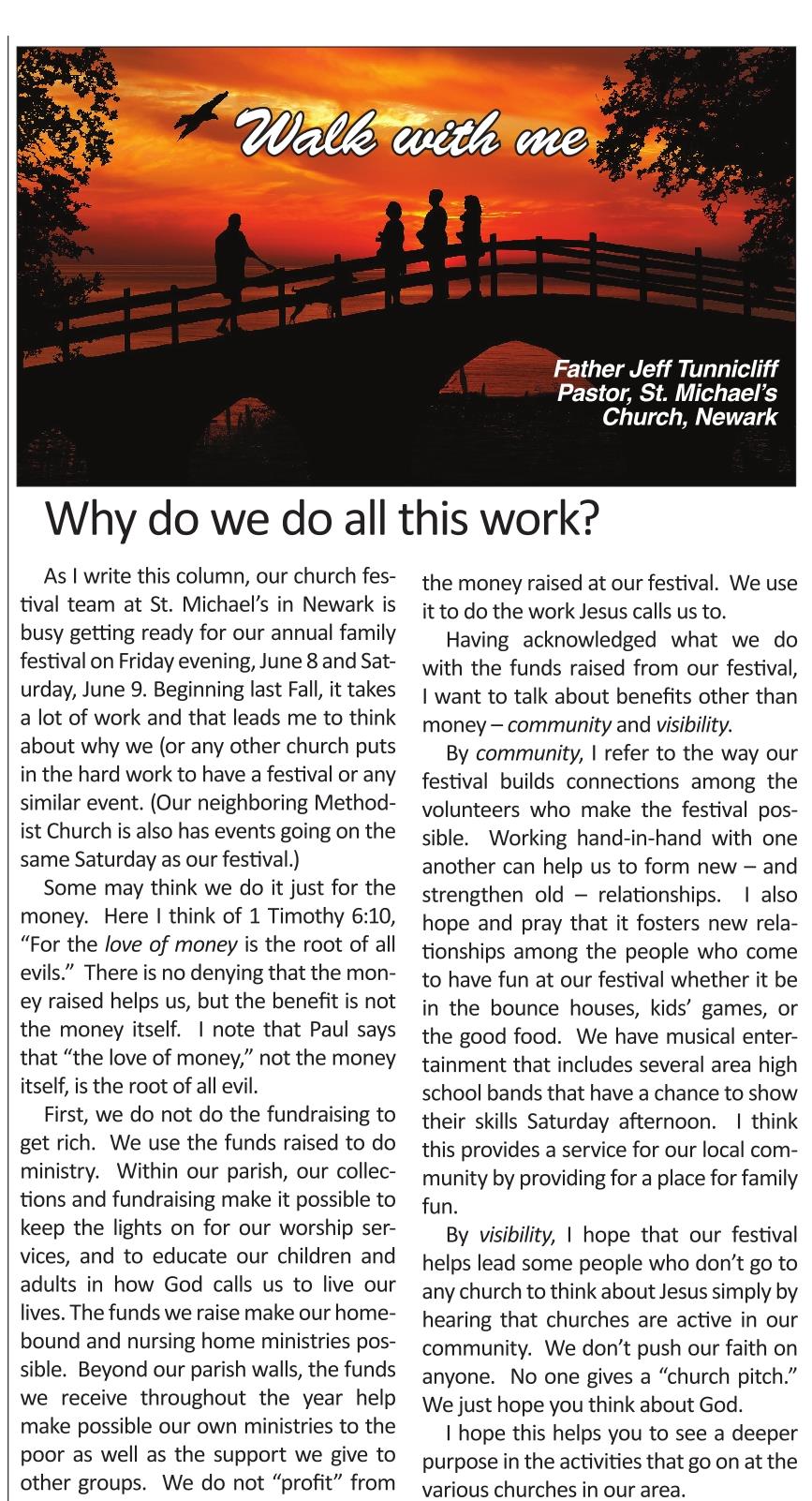
Column for the May 24, 2018 Sun & Record/Wayne County Mail

In addition to what you find posted here on my blog, I write a column about once a month for the Sun & Record/Wayne County Mail? His column this month is found on page 8 of the May 24, 2018 edition. (Their phone number is 315-589-4421).  This column is on why we do things like our parish festival.  Here is this month’s column.  (If it appears small on your screen, try clicking on it to enlarge it.)

Peace,

Fr. Jeff

Pentecost, Year B – Homily

Pentecost, Year B
Acts 2:1-11
Psalm 104:1, 24, 29-30, 31, 34
Galatians 5:16-25
John 15:26-27; 16:12-5
May 20, 2018

Our Easter season draws to a close today with our celebration of Pentecost.  To appreciate Pentecost, we need to look at it in the context of the whole season of Easter.  In fact, we need to go back to the Easter Triduum and what happened those three days.

It began with the Last Supper when Jesus instituted the Eucharist to feed us with his Body and Blood.  We need the strength that comes from receiving Jesus as the Bread of Life.

At the Last Supper, Jesus also made the Eucharist the Memorial of his sacrifice on the Cross that we celebrate on Good Friday.  Jesus died for our sins!

Then comes the empty tomb with the news that Jesus is risen.  He appeared to his disciples so we know what it means to rise body and soul.  We know that if we follow Jesus as the way and truth and the life, we have a place waiting for us in Heaven.

Forty days after the tomb was found empty, Jesus returned to his place at the right of his Father but he does not simply disappear.  He allows his disciples to see him ascend, not for media fanfare, but so we know where he went, to Heaven.

Yet, the Ascension is not the end of Easter.  Just before he ascended, he told his disciples to wait for the Holy Spirit before they began their mission.

It is during the Pentecost event itself that the first disciples “were all filled with the Holy Spirit.” After receiving the Holy Spirit, they went out to proclaim the gospel to all lands.

The first disciples received the Holy Spirit at Pentecost.  We receive the Holy Spirit when we are baptized in the name of the Father, and the Son, and of the Holy Spirit.

The Holy Spirit is sent by Jesus proceeding from the Father.  This is what we profess in our Creed.  If we accept the Spirit, he will continue to guide us to all truth.

Yet, we struggle to live as Jesus’ disciples.  We try to “live by the Spirit” yet we struggle against the desires of flesh.  Paul lists the “works of the flesh” as including immorality, lust, hatreds, rivalry, and jealously just to name a few.  Sometimes the struggle begins with even recognizing these as sin.

None of these are what we seek as children of God but they are tempting.  We would rather experience love, joy, peace, patience, kindness, generosity, faithfulness, self-control but we fall short of the fruits of the Spirit.

In thinking of falling short, I turn to our psalm response, “Lord, send out your Spirit, and renew the face of the earth.”  I emphasize “renew” because we have all received the Holy Spirit in our baptism but we need constant renewal.  We need the Holy Spirit to guide us to all truth.  We are not instantly transformed to be perfect disciples.  We can’t handle that but the Spirit will guide us in steps.

I speak for myself when I say I know I don’t know it all.  It is too much but I keep asking the Spirit to lead me to do what I can but we only accomplish what we are truly called to be when we let go of our own desires and allow the Spirit to transform us and to use us to reveal God to the world.

There are those who think the world is getting better because our freedoms are only now truly being realized so that people can choose whatever lifestyle they choose.

If these freedoms are so great, how come there continues to be conflict in the world?  I don’t mean just conflict between individuals.  I think of international conflict like what goes on in Israel and other parts of the Middle East or the situation in North Korea.

Freedom is at its best when people use their freedom to make good choices.  There are lots of bad choices being made.

Just this week there was another school shooting with several dead.  Much closer to home, there’s the three year who died in Seneca Falls this week.  I think we would all agree that the assailants did not make good choices of what to do with their freedom.

But what about the choices of others leading up to the shooting?  Perhaps someone choose not to say anything when they saw a warning sign but didn’t want to get involved.

While such shootings are not justified, what about choices of others leading up to the shootings on how they treat people?  Perhaps the assailants felt bullied and/or demeaned.  If they have mental illness, how were they treated?  Were they given any help?

I don’t know the answers.  I feel like I am just taking stabs in the dark.  What I do know is that we need to embrace the words of the Lord’s Prayer, “thy kingdom come, thy will be done.”

The way to stop all the shootings and violence is to take our freedom and choose not what we want but what God intends.  To do so, we need to let the Holy Spirit transform us.  We need to let go of our wants and give it all to God.


Homily for May 2018 Holy Hour

Homily for May 2018 Holy Hour
1 Kings 19:9-13a
Psalm 31:2, 6, 12-13, 15-16, 17, 25
1 Corinthians 11:23-26
Matthew 26:36-46

In June of last year, we begin a Year of the Eucharist in our diocese.  Bishop Matano proclaimed this year with the desire to help us deepen our awareness of the Real Presence of Jesus in the Eucharist and what the Mass means for us.

In two and a half weeks (on June 3rd), our Year of the Eucharist will draw to a close as we celebrate the Feast of Corpus Christi, the Most Holy Body and Blood of Jesus.  Of course, the end of the Year of the Eucharist does NOT mean that Jesus will stop being present in the Eucharist.  Our belief in the Eucharist is based not on this year proclaimed by Bishop Matano but rather on Jesus’ words 2,000 years ago at the Last Supper.

The first thing we started doing differently during this year was to return to the old custom of kneeling after the Lamb of God at Mass.  We kneel now in recognition of the Real Presence of Jesus as the priest holds up the Blessed Sacrament.  Then we stand as we come forward.  Our standing signifies that Jesus lifts us up.  So, we have both kneeling and standing now at Communion.

The other change we made at Mass came in October as we began distributing Communion only in the front of church except at Christmas and Easter.  I note Christmas and Easter because those are times when the church is filled.  When the parish started distributed Communion in back there were far more people in church.  Unfortunately, now on our typical Sunday, Communion in back is no longer needed.  (By the way, we need to pray for the decline in attendance to turn around.)

Our other big change for our Year of the Eucharist was the addition of our monthly holy hour.  This was something I was actually thinking about before Bishop Matano proclaimed a Year of the Eucharist.  We need to spend time with Jesus.  I personally enjoy the hour before the Blessed Sacrament but would people come?  The Year of the Eucharist became the perfect time to try.

I was ecstatic when we have about 45 people show up for the first holy hour.  I was worried it might be one or two.  Since then our numbers have dwindled to an average in the 20’s but several of you are very consistent in your attendance.  So, our monthly holy hours will continue.

What have our holy hours meant for you?  I assume since you keep coming, that it has been a good experience.  Have you shared with others how the time has been for you to perhaps encourage them to come and deepen their belief in the Real Presence?

As we reflect on what this Year of the Eucharist has meant for us, every one of our prayers, readings, and hymns tonight have been used during previous holy hours this year.  I did this to review this year.

I will start with our second reading.  It is Paul’s telling of the Institution of the Holy Eucharist.  He cites the words of Jesus, “This is my body…this cup is the new covenant in my blood” reminding us that our belief in the Real Presence Jesus in the Eucharist is not some human invention but from Jesus’ own words.  This is fundamental to our belief in the Eucharist.

The gospel reading today comes from Jesus’ prayer in the garden as told in Matthew’s Gospel.  I use this passage to provide the answer to the question of how long our time in Exposition of the Blessed Sacrament.  The answer, of course, is one hour.  The reason is Jesus’ words to Peter, “So, you could not keep watch for one hour?”  Again, it is from Jesus’ own words.

What about the structure of our holy hour?

We use incense as a sign of our prayers going up to God.

We use readings from the Bible to put God’s Word at the center of our lives.

Of course, the Blessed Sacrament is on the altar because of our belief in the Real Presence.

How about the silence?  The reason for the silence is found in the first reading.  Often, God chooses to come to us in the silence.  We need to turn everything else to be aware of God in the silence.  God speaks to us in his words found in the Bible and he speaks to us in the silence of our hearts.

So, what are we to do with this hour?  Here I turn to our responsorial verse, “Father, into your hands I commend my spirit.”  Give all to God in thanksgiving for all he has done for us.


St. Isidore, the Patron Saint of Farmers, and Holiness

Today is the Memorial of St. Isidore.  Actually, it’s an optional memorial but I chose to use the opening prayer and antiphon for St. Isidore at Mass this morning for three reasons.

First, because he is the patron saint of farmers, in fact he was a farmer himself, and since I like to eat, I consider farmers very important.  Farmers don’t get enough credit.  We need food and so we need them.

Second, in the United States he is the patron saint of the National Rural Life Conference.  This places him a little higher on the list of memorials for saints.

Third, his wife, Maria de la Cabeza (Torribia) is also canonized as a saint.  So they can be a model of holiness in marriage.

St. Isidore was a man devoted to God.  He is known as having spent his time plowing in the fields contemplating the glory of God, the same glory that Jesus speaks of in today’s gospel.  I hope we all recognize the presence of God in church at Mass.  I hope you pray at home and feel God’s presence there.  How about in the ordinary things of your life?  St. Isidore could find God in his work as a farmer.  Can you find God in the work you do?

The more we are aware of God’s presence in the ordinary moments of our lives, the more we can be like Paul in today’s first reading who felt “compelled by the Spirit” to go to Jerusalem and was willing to go even though he wasn’t sure what would happen to him there.  He was in tune with God and trusted in God.

So, today let us ask for St. Isidore’s intercession for our farmers to have a good year and we ask St. Isidore’s intercession to help for each of us to find God in the ordinary events of our lives.

Peace,

Fr. Jeff