Being “Church”

We continue to be separated to do our part to prevent the spread of the Coronavirus. I miss seeing the people. I miss gathering together to celebrate the Eucharist. Celebrating the Eucharist is the most important thing we can do. In our celebration at Mass, God makes present the sacrifice of Jesus on the Cross so that our sins might be forgiven. The bread and wine are transformed into the Body and Blood of Christ. In receiving Jesus’ Body and Blood, we are strengthened to fulfill the mission we have been given to proclaim the gospel (for more on the Eucharist, watch my recent presentation).

If the Eucharist is the most important thing we can do as a “church”, does that mean we stop being “church” without the Eucharist? No! We can still proclaim the gospel in the way we live our lives. Even with social distancing and staying home, we can still love God and our neighbor.

What do you think of first when you hear the word “church”? Is it the building where we gather for Mass? We do call the building a church. The building is very important as the place where we normally gather. Our church buildings need to be worthy of what we do there. The way we build and decorate our churches needs to be signs of what we believe.

However, church is more than just the building. We read in the United States Catholic Catechism for Adults, “The word Church is a translation of biblical words: the Hebrew word qahal, and the Greek word ekklesia, both of which mean “gathering of people or community” for worship” (113, cf. Catechism of the Catholic Church, 751-752).

It is the gathering of the people as a community that is church. Coming together, we celebrate the Eucharist. It is the priest who presides at the Mass as the one called by God and gifted in ordination to fulfill this calling. However, the people are not just to be spectators at Mass. Look at the words in all of the Eucharistic prayers at Mass. They speak of “we” celebrating the mystery of the Eucharist. The priest acts in persona Christi as but it is as a community that we celebrate Mass together. Even now when priests are celebrating Mass privately, it is still for the people.

So, church is the gathering of people. Which people? If someone asks you what church you belong to, on what level do you respond? Do you think of the church building where you go for worship? It used to be that parishes normally only had one church building. Now, a parish might have several church buildings. Do you identify yourself to the name of the church building or by the parish name? How about the diocese? How about the worldwide Catholic Church? How about the Church that transcends this earthly realm?

We need church buildings. We need an institutional church with a hierarchy that leads us to be who God calls us to be.

“Who God calls us to be”? Hum. “to be” points to some kind of action doesn’t it? We are not supposed to gather for Mass for one hour a week and forget about church the rest of the time. Even now, when we cannot gather for Mass, we are still called to fulfill the mission of proclaiming the gospel.

Jesus tells us ” the Son of Man did not come to be served but to serve” (Matthew 20:28). We are called to follow Jesus’ example to serve others. Again, with the Coronavirus, the ways in which we serve others might be limited but “service” to others does not stop. We can always serve others by praying for them. We can serve others by checking in on the elderly and infirmed with a phone call. If we have the means, we can serve others by donating to charities that serve those in need.

We also serve others by sharing with them the Truth that God proclaims. We are not to force it on others. It is their choice how to live their lives. However, they only truly have a choice when they know what their options are.

In the Lord’s Prayer, we pray “thy kingdom come.” We are called to work for the spread of God’s kingdom here on Earth. We need to be a voice for Jesus. We need to stop letting what the world says is good dictate our beliefs. Instead, we need to embrace the Truth of Jesus, and live in a way that changes the world for the better. This is part of how we are called to be “church” not just for ourselves but for all God’s people.

What I have offered here are some general thoughts about what it means to be a church. This is not meant to say the examples I give are the only way to be a church. For more on this, I invite you to watch my presentation, What It Means to be a Church?

We miss coming together for the Eucharist but we are still a community of believers. We are still a church. God will give us what we need to be who He calls us to be.

Peace,

Fr. Jeff
Staying Connected

We are not currently able to gather together to celebrate Mass because of the Coronavirus. The Eucharist is the source and summit of our faith (Lumen Gentium, 11). Thus, this time without public celebration of the Eucharist might seem a threat to our church. Is this the devil at work? What does this mean for our Church?

We have divine assurance that the devil will not prevail. That divine assurance comes from Jesus’ own words to Peter in Matthew 16:18, “And so I say to you, you are Peter, and upon this rock I will build my church, and the gates of the netherworld shall not prevail against it.

Paul, in his letter to the Romans reminds the people that God is on our side, “If God is for us, who can be against us?” (Romans 8:31b, for entire passage see Romans 8:28-39).

Yes, it is true we face a challenge to stay connected as a church that is the community of believers. We can still come together in prayer, albeit from our own homes. Last Friday, March 20th, Pope Francis called all to pray the Rosary together at 4 pm EDT. As we celebrate the celebrate the Annunciation this Wednesday, March 25th, Pope Francis invites all to pray the Lord’s Prayer at noon. Also on Wednesday, Bishop Matano has invited all in our diocese to pray a Rosary lead by him streamed on YouTube at noon.

We can also pray on our own but sharing common intentions. This is why I have been putting a prayer/intention on St. Luke’s Facebook page each morning. Certainly, we are sharing a common prayer intention in praying for an end to the Coronavirus.

We should also remember that while public Masses are not being said, Masses are being said privately. The Sacrifice of the Mass, which makes present today the Sacrifice of Jesus on the Cross, does not stop. As I say Mass, I offer for each and every one of you. I cannot say it enough that you are all very much on my mind as I celebrate Mass.

Yes, the Coronavirus crisis poses a threat to how we currently live as a community of believers. We are used to coming together for Mass weekly (daily for some). Mass is often the only time people see each other. Yet, that does not mean our connection to one another is broken right now. As you pray, take time to remember the people in our community. Even if you don’t know their names, you have seen them at church. Pray for them. If you don’t know their names, God does. God knows each and everyone of us by name. God will direct the prayer to the right person.

For those you know by name and are close to, make effort to stay connected. You may begin this by praying for them. You could also reach out to them. Good social distancing may prevent us from seeing them in person but it doesn’t prevent us from reaching out to them by phone or email.

In reaching out in prayer and to communicate with one another, we take the threat of the Coronavirus breaking our community apart and turn it into a new opportunity, a new way of being the community of believers.

By praying more often, we also take this time where we are told to stay home and turn it into an opportunity to spend more time with God. God embraces the opportunity to converse with you in prayer.

If you find yourself with a lot of free time, in addition to prayer, I encourage you to use this time to learn more about God as a means to deepen your relationship with him. You can do this by reading scripture and other spiritual reading. You can watch Catholic programming on TV or listen on radio (where available).

For those who are new to this blog, I take a moment here to point you to my website beyond this blog, www.renewaloffaith.org. The articles there are all written by me to help people learn and understand more about our faith. In addition to written articles, you will also find presentations recorded on video I have done. The menu bar is sorted by topic if you have something particular you would like to learn about. If you would like to know what the newest material is, check out the “What’s New” page.

Returning to the theme of staying connected, for those of you who are regular readers of my blog, you have probably noticed I am posting much more often since the Coronavirus crisis began in the United States. This is my way of staying connected with our parishioners but also everyone who reads my blog. (I encourage you to share what you read here with others.)

It is important for us to put effort into maintaining our relationships with fellow believers. I know some, myself included, are concerned that when we are able to once again gather to celebrate Mass publicly, not everyone will come back. This is why our efforts toward maintaining community are so important. In fact, it is my prayer that our efforts to sustain our community during the Coronavirus crisis will actually lead us to find new ways to reach out to those who stopped coming to church long before the Coronavirus as well as those who have never come to church.

I’ll end this blog with a request. As I pray for you, and you pray for each other, please remember your parish and the whole church in your prayer. Pray that we find ways to maintain and even strengthen our communities. Pray that we fulfill our mission to bring Jesus to the world. I also encourage you to continue financial support of your parishes in whatever way you can (many parishes offer online giving). Like you, during the Coronavirus crisis, parishes have bills that need to be paid. I don’t like to talk about money. The money is never the focus. Yet, we rely on your support. The most important support is your prayers.

Peace,

Fr. Jeff

Seeing the Best and/or Worst in Us

Difficult times can bring out the best and the worst in us. It is in our response to difficult times that we witness to the world what we really believe. It is in difficult times that we can find out for ourselves who we truly are.

We find ourselves in difficult times because of the Coronavirus. People with non-essential jobs find themselves without work and, for many, that means without pay (St. Cajetan is the patron saint of the unemployed). On the other side, medical and health care workers find themselves overworked (I think of St. Luke and St. Raphael among patron saints for health care workers). We are told to practice social distancing to “flatten the curve” to minimize the spread of the Coronavirus so that our medical system can handle it. Now, several states in the United States as well as other places in the world are on lock down. Thus, we may find ourselves without in-person support from our friends and family.

What is our response individually?

Is it bringing out the worst in us? Here I wonder about the empty shelves in the stores. With being told to stay home, we need to stock up on groceries. That is a smart response but how much do we need to stock up? Are some people hoarding? I don’t know. If one is buying up supplies to sell to others at a higher price, I point to the Seventh Commandment, “You shall not steal” (Exodus 20:15, Deuteronomy 5:19). We must remember, “The goods of creation are destined for the whole human race” (Catechism of the Catholic Church, 2402).

However, if we see someone leaving the store with a lot of one or two items, we should not assume their intent is “stealing” in the sense I mentioned above. While buying up supplies with the intent to sell at higher prices is a sign of “greed“, some people may be motivated by “fear”. Fear can be a powerful thing. We don’t know what is going to happen with the Coronavirus. The unknown can bring fear (and loss of a sense of control). One might go to the store to get groceries, see the shelves nearly empty, and, out of fear, feel they need to buy more before it is all gone to make sure they have enough. We pray that we all hand our fears over to God.

I have heard one or two stores of people fighting in the stores over what is left on the shelves. I hope this isn’t happening much but it can be part of fear.

Lastly, in terms of bringing out the worst in us (and related to fear), our anxiety levels may be high. I admit one of the things that causes me anxiety is how directives are changing often. This happens in the church as we went from practicing extra precautions (like suspending distribution of the Precious Blood in the Cup and the Sign of Peace) to the suspension of public Masses. We see it in general society as more and more people are told not to go to work and non-essential businesses have been shut down. We must remember God will get us through this.

With God in mind, I turn to how the Coronavirus crisis can bring out the best in us. With regards to the empty shelves in the stores, I think things are beginning to calm down. I was in a store yesterday for two items and found the store calmer than a couple of days ago.

I see it bringing out the best in us in the way some people have shown concern for others. This can be as simple as checking on elderly neighbors (while practicing social distancing). I see it in medical workers and emergency workers who work hard to care for the sick despite the risk of becoming sick themselves.

I also see it bringing out the best in us in people’s response to the suspension of Masses. I think of people who have said to me they never would have guessed we won’t ever be able to go to Mass. We took it for granted that Mass and the Eucharist would always be available. People who don’t normally go to daily Mass have told me they have started watching daily Mass on TV or online (other Prayer Resources) People are indeed turning to God!

As a priest, I am able to say Mass privately. However, I say it not just for myself. While you cannot join me for Mass, I offer the Mass for all of you. You are very much on my mind (even teary eyed) as I celebrate Mass.

We don’t know how long the Coronavirus crisis will last. What we do know is that God is eternal. God will always be with us. Nothing can take God away from us. I pray that we all have the grace we need to bring out the best in us to be good Christian witnesses to the world that needs God.

Peace,

Fr. Jeff

4th Sunday of Lent, Year A – Homily

For those unable to attend Mass this Sunday, here are some helpful links before sharing my homily:

4th Sunday of Lent, Year A
1 Samuel 16:1b, 6-7, 10-13a
Psalm 23:1-3a, 3b-4, 5, 6 (1)
Ephesians 5:8-14
John 9:1-41
March 22, 2020

While we are not able to come together for Mass this Sunday because of the Coronavirus, it is still good for us to reflect on the readings for Mass.

This Sunday’s gospel tells the story of “The Man Born Blind.”  The healing of the blind man is the sixth of seven great signs done by Jesus as told in the Gospel of John.  These signs are miracles and good for the people in the stories.  They also help us to know who Jesus is, that the power of God is at work through him.

When the disciples see the man born blind, they ask Jesus, “Rabbi, who sinned, this man or his parents, that he was born blind?”  To understand their question we must remember how they saw illness and infirmity in those days.  It was seen as punishment for sin. 

So, noting the man’s blindness, Jesus’ disciples assume a sin has been committed.  Jesus helps them to see things in a new way, saying, “it is so that works of God might be made visible through him.”

Jesus speaks of “day” and “night”.  He identifies himself as “the light of the world.”  He brings light to the blind man by giving him his sight. 

At first, when the man is able to see, he sees what has happened only in physical terms.  When he is asked how his eyes were opened, he replies by saying that Jesus made clay and anointed his eyes and he then washed in the Pool of Simeon.

Next, the Pharisees become part of the story.  When they hear what has happened, they miss the importance of the miracle and focus on the fact that Jesus did this on a Sabbath, breaking the law against doing work on the Sabbath.  Stuck in seeing the world in their terms, they fail to see the sign.

But there are others who are open to seeing something more who ask, “How can a sinful man do such signs?” 

Meanwhile, through the dialogue the man born blind moves from seeing what has happened only in physical terms to proclaiming that Jesus is a prophet. 

He doesn’t know who Jesus is.  He doesn’t know if Jesus is a sinner.  What he does know is that he was blind and now he sees.  He knows that means something even if the Pharisees don’t. 

He says, “It is unheard of that anyone ever opened the eyes of a person born blind.  If this man were not from God, he would not be able to do anything.”  He has made a great leap in his faith.  Ultimately, he comes to know Jesus is the Son of Man.

In this passage, the disciples were led from seeing illness as punishment from sin to seeing it as a means of revealing the “works of God.” 

The blind man went from not knowing Jesus at all to knowing him as the Son of Man.

Both Jesus’ disciples and the man born blind were open to seeing things in a new way, to move from seeing the world only in human terms to seeing as God sees it.

The Pharisees in this story (not all Pharisees) were not open to seeing things different.  This made them blind to who Jesus really is.

We are living in a trying time.  The Coronavirus has changed the way we live.  One might describe what we are experiencing as living in “darkness.”  We might even fear the darkness. 

Why might we fear?  Obviously, we might fear that someone we love or even we ourselves might get the virus.  What will happen then?  The good news is that most people recover. 

We might also fear what is happening in response to the virus.  The lockdowns and empty shelves in the grocery might lead us to fear.  There is uncertainty in all of this.  We might fear what is unknown (what we can’t see). 

Do we really need to fear?  For instance, how do you see the empty shelves in the grocery store?  Now, if you need something now and can’t find it in the stores, you can be concerned about what to do.  Yet, we should remember that this virus does not mean we need more food and supplies than normal.  There is enough out there.  It is simply that people have panicked and stocked up.  One has every right to stock up within reason but please don’t hoard more than you need.  You won’t need anymore toilet paper than normal.

Of course, we each have our needs that we are concerned about.  Different people will have different things that concern them most.  I’m not going to try to name all the concerns here.  You know what yours are. 

Pray about them.  Ask God to help you know what you really need vs. what is just a “want.”  Then, ask God to “guide” you in your needs.  Ask God to help you find “restful waters.”  We may feel like we are in a “dark valley” right now but remember what the 23rd Psalm says, “Even though I walk in the dark valley I fear no evil; for you are at my side, with your rod and your staff that give me courage.”

I end with the words that make up the Prayer over the People for the final blessing for Mass this Sunday.

“Look upon those who call to you, O Lord,
and sustain the weak;
give life by your unfailing light
to those who walk in the shadow of death,
and bring those rescued by your mercy from every evil
to reach the highest good.
Through Christ our Lord.”

Presentation on the Sacraments of Healing

I was scheduled to do the next presentation in my series on the Sacraments on March 25th. Like so many other things, because of the Coronavirus, that in-person has been cancelled.

Because of the uncertainty of how long it will be before we can gather for presentations, I decided to go ahead and make a video of the presentation without an audience. That means I used different technology (hence a change in voice quality – you might want to turn the volume down. I thought I was speaking softly but apparently my computer has a very powerful microphone).

The video and handouts on the Sacraments of Healing are now available here.

Peace,

Fr. Jeff

Facing the Coronavirus With Prayer

On Tuesday I wrote an article, “What are We to do Without the Mass” on how we can stay connected to God. There I spoke of the importance of the Eucharist in our lives and pointed to the new “Prayer Resources” page on our parish website.

This time of distress continues. As it does, we need to pray for medical care workers, their support staff, and emergency responders, to be kept safe and healthy as they work to care for the sick. We also need to pray for all government officials to have the wisdom they need to address the situation. We pray for all churches to find ways to support the needs of their parishioners. We pray for those sick with the Coronavirus. We pray for the repose of the souls who have died and for consolation for their families. We pray for a cure.

The restrictions on our lives continue to increase to protect us and minimize the spread of the virus. It started with school closings. We pray for the students, faculty, and staff. Now, we have restrictions that force people to work from home. The closing of businesses and the decrease in business for those who are open continues. We pray for those out of work or with diminished incomes because of the virus.

With many shelves empty in the stores, we pray that all have their basic needs fulfilled.

My intent here is not to add to anyone’s distress. I don’t think that I mentioned any challenges that most people aren’t already aware of. I list all of these things to remind us to pray for all these needs. We cannot gather together for worship and pray as we would like. We can pray in our own homes and with a common purpose.

Prayer is important. We need the connection to God. That’s why we need for each others and to pray for ourselves.

Remember, prayer is not simply a matter of giving our list of needs to God. Prayer is more than just petitions. Praying is about conversation with God. (cf. a video I did on prayer a few years ago, Talking About God: A Conversation About Prayer). We want God to listen to our prayers. We need to be willing to listen to God.

This does not mean that God will literally speak to us and give us precise direction. God speaks to us more in the heart than in the head. Of course, we need to listen to both, relying on “faith and reason.” Quieting ourselves in prayer is to help us be aware of God in the moment.

Think of it this way, when things are not going the way you want and you talk to another human being, what are you seeking? Sometimes we want the person to fix whatever our problem is. However, are there not times when we just want someone to listen? We just want them to be there for us.

This is true with God. Often, we ask God to fix things. Sometimes we just need to know God is there.

We certainly should pray that God would lead medical researchers to a cure for the Coronavirus. In addition to the earthly problems I mentioned above, it is also causing anxiety and distress. That’s where we just want someone to listen. We need a shoulder to cry on. God has big shoulders. God has big arms to hug us with so that we might have comfort and peace. Prayer is a conduit for this.

God did not cause the Coronavirus but, if we let him, God can use it to lead us to a deeper sense of prayer, to a deeper relationship with him. (Maybe it reminds us how important prayer already is to us.) It can remind us that God doesn’t want to be in our lives for just an hour on Sunday. He wants to be with us everyday. The Eucharist is the source and summit of our faith (Lumen Gentium, 11). I hope you miss receiving it. However, while you cannot receive the Eucharist, God is still present with you now and in every moment. Prayer helps us to know that.

I end with the words of Psalm 46:11, “Be still and know that I am God!”

Peace,

Fr. Jeff

What are We to do Without the Mass?

The way in which we live out our faith has changed drastically in the last two weeks. We first heard of the Coronavirus in China back in December. It has been spreading since then. Other countries like Italy began to take precautions, including canceling Masses.

On March 12th, Bishop Matano issued new precautions for Mass. Among other things, the precautions included the suspension of the distribution of the Precious Blood in the cup and of exchanging the Sign of Peace. We did not want these changes but we could manage. In my homily last Sunday, I spoke about how we need to both trust in God and take proper human precautions.

Attendance was down at our Sunday Masses. I had people say how they hoped and prayed we would be able to continue to have Mass. I felt the same way.

Monday morning (March 16, 2000) we were deciding what parish activities to cancel. At 3:30 p.m. we received a statement from the diocese suspending all public Masses. (Today, March 17th, we received a letter from the Bishop with more details about what this means for sacraments and parish activities).

It is sad that we cannot celebrate Mass publicly but it is necessary for the health of all. As I think about what this means, I recall that it was just two weeks ago when I offered a presentation on the Eucharist as part of my series, Sacraments: Channels of God’s Grace. In that presentation, I stressed the Real Presence of Jesus in the Eucharist.

The Eucharist is the source and summit of our Catholic life (described as the “fount and apex” in Lumen Gentium, 11). It stands are the heart of what I do as a priest and why I am a priest.

The Eucharist is central to who we are and what we do as Catholics but it is not the only thing we do. The fact that we are not able to celebrate Mass publicly does not mean we cannot pray. With that in mind, at St. Luke’s where I serve, we have created a page on our website with prayer resources. It includes information on where people can watch Mass on TV as well as find it streaming on the Internet. It also includes links to resources for people to be able to pray the Stations of the Cross, Rosary, and other devotions at home, individually and/or as a family.

You can do any of these prayers at anytime. In fact one is a link for the Liturgy of the Hours, that can be done several times (with different prayers) in a day and every day. The Lord is always in our midst.

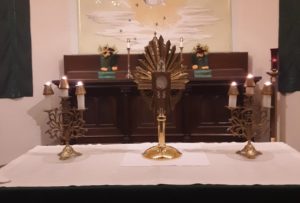
There is another activity I would like to recommend. It is a variation of “Adoration.” Normally, when we talk about Adoration, it is of the Eucharist, either in the Tabernacle, or in the monstrance of the altar.

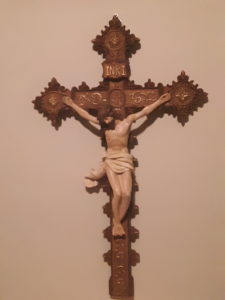
Unfortunately, we cannot do that unless you are fortunate to be near a church that is open for private prayer. So, I offer another possibility that I do myself. In my sitting room, I have a Crucifix hanging on the wall. When I want to pray in silence, I light a candle on a table underneath the Crucifix and turn out the lights and gaze upon, “adore”, Jesus on the Cross. When we celebrate the Sacrifice of the Eucharist, it is the sacrifice of Jesus giving his life for us on the Cross. You do not have the Eucharist in your home but I hope you have a Crucifix.

It is also important to realize that while anyone who is in an area where the Coronavirus has led to the suspension of Masses cannot attend Mass, that does not mean that you cannot “Keep the Sabbath holy” as God himself directs. You can watch Mass on TV or on the Internet. Even if you are in an area where you do not have a Mass available on TV or do not have access to the Internet, you can still “keep the sabbath holy” by sitting before a Crucifix, praying a devotion, and/or reflecting on the readings of the day (see “Prayer Resources“). (For more on “keeping the Sabbath holy” see my reflection “Keeping the Sabbath Holy: What Does It Mean to Me?” and Dies Domini by Pope John Paul II).

Since one cannot go to Mass, it would be easy to forget about the Lord and do something else. I worry that we will lose people who feel this way even after churches reopen after the Coronavirus is over. I was lamenting this in an email conversation with a friend. She responded by saying another friend had said to her just that morning that she hopes that this time without the Eucharist will actually help people realize how valuable the Eucharist is and appreciate it more. Let that be our prayer during this time.

Peace,

Fr. Jeff

3rd Sunday of Lent, Year A – Homily

3rd Sunday of Lent, Year A
Exodus 17:3-7
Psalm 95:1-2, 6-7, 8-9 (8)
Romans 5:1-2, 5-8
John 4:5-42
March 15, 2020

After God set them free from slavery in Egypt, the Israelites found themselves in the desert thirsting for water.  Water is not just a want, it is a need.  They grumbled to Moses, who in turn “cried out to the LORD.”

God answered their need by having water flow from a rock struck by Moses.  God did this not just to provide for his people in their physical needs but also for their spiritual needs, showing that He was in their midst.

Our gospel reading picks up the theme of water as an earthly drink but then Jesus takes it to a spiritual level. 

Jesus finds himself alone at the well about noon.  While He is there, a Samaritan woman comes to draw water.  “Jesus said to her, “Give me a drink.””

She is astounded He would ask for a drink.  She recognizes him as a Jew and knows the “Jews use nothing in common with Samaritans.”  She also knew that in those days, men did not talk with a woman alone.

Jesus responds by beginning to take the conversation to a spiritual level.  He said, “If you knew the gift of God and who is saying to you, ‘Give me a drink,’ you would have asked and he would have giving you living water.” 

In offering her “living water”, He speaks of more than physical water but she hasn’t realized that.  She is still thinking in terms of physical water.  So, when Jesus says those who drink the living water “will never thirst”, she thinks this is great because she won’t have to come to the well anymore.

To help her understand who He is, He tells her something that He would not know if He were just an ordinary human.  He speaks of how many husbands she has had.  From this she comes to see him as a “prophet.”  She has taken the first step.

He speaks of the true worship that will come.  She speaks of knowing that a “Messiah is coming.”  He tells her, “I am he.”

She’s puzzled by this and goes to the town.  At this point, she knows little about Jesus but that doesn’t stop her from telling others about Jesus (we can learn from her example).  When she tells the towns people, many came to believe in Jesus because of her proclamation.  They began to know Jesus because of her words but then come to a fuller faith because they came to hear Jesus for themselves.

She was a Samaritan, despised by the Jews.  Yet, when she encountered Jesus, she did not harden her heart.  Rather, she was open to his words.  Jesus poured the living waters through the Holy Spirit into her heart.  From this, she grew in faith and led others to faith in Jesus.

Growth is something we should always be open to.  It can be in our individual relationships with Jesus.  We need to come to Mass.  We need to read the Bible.  We should do spiritual reading, watch good Catholic programming, or attend presentations to help us know more about our faith.

We might also think about growth in relationships with others.  For example, think of the Sacrament of Marriage.  A couple can become complacent in their marriage.  Here you might consider attending a marriage encounter weekend.  You can find more about that in this week’s bulletin.

Why do we need to grow?  To always keep our trust in God strong!  To help us know that the Lord is always in our midst.

Then, when we face times of difficulty, we can find peace in the Lord.  It doesn’t mean we don’t face difficulties, just that we know Jesus is with us.

For instance, the world is in distress concerning the Coronavirus.  We turn to the Lord seeking peace.  This is based on our trust in him.  However, trusting in the Lord does not mean we don’t take precautions.  Remember what Jesus said when He was tempted by Satan?  “You shall not put the Lord, your God, to the test.” (1st Sunday of Lent, Matthew 4:7, cf. Deuteronomy 6:16). 

We are to take proper human precautions but then to trust that the Lord is with us.

So, we are not cancelling Masses now but we are taking precautions.

Last week, we suspended distributing the Precious Blood in the Cup.  That will continue.  Here, I assure you that our Catholic faith teaches that if when we receive just the consecrated host, we receive the whole Jesus, Body and Blood.  We receive all the grace we need.

We also encourage you to be mindful of how you receive the host.  It is permissible to receive on the tongue or the hand but in terms of illness, the hand is preferred to help prevent spreading any illness. 

Here, I want to remind everyone that receiving on the hand, was not a new invention from the Second Vatican Council.  In the early church, Communion was normally received in the hand.  St. Cyril of Jerusalem, a fourth century saint, wrote instructions to the catechumens joining the Church on how to receive Communion.  He said to “receive Communion by making a throne, one hand over the other, ready to receive our great king.”

Last week, we also said to not shake hands at the Sign of Peace to avoid spreading viruses.  This week, Bishop Matano has directed (you can find his memo online at https://catholiccourier.com/sites/default/files/DioceseCoronavirusPrecautions.pdf) that we suspend the Sign of Peace.  So, I will say the words leading up to the Sign of Peace but not call for the Sign of Peace to be exchanged. 

Likewise, Bishop Matano has said not to hold hands “during the Lord’s Prayer or at any other time during Mass.”

Bishop Matano also reminds us that when we are sick, we should stay home to care for ourselves and to protect others.  When we are sick, we are not obligated to attend Mass.  He adds, “Anyone with concern for his or her health is not obligated to attend Mass.”  You know your health history.  Please make wise choices.

We, and the diocese, continue to monitor the situation with the Coronavirus.  We will continue to implement human precautions as appropriate.  We do this to be wise, but we also do so trusting in the Lord, that knowing we have done our part and that the Lord is with us, calming our fears in the midst of distress.

2nd Sunday of Lent, Year A – Homily

2nd Sunday of Lent, Year A
Genesis 12:1-4a
Psalm 33:4-5, 18-19, 20, 22 (22)
2 Timothy 1:8b-10
Matthew 17:1-9
March 8, 2020

We hear today the story of Jesus’ Transfiguration.  He took Peter, James, and John “and led them up a high mountain.”  On the mountain they saw Jesus transfigured, his facing shining, and his clothes “became white as light.”  Moses, symbolizing the law, and Elijah, symbolizing the prophets appeared there.  To all of this Peter said, “Lord, it is good that we are here.

Yes, it is good that they were there but why did Jesus take them with him this time when He went alone other times?

Jesus knew his passion was coming.  He knew they would need assurances of who He is.  So, He took them with him to see the transfiguration to give them assurance, to give them “the strength that comes from God.

We too will, as Paul says to Timothy, bear our “share of hardships for the gospel with the strength that comes from God.” 

We are called to place our trust in God, to work for, as we pray for in the Lord’s Prayer, thy kingdom come, thy will be done.

The story of the Transfiguration assures us of who Jesus is so we can trust him.  We are given an example of that trust in Abram, who will become Abraham, in the first reading.  God said to Abram, “Go forth from the land of your kinsfolk.. to a land that I will show you.”  Abram doesn’t know where the land is and he doesn’t ask.  He simply trusted and “went as the LORD directed him.

We are all called to work for the building up of the Kingdom of God.  We do this through giving of our time, talent, and treasure.  Last week, we heard about our increased offertory program, “Be the Gift That Makes a Difference.”  Today, we hear from one of our parishioners about that.  Ask yourself what you can do to help build up the Kingdom of God.

My church is composed of people like me.
I help make it what it is. 
It will be friendly, if I am. 
Its pews will be filled, if I help fill them. 
It will do great work, if I work. 
It will make generous gifts to many causes,
If I am a generous giver. 
It will bring other people
into its worship and fellowship,
f I invite and bring them. 
It will be a church of loyalty and love,
of fearlessness and faith,
and a church with a noble spirit,
if I, who make it what it is,
am filled with these same things. 
Therefore, with the help of God,
I shall dedicate myself to the task of being
all the things I want my church to be.

Conclusion on “How Do You Evangelize a Culture That Used to be Christian?”

Today I conclude the series of blog articles I have been writing in my attempt to reflect on the question, “How do you evangelize a culture that used to be Christian?” 

Of course, the ministry of evangelization will continue as long as there is someone alive who has not yet turned their heart to Jesus Christ.  It is only this particular series of blog articles that comes to an end with this article.

In my last article, I addressed the question, “Whose Job is it?”  In our Baptism, we each receive the Light of Christ and we are appointed to share the Light of Jesus with others.  We are not to force it on anyone.  They need to choose for themselves what to believe but we have an obligation as baptized Christians to speak up for how our faith teaches us to live.  Ezekiel 3:17-21 tells us that we must speak up but once we do so, it is in the other person’s hands.  On the other hand, Ezekiel tells us that if we don’t speak up, we are culpable for their sins.  We rely on God to know what each of us are to do individually and together as a community of believers.

In thinking about our culture that used to be Christian, we need to think about why people leave the Church.  Some may make a deliberate choice.  Among this group, I would include those who reject faith because they think science proves that there is no God (see article #2 in this series, “How Science Eliminated the Need for God”). 

Among those who might deliberately leave the Church are those who think faith has become outdated and irrelevant (see article #3 in this series, “Answering Those Who Think Faith is Irrelevant”).  People in this group may make a conscious choice to stop going to Church but it is based on faulty premises that lead them to think faith is irrelevant.  It is our task to help them see how faith is relevant today.  It is only misunderstanding and/or incomplete knowledge of our faith that makes it seem irrelevant.  We also need to help them see how God is active in our world and in our individual lives.

Another group of those who might deliberately leave the Church includes victims of abuse and people who know them.  Because they are a victim of a great wrong by a priest, they may come to doubt the Catholic Church as the authentic Church or they might even become atheist, thinking that if there was a God, He would never allow the abuse to happen.  First, I again say I am sorry to anyone who has been a victim.  We must do everything we can to make sure such abuse or any other abuse never happens again. 

There are those get distracted by earthly things.  They might have good intentions of coming to know Jesus but they think they have to first get a good job with good money and power.  They put all their energy into that and forget about God.  Sometimes they come back to Church but many get caught forever in material things (see article #1 in this series, “The Quest for Fulfillment in the Modern World”).  They may never make a conscious decision to turn away from the Church.  They more just slip away.

Another group that might just slip away are those who feel like they don’t get much out of coming to Church (see article #4 in this series, “Answering Those Who Say They Don’t Get Much Out of Mass”).

So, what are we to do?  We need to build bridges between our Catholic faith and the modern (or what some even call the “postmodern world.”

This means we need to meet people where they are at.  Old school missionaries would often “force” their own culture on others while trying to evangelize.  Today we understand we need to learn about their culture and then build bridges (see Pope Francis Apostolic Exhortation, Querida Amazoniaand the final document from the Amazonian Synod).

We need to respect different cultures and ethnicities in our work of Evangelization.  We also need to understand the differences between generations.  Within the Church, this starts with understanding the differences between the Pre-Vatican II and the Post-Vatican II generations.  We must also understand that people born in the Great Depression of the 1930’s have a different sense of entitlement and sacrifice than those born in recent years.  Events like World War II, the Korean War, the Vietnam War, and 9-11 all influence everyone some but most especially those who come of age when these events are happening. 

It is the work of all of us, no matter what generation, culture, or ethnicity we belong to work to spread the gospel message.  The Truth of the gospel does not change but we need new ways to help make our faith relevant to every generation, culture, and ethnicity. 

I will end with the following passage taken from my document, “What Sort of Church Should We Be?” (November 24, 2017)

“If we are to build bridges, we cannot keep relying on old methods

In her ongoing discernment, the Church can also come to see that certain customs not directly connected to the heart of the Gospel, even some which have deep historical roots, are no longer properly understood and appreciated. Some of these customs may be beautiful, but they no longer serve as means of communicating the Gospel (EG, 43. Italics my emphasis).

We cannot and should not change the Gospel message. Yet we need to realize that the world we live in is not the same as it was 200 years ago, let alone 2,000 years ago. We live in an age of communication where information is transmitted across the world in seconds. This gives us new means to spread the gospel but as Pope Francis points out

“We are living in an information-driven society which bombards us indiscriminately with data-all treated as being of equal importance-and which leads to remarkable superficiality in the area of moral discernment. In response, we need to provide an education which teaches critical thinking and encourages the development of mature moral values (EG, 64).”

I know I may not have provided the explicit answers that we (myself included) would like in how to evangelize but I hope this series has helped you as well as me to take the next step to build up the Kingdom of God.


Peace,

Fr. Jeff