Easter Vigil Homily

Easter Vigil
Genesis 1:1-2:2
Exodus 14:15-15:1
Isaiah 55:1-11
Romans 6:3-11
Matthew 28:1-10
April 11, 2020

Tonight we celebrate our Easter Vigil.  It is the highest liturgy of our liturgical year.  We started our Easter Triduum Thursday evening with the Mass of the Lord’s Supper with the Institution of the Eucharist and the Priesthood.

Yesterday we celebrated Good Friday, the sacrifice of Jesus on the Cross for us.  At the end of yesterday’s gospel Jesus was laid in a tomb.  Tonight we hear the tomb is found empty and that Jesus is risen.  This is good news.

However, before we jump into the Resurrection, our readings and the singing of the Exultant tell us events in the story of Salvation History, the story of God saving his people throughout the millennia. 

Our readings begin with the story of creation “in the beginning” and conclude in God making a new “creation” manifest in Jesus’ Resurrection.  Jesus restores creation to what God intended.

We must understand that the story of creation as told in Genesis is not meant to provide a scientific explanation.  God is very much the creator of the universe but this story is not trying to tell us how He created the world.  Its goal is to provide meaning to our existence and to articulate the divine order in which God created everything.

Before God created the universe as we know it, “the earth was a formless wasteland, and darkness covered the abyss.”  God began by bringing light to creation so that we may see creation coming from the “formless wasteland.”

God separated the waters and created the sky.  He gathered the water and dry land appeared.  He created vegetation and all sorts of living creatures.

God created everything in balance, with a divine order.

God’s creating of the world culminated in the creation of male and female in his image.  He gave humans dominion over creation. 

God did not create and walk away.  Throughout Salvation History God has always been there for his people.  He gives us free will and allows us to sin.  He allows us to suffer the consequences of our sins but God is always with us.

Scripture is full of stories of God being present to his people.  

There are stories of faithful and righteous people like Abraham and Joseph.  There are also stories of difficulty. 

For instance, the Israelites were made slaves in Egypt.  They cried out to God who rescued them, sending Moses to lead them out. When God rescues his people, He does it in a way only God can, the parting of the Red Sea.  He does it in a way that reveals himself to both the Israelites and the Egyptians.

In the Bible we can read about how Joshua led the people across the Jordan to the Promised Land.  We can hear how God built up the Kingdom of Israel through David even though David himself was also a sinner.

We hear of how the Israelites were defeated by the Babylonians and many were taken into Exile.  Our reading from Isaiah comes at the end of the Exile.  God is inviting the Israelites to return home to him.  God invites all to come to him as He says, “All you who are thirsty, come to the water.

In our humanity, we put much effort into obtaining earthly things.  Some of these things we need.  Some are just wants. 

What God offers us, salvation, is far more valuable than anything on earth.  We need to strive to follow God’s way but ultimately Salvation is a gift, a gift we receive “without paying and without cost.

The Lord gives us this gift because He is merciful and is “generous in forgiving.” 

How does God offer us this gift of Salvation?

Through Jesus.

God forgives us because Jesus gave his life for us on the Cross so that “we shall also be united with him in the Resurrection.”  Life with Christ begins in Baptism as we die to this world.  Life reaches its fullness in the Resurrection.

So, here we are.  Jesus has been Crucified and laid in the tomb.  Does his death mean that He has been defeated?  No.  God has power even over death. 

Not understanding the Resurrection, the women go to the tomb and find it empty.  The angel tells them that Jesus has risen and directs them to tell his disciples.

On their way to the disciples, they encounter the Risen Jesus.  Jesus Christ is risen today. 

The Old Testament includes stories of struggle. 

Since the first coming of Christ, we continue to face challenge and difficulty.  As humans we are not perfect.  We sin.  The church has faced disease like the Black Plague.  It has faced corruption.  Yet, God has always walked with his people through it all.  God restores what has been broken.

Even now we face the Coronavirus pandemic.  It changes how we worship but it does not change what it is that we believe.  We believe in Jesus who is consubstantial with the Father and united in a perfect Trinity with the Holy Spirit who gives us gifts to aid us.  Even as we are separated by distance right now, we are united through the Spirit to know God is with us. 
Who is Our Savior?

If you read this the same day I write it, Good Friday, the answer to the question in the title, “Who is Our Savior?” might seem obvious. However, there are people who don’t go for the Christian answer.

There are people who make themselves their own savior. They are only looking out for themselves. They think there is no else is looking out for them. They think everything depends on them.

There are people who think the government is supposed to fix everything. Certainly, the primary role of government is to care for the needs of the people within its boundaries. However, that doesn’t mean that we can live however we want and expect the government to bail us out. We need to do our part. I think there are people in government who see themselves as the “savior”. They think they can take care of everything if everyone else would just let them have their way.

Of course, the Christian answer to “Who is Our Savior?” is Jesus Christ. He came into this world (the Incarnation) to be our Savior. While on Earth Jesus did many miracles. He taught us how to live as God’s children. He brings us salvation when He gives his life for us on the Cross. It is through his sacrificing his life on the Cross that we are saved, saved from our sins.

It was not an easy thing for him to do. I think of phrases in today’s (Good Friday) first reading from Isaiah 52:13-53:12). This is the fourth of four Suffering Servant oracles in Isaiah. It speaks of the suffering servant as one who was marred “beyond human semblance.” “He was spurned and avoided by people, a man of suffering.” Why? Isaiah tells us that “it was our infirmities he bore…he was pierced for our offenses.” Jesus himself “had done no wrong.” Jesus suffered to “to take away the sins of many, and win pardon for their offenses.

Jesus suffered for us. Jesus is our Savior.

Does that mean we can do whatever we want and just expect that Jesus will save us? Ultimately, we cannot save ourselves. We need Jesus but we must do our part. Otherwise, we don’t really open ourselves to letting Jesus save us. We need to do the best we can but then to leave it in God’s hands. For example, when we sin, we need to repent but we shouldn’t wait till we stop sinning. We can’t stop on our own. We need to seek forgiveness through Jesus and count on God to help us resist sin.

What about the government? Do they have a role to play in our salvation? Spiritually, the government’s place to help us is to ensure we have freedom of religion so that we can live according to our beliefs.

However, that doesn’t let the government off the hook in earthly activities. The government exists to serve the needs of the people. Each individual needs to do their part but sometimes that isn’t enough. Then, the government has the responsibility and duty to help. However, the government is not our savior. Jesus is.

We need to do what we can. For instance, in regards to the Coronavirus, as individuals, we need to practice good social distancing. It makes sense. God gave us brains to use our reason to make good choices.

However, we can’t do everything ourselves to protect everyone from the Coronavirus. The government must do its part to make sure earthly help is directed where it is most needed.

Still, the government can’t do everything. We place it in God’s hands. We pray for the healthcare workers who risk their own health to help those sick with the Coronavirus. We pray for the government officials to make wise decisions. We pray those at the stores who are in public all day long with potential exposure to the virus so that we can have what we need.

Still, all the human effort is not always enough. So, we turn to God to save us. God walks with us in this challenging time. God loves. Jesus is our Savior.

Thanks be to God.

Peace,

Fr. Jeff

Holy Thursday Homily

Holy Thursday
Exodus 12:1-8, 11-14
Psalm 116:12-13, 15-16bc, 17-18
1 Corinthians 11:23-26
John 13:1-15
April 9, 2020

As we begin our Easter Triduum tonight, I note that the Jewish people just began their Passover last night.  Our first reading tonight is the story of the very first Passover.

The Israelites had been made slaves in Egypt.  They cried out to the Lord to rescue them.  The Lord sent Moses to lead them out.  To get the Egyptians to release the Israelites, God sent a series of ten plagues.  The 10th plague is the death of the firstborn son.  This is the time of the first Passover.

Each Israelite family “must procure for itself a lamb” that is “a year-old male and without blemish.”  It is to be sacrificed to the Lord.  We must give the Lord our best.

Then they are to sprinkle some of the blood from the sacrifice of the lamb on their door posts.  The blood will be a sign to the Lord that it is an Israelite home.  He will “Passover” Israelite homes without killing the firstborn. 

The Lord tells them to make this a “memorial feast..a perpetual institution.”  Even today, Jewish people celebrate the Passover every year.  It stands at the head of their calendar.  When they celebrate the Passover, they are making present what God did for them when He set them free from slavery.  It is a defining moment in the history of God’s people.

Tonight, we begin our Easter Triduum.  Easter stands at the head of our liturgical calendar.  No day is more important than Easter.

The word “triduum” means three days.  What we begin tonight continues for three days.  Tonight is the Mass of the Lord’s Supper with the Institution of the Eucharist.  Tomorrow, on Good Friday we celebrate the Crucifixion.  What would the Crucifixion be without the Resurrection on Easter?

These three actions (Lord’s Supper, Crucifixion, and Resurrection) occur over three days but they are one continuous event in Jesus’ saving action for us.

In our second reading, we hear Paul tell the institution narrative for the Eucharist.  He says that it is what he “received from the Lord.”  What we celebrate in the Eucharist is not of human origin.  It is what Jesus directed us to do when He said, “Do this in remembrance of me.

When we think of the Eucharist, we think of the Body and Blood of Jesus, the Real Presence.  Jesus gives us this Sacrament to nourish our souls.  Yet, we live in a moment when we cannot come together to celebrate the Eucharist.  You are not able to receive Jesus sacramentally.  However, this does mean we stop celebrating Mass.

Priests continue to celebrate Mass privately.  One might ask why when there is no one else present to receive the Eucharist.  Celebrating Mass is not only to receive the Eucharist.  We need to think about what it is we celebrate in the Mass.

Remember how I said what happens over the three days of the Triduum are one event.  When we celebrate the Eucharist, we are celebrating the Sacrifice of Jesus giving his life for us on the Cross.  When Jesus institutes the Eucharist, He speaks of his body that will be given up for us, his blood that will be shed for us.  By his own words, Jesus unites the Eucharist and the Crucifixion. 

He tells us to celebrate it over and over.  However, it is not just a historical reenactment like a play might be.  Remember God is not bound by time.  What we celebrate in the Eucharist transcends time and placeGod, in a way that only He can, makes present for us now what Jesus did 2,000 years ago. 

Tonight is about the Institution of the Eucharist.  It is also the Institution of the Priesthood.  Why?  Because the Eucharist is a “sacrifice.”  To celebrate a “sacrifice” requires a priest to preside. 

Jesus made the Twelve the first priests.  In ordination the one being ordained is ontologically changed in a way that marks them with an indelible mark and set apart to serve the people.  In being ordained, the priest is not made better than the laity.  The priest is given a unique role to serve the people.

The priest is to be a servant leader.  Jesus gave us an example of this, “a model to follow,” when He washed the feet of his disciples.

This was not a role for the master of the house.  It was the role of a servant to wash the feet of guests.  Jesus shows us a different way.  He shows us the way of service.

Before I presided at a Holy Thursday Mass and washed the feet of some parishioners, I knew about the washing of the feet but I hadn’t quite gotten what Jesus was saying about service in priesthood.

It is a humbly experience to wash the feet of others.  As I would wash the feet of each person, I would think not just of that one person but all the parishioners that I am called to serve.

Tonight is different.  There are no people here because of the Coronavirus.  So, there will be no foot washing. 

I have to say this is difficult for me.  As a priest, I am here to serve the spiritual needs of our parishioners.  This is very different right now.  But it does not stop priests from serving the people.  Each priest is challenged to find ways to support their people.

I try to do it in part with the Facebook posts I do on our parish Facebook page and in writing articles for my blog to offer those with a computer spiritual support.  Fr. Bernard does it in other ways.  We are still here to serve you.

I also say Mass regularly.  I do this not for myself.  In fact, when I am celebrating Mass privately, I find it difficult in a way.  For me, I say Mass for the people, it is for your benefit more than mine.  When I say Mass I long to see you.  Even when livestreaming Masses I long for the day when we can celebrate Mass together.  Right now, I look out and I see computer screens with cameras and empty pews.  I would much rather see you here.

Tonight we celebrate the Mass of the Lord’s Supper.  It is the Institution of the Eucharist and the Priesthood.  It is the sacrifice of Jesus.  It is our salvation.  It comes to us from the love of Jesus.

What Will Your Life be Like After the Coronavirus?

What was your life like before the Coronavirus? Maybe you were very busy at work. Maybe you were very busy with your children’s (or grandchildren’s) activities. Maybe you are retired and you didn’t do much because it always seemed like there was plenty of time, and now you can’t do the stuff you hadn’t gotten to.

How different has your life been during the Coronavirus shutdown? Are you still going into work? Healthcare workers and grocery stores are busier than ever (we are very grateful for their work and care). Maybe you are working from home. Is working from home a good or a bad thing? It has its pros and cons. Maybe you have been laid off and find yourself with a lot of time.

If you are a student of any age, how is the online learning going? How much time does it take? What have you done with all the time that used to go into student’s extracurricular activities like sports and plays?

What about the time you would normally spend at church? Have you been praying at all? I heard Cardinal Dolan say that some of the priests in the Archdiocese of New York have said that in some cases they have more people watching Mass online now than were going to church before the shutdown. A crisis can lead people back to God. We pray they keep coming?

Maybe you have been cleaning the house. I know some people who say their house is cleaner than it has been in years. Maybe you have completed some longstanding projects around the house. If you are one of the families that are always on the go because of so many activities for your children such that you never sit down to eat a meal together, maybe you have shared some meals together and just talked.

Maybe you have used some of the time for some much needed rest.

If you have had a lot of extra free time, I hope you have given some of it to Jesus. One might think of some of the time as a retreat. A spiritual retreat includes some time to rest but it always includes prayer and perhaps spiritual reading to ask God to help you regroup and discern what God wants you to be doing.

So, when the Coronavirus shutdown ends, what are you going to do?

Healthcare workers and grocery store workers will need some rest but what about the rest of you? Do you just plan to go back to your old routine exactly as it was? Does that mean you will be too busy to spend time with your family or with God?

If you are retired and weren’t busy, is there something God has been calling you to do that you can start now?

Maybe you are looking forward to spending time with family and friends that you haven’t seen during the shutdown. That is a good thing.

If you are student or a teacher, are you looking forward to back to traditional school classroom? What about all those extracurricular activities? Are you going to let your life become too busy to have any time for God again?

What will your prayer life be like? Will you pray everyday? How long? Will you thank God that the Coronavirus shutdown is over? What about Mass? I know some people are eager to get back to church because they have missed the Eucharist. Have you? If you were a busy person who didn’t always go to Mass on Sunday because of being too busy, will you make it a priority to go to Mass every Sunday? (If you are able, how about daily Mass?)

There is no one detailed answer for everyone (it should include God for everyone). The question is have you given it any thought or are you just assuming life will go back to the old normal. Maybe that is what God wants. Maybe God says this is the time to make him a priority.

Even if God is a priority in your life, is there something different you might do for God? It might be prayer, reading, or how you use your time to work for the coming of God’s kingdom.

Pray and let God be your guide.

Peace,

Fr. Jeff

Passion (Palm) Sunday, Year A – Homily

Palm Sunday of the Passion of the Lord
Gospel for the Procession Matthew 21:1-11
Isaiah 50:4-7
Psalm 22:8-9, 17-18, 19-20, 23-24 (2a)
Philippians 2:6-11
Matthew 26:14-27:66
April 5, 2020

The appointed time draws near so Jesus goes to Jerusalem.  As He nears Jerusalem, He receives a royal welcome as the “crowd spread their cloaks and cut branches from the trees.”  The crowds identify Jesus as the prophet.  They have come to realize Jesus is somebody special but do not yet fully understand who He is.

In what happens to Jesus in his Passion, many prophecies are fulfilled.  He is mocked, his hands and feet pierced, and his garments divided.  Jesus knew what was going to happen and He willingly submitted to it.  He had been “in the form of God” but “did not regard equality with God something to be grasped at.”  He willingly “emptied himself” in the Incarnation “becoming obedient to the point of death” on the Cross for us. 

There are four individuals identified by name in the Passion that I would like to reflect on what motivates them.

The first is Judas Iscariot.  He was “one of the Twelve.”  That means he had been specifically called by Jesus.  That did not mean he was perfect.  In fact, he will betray Jesus.

What motivates Judas’ betrayal?  We are told “he went to the chief priests.”  This means it was something he chose.  He was not tricked into it by those who opposed Jesus.  He says to them, “What are you willing to give me if I hand him over to you!”  Judas’ motivation appears to be greed.  Greed is one of the seven deadly sins.

Does greed motivate your actions?

The next person I would like to discuss is Pilate.  Jesus is brought to Pilate by his opponents.  Pilate asks, “Why? What evil has he done?”  He sees no crime.  Pilate proclaims himself “innocent of this man’s blood” yet he orders Jesus to be crucified.  Why?  To appease the crowd.  Pilate allows the crowds to dictate what he does.

Are you willing to set aside what you know is right to appease others?

Then there is Peter.  Peter is the one who, when Jesus asked, “Who do you say that I am,” identified Jesus as the Christ.  One might think Peter’s faith is strong.  In the Passion, we see Peter’s fear.

Jesus tells the disciples that their faith will be shaken and when it is “the sheep of the flock will be dispersed.”  Peter replies that his faith will never be shaken.  We could only hope.

Jesus tells Peter, “before the cock crows, you will deny me three times.”  Peter remains adamant that He will not deny Jesus. 

Jesus is then arrested.  The disciples do scatter, including Peter.  Peter watches from a distance.  When others recognize Peter as one who was with Jesus, Peter does indeed deny Jesus three times. 

Why?  Fear!  Fear for his life. 

At what times in your life has your faith been shaken?  Does the closing of churches and the Coronavirus cause you fear?  I pray that your faith is strong and this time without public Masses makes you yearn for Jesus even more. 

Perhaps you have experienced something else in your life that shakes your faith, that makes you afraid.  Do not let your fear control you.  Hand your fears over to Jesus.

So that’s Judas, Pilate, and Peter.  Of course, the fourth person named in the Passion I want to talk about Jesus.

Jesus knew exactly what was coming.  He did not run from it even though it caused him agony in the garden.  Knowing what is about to happen, He goes off to pray.  Three times He prays.  He prays, “My Father, if it is possible, let this cup pass from me; yet, not as I will, but as you will.

He does not want to suffer.  He does not want to die.  Yet He is “obedient to the point of death, even death on a cross.”  Jesus surrenders himself to his Father’s Will. 

Then comes his betrayal.  Judas betrays Jesus with a kiss.  Jesus knew this was going to happen.  He could have easily stopped Judas but He did not.  He knows that it must be or else, “how would the Scriptures be fulfilled, which say that it must come to pass in this way?

He trusted in God.  Yet, that did not make it easy.  Jesus is fully divine but He is also fully human.  In his humanity He suffered greatly as He was mocked and scourged.  He was nailed to the Cross for our sins. 

As He hung on the Cross in agony, He called out, “My God, my God, why have you forsaken me.”  Yet, even then He submitted to the Father’s Will and “gave up his spirit.

At that moment, in Jesus’ suffering death, our salvation was won. 

It was sacred moment.  It was a powerful moment in the history of God’s people.  “The earth quaked, rocks were split, tombs were opened.” 

In that moment, Jesus was recognized for who He is.  It was not the Jews who first recognized the power and grace of the moment.  It was a centurion, a Roman, and his men who called out in that moment, “Truly, this was the Son of God!”

Judas was motivated by greed.  Peter was motivated by fear.  Pilate acted as he did to appease the crowd.

What motivated Jesus?

Love.

Jesus had nothing to gain for himself.  He did not empty himself for his own good when He became man in the Incarnation.  He did it for us.  He did it to show us the way to the Father.  He did it because He loved us.

What is your greatest motivation?  Greed?  Fear? Making others happy? 

Let us pray that all our actions be motivated by love, the love of Jesus on the Cross.

A Different Kind of Holy Week

I write this on Saturday morning just before we celebrate Palm Sunday. Palm Sunday begins Holy Week with our celebration of the Easter Triduum culminating in the Resurrection of Jesus.

This year Holy Week will be like no other Holy Week before. When it came time for Jesus to enter into Jerusalem for his Passion (the first Holy Week), He received a royal welcome (Matthew 21:1-11) as the “crowd spread their cloaks and cut branches from the trees.” The key word here being “crowd.”

There will be no crowds to welcome Jesus this year. We continue to stay at home to stop the spread of the Coronavirus. We do this to protect God’s people against the Coronavirus.

However, the fact that we cannot gather physically together in church does not prevent us from welcoming Jesus into our lives. We are fortune to have Masses on TV and online. I encourage you to watch the Masses and Good Friday Service this week as part of your continuing welcoming of Jesus into your life.

We are called to welcome Jesus into our hearts. We are called to welcome Jesus into our homes. Here, the Church speaks of our homes being a “domestic church,” the first place we experience our faith.

We read in the Catechism of the Catholic Church, “It is in the bosom of the family that parents are “by word and example…the first heralds of the faith with regard to their children… It is here that the father of the family, the mother, children, and all members of the family exercise the priesthood of the baptized in a privileged way, “by the reception of the sacraments, prayer and thanksgiving, the witness of a holy life, and self-denial and active charity.”  Thus the home is the first school of Christian life and “a school for human enrichment” (1656-7).

What can we do to welcome into our homes, making our homes a “domestic church”?

It starts with watching Mass on TV or online. In doing so, we open ourselves to all that God offers us. We make an Act of Spiritual Communion (see my article “Our Desire for the Eucharist“). To continue to open ourselves to the Lord we can read the Bible, say grace thanking God for the meal He has given us, we can a Rosary and/or other devotions.

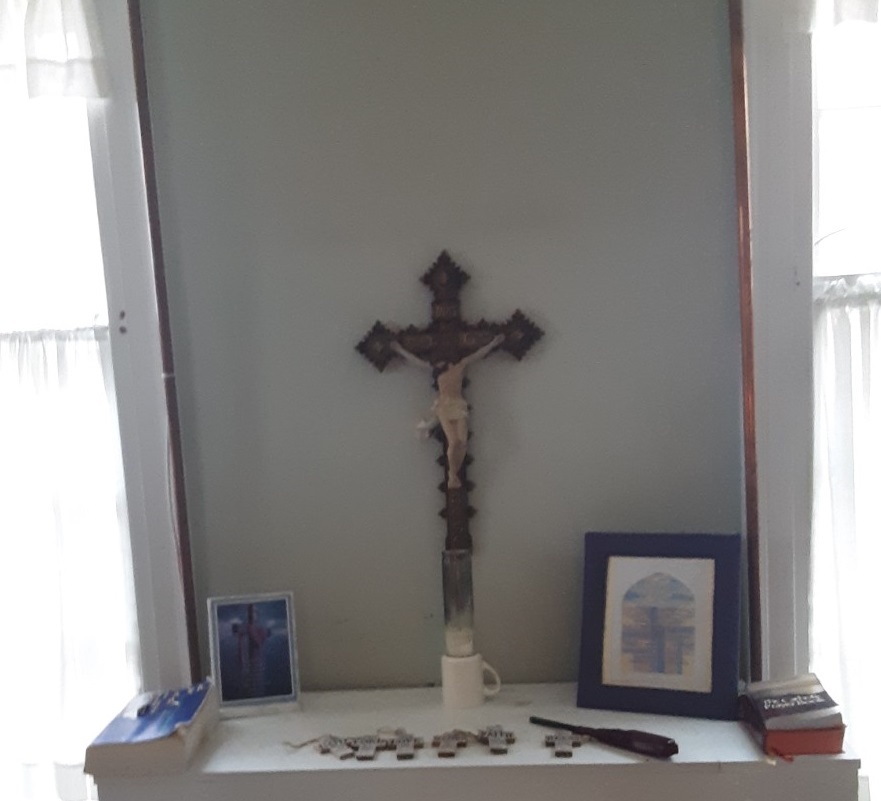
We can also create a physical space in our homes for God.

It doesn’t have to be complicated or big. Above you see my little shrine. There is a Crucifix and a Bible as well as some other spiritual artwork. Often people include statues when making a space for Jesus (if you don’t have religious items already in your home, you can purchase them online). Use images that lead you to Jesus. Sit before it as you pray.

For those who already have a dedicated physical space for Jesus, I encourage you to spend a little time there praying for those who don’t. Pray that our prayers and the witness of our lives help lead all to Jesus.

Peace,

Fr. Jeff

More on Sacrifice

In my most recent blog article, “The Sacrifice of the Mass,” I wrote on how in our celebration of the Eucharist, God makes present for us the sacrifice of Jesus on the Cross. Now, I want to talk about our response to Jesus’ sacrifice.

The Catechism of the Catholic Church states, “It is right to offer sacrifice to God as a sign of adoration and gratitude, supplication and communion” (2099). I emphasize “gratitude” because we should be thankful that Jesus made this sacrifice. We can show our gratitude by offering sacrifice in return.

Of course, our sacrifice cannot equal Jesus’ sacrifice but it does show our gratitude. It isn’t about the external action of our sacrifice. The Catechism of the Catholic Church goes on to say “Outward sacrifice, to be genuine, must be the expression of spiritual sacrifice” (2100). Our sacrifices need to show that our heart is humble and contrite (see Psalm 51:18-19).

We unite our own sacrifices to that of Jesus at the Offertory in Mass. The collection is taken up and the gifts of bread and wine are brought forth. Yet, we should not think of what is being offered at that point in terms of just the bread and wine along with the collection. It is symbolic of what we offer as we give of our time, talent, and treasure as a sacrifice to God.

Paul writes to the Colossians, “Now I rejoice in my sufferings for your sake, and in my flesh I am filling up what is lacking in the afflictions of Christ” (Colossians 1:24). We can offer our sufferings as a sacrifice for the good of others. Yet, how can we fill up what is “lacking in the afflictions of Christ“? In fact, how can anything be “lacking in the afflictions of Christ“?

It’s not that anything is lacking on Christ’s part. All that remains is our response, our willingness to sacrifice in response to Jesus’ love for us. We need to respond with love.

Motivated in love, there are sacrifices that good Christian disciples make often. Think of a parent who makes sacrifices for their children. Think of a parent who drives an old car instead of a new car to use the money to provide for the needs of their children. Think of a parent who gives up their career to raise their children.

Marriage is also meant to involve sacrificial love. The man and woman give themselves completely to each other. As husband and wife they become more concerned for the other than for themselves. In choosing to commit themselves to one person in marriage, they give up being concerned only for their own pleasure. In this way, the marriage covenant of a husband and wife serve as an image of Jesus’ love for his bride, the Church.

People who answer the call to religious life and priesthood sacrifice having a human family of their own to be a sign of Jesus’ total commitment to the world. People who remain single through their entire life can do so in a way that is for the glory of God.

Any worldly thing we give up for the sake of our faith may represent a sacrifice. It might be for our whole lives. It might be a temporary sacrifice.

We are told to stay home right now because of the Coronavirus. If we are only doing it because the government is telling us to, our doing so is just following orders. What is your motivation for staying home?

Are you staying home out of fear, fear that you will get sick? Are you doing just for yourself? When you practice social distancing are you doing just for yourself or for others? Does it make a difference who the other is?

Let me provide a possible example. Prior to the suspension of Masses, our bishop suspended the exchange of the Sign of Peace at Mass and told us not to hold hands or shake hands. This was solely to help prevent the spread of the Coronavirus through good social distancing. I like to stand outside before and after Mass to interact with the people I serve. Part of that interaction is to shake hands with those who choose to do so. As we began social distancing, I stopped shaking hands. I didn’t do this for selfish reasons (not getting sick myself). I made a deliberate effort to do this for the sake of others. I didn’t want to risk shaking hands with one person with the virus and passes the virus onto another unsuspecting person. Did this help protect me? Yes, but my concern was more for others.

Of course, there is another side in the Coronavirus. What about those who have to work and put themselves at risk to care for others? Most obvious here are the health care workers who put themselves at risk to take care of the sick. I think of Jesus’ words in John 15:13, “No one has greater love than this, to lay down one’s life for one’s friends.” The health care workers do this even for strangers. I also think of others who put themselves in public like grocery store employers so that we might have the items we need.

What sacrifices do you make in your life now? What sacrifices have you made in the past? Ask yourself if you give something up because you had to or because you have been loved by God and want to show that love to others? It is when we do it for love of God and our neighbor that it becomes a sacrifice that we offer to God in gratitude for all He has done for us.

Peace,

Fr. Jeff

The Sacrifice of the Mass

In the articles I have written during the Coronavirus crisis, my discussion about the Eucharist has so far focused on the Real Presence of Jesus in the Eucharist. It is his Body and Blood that give us spiritual nourishment.

Now, I would like to talk about the Eucharist as a sacrifice. The notion of the Mass celebrating a sacrifice has often been misunderstood.

The Law of the Old Testament called for sacrifices to be offered (the Book of Leviticus is a central place to find these). The sacrifices entailed the sacrifice of animals officiated by a priest. The people were imperfect. The animals were an earthly sacrifice. The sacrifices were not perfect. Thus, they had to be offered over and over.

Jesus came to offer a new sacrifice once and for all. Once Jesus offers this sacrifice, there is no need of further sacrifices. The sacrifice we are talking about is Jesus sacrificing his life on the Cross for the forgiveness of sins.

Jesus’ sacrifice is perfect because He is perfect. He is the unblemished lamb. We thank God for the sacrifice of Jesus. It reveals how absolute God’s love for us. Jesus is willing to lay down his life for us.

The sacrifice of the Crucifixion on Good Friday. The Institution of the Eucharist happened on Holy Thursday. How do the two relate?

For the answer, we turn to Luke 22:19-20, “Then he took the bread, said the blessing, broke it, and gave it to them, saying, “This is my body, which will be given for you; do this in memory of me.”  And likewise the cup after they had eaten, saying, “This cup is the new covenant in my blood, which will be shed for you.

When Jesus says, “which will be given for you…which will be shed for you,” He is speaking of his body given up for us on the Cross. He is speaking of his blood shed for us on the Cross. Thus, Jesus unites the Eucharist to his sacrifice on the Cross. When we celebrate Mass, we are celebrating the Sacrifice of the Cross. Since it is a sacrifice, a priest is the one who presides, offering the sacrifice.

Two thousand years later we continue to celebrate the Eucharist at Mass. Why? Because Jesus said “Do this in memory of me” (Luke 22:19).

Does that mean we are celebrating a new sacrifice each time we celebrate Mass? No, as I already said, Jesus died once for all, no further sacrifice is needed.

God chose the night of the Passover for the Institution of the Eucharist. This was no coincidence. For the Jews, the Passover was celebrated as a “memorial feast“, a “perpetual institution” (See Exodus 12:1-8, 11-14, first reading for Holy Thursday). It was not a just a historical recalling of the Passover event. It made present the original Passover event.

In the same way, in our celebration of the Eucharist, we do not celebrate a new sacrifice. Rather, God makes present the Sacrifice of the Cross present on our altar. It is difficult to express in human words how this happens. As earthly human beings, we are bound by time. God is not. The Sacrifice of the Cross is not bound to a single day, a historical event and nothing more. It transcends time and place. It is made present for us on every altar in every place and every time the Eucharist is celebrated.

Jesus loves us. He gives his life for us as we celebrate the Eucharist. We place a Crucifix near the altar to remind us of the bond Jesus placed between the Eucharist and the Crucifixion.

This understanding of the Mass as a Sacrifice is why priests continue to celebrate Mass privately even though we cannot gather for public Masses. It is to offer this wonderful Sacrifice not just for the priest but for all God’s people.

Peace,

Fr. Jeff

Our Desire for the Eucharist

When I posted my homily last week, I included a link to an Act of Spiritual Communion and some information about it. It was the first week after Masses were suspended because of the Coronavirus in the Diocese of Rochester where I serve as a priest. We continue to deal with the Coronavirus so this is another week without public Masses. I pray often for the Coronavirus to end. God is listening. God is with us. God who sees what is in your heart will repay you (see gospel for Ash Wednesday, Matthew 6:1-6, 16-18).

Here I include the words of the Act of Spiritual Communion:

Prayer for Spiritual Communion
My Jesus, I believe that You are present in the Most Holy Sacrament.
I love You above all things and I desire to receive You in my soul.
Since I cannot at this moment receive You sacramentally,
come at least spiritually into my heart.
I embrace You as if you were already there
and unite myself wholly to You.
Never permit me to be separated from You. Amen.

I want to offer some reflection on this prayer now as we face this time without the Eucharist. The first line speaks of what is at the heart of our faith, the Eucharist stating our belief that Jesus is present in the Eucharist. The bread and wine become the Body and Blood of Jesus. It is Jesus! This is why we yearn for it. (For more on how it is Jesus himself who tells us that it is his Body and Blood, see my recent presentation on the Eucharist.)

Next, in this prayer, we state that we love Jesus above all else. Our lives can be busy at times but we want to put Jesus first (this isn’t always easy). We desire to receive Jesus. I emphasize “desire” because the “desire” is key here. There are more and more people today who say they are spiritual but not religious. They think it is not necessary to come to church. Do they desire Jesus? I leave them to being between them and Jesus.

There are those who might come to church once in a while. Do they desire Jesus? There are some people who come more out of obligation than desire. Sometimes, that is because the religious education they received was lacking in helping them realize all that God offers us in the Eucharist. They know they long for (i.e. desire) what the Eucharist offers but struggle to understand.

Then, there are those of us who want to be in church every week, maybe everyday because they desire Jesus. Yet, right now people cannot receive Jesus sacramentally, through no fault of their own but because of the Coronavirus. So, in this Act of Spiritual Communion, you ask that Jesus come at least spiritually into your hearts.

Jesus will come in response to your desire. Remember, God sees what is your heart. God knows your desire. In my recent presentation on Baptism and Confirmation, I spoke about what happens to infants who die without Baptism. On slide 31, I offered the following two quotes:

Catechism of the Catholic Church, 1129 “The Church affirms that for believers the sacraments of the New Covenant are necessary for salvation.”

Catechism of the Catholic Church, 1257 “God has bound salvation to the sacrament of Baptism, but he himself is not bound by his sacraments.

The first tells us that the Sacraments are necessary. Our faith still teaches that we should “Keep the Sabbath Holy” and come to church weekly where we can give praise and worship to God as well as receive the Eucharist. If we are ill or snowed in, thus being “prevented” from coming to Mass, there is no sin.

At this time we are prevented (and excused by the bishops) from coming to Mass, not because we are all sick but to prevent us as well as others from contracting the Coronavirus. So, we ask Jesus to come into your hearts spiritually. Here I point to the second quote I just offered above, God, “himself is not bound by his sacraments.” We need the Sacraments. They are the way in which we can be aware of receiving the grace that God offers us. God can, and does, give us that grace whenever we truly desire it.

Before public Masses people were saying to me that they hoped we would be able to keep celebrating Mass. They showed their desire for the Eucharist. Since public Masses have been suspended even more people have said they hope the suspension ends soon. They too have showed their desire. Jesus comes to you in your desire.

Does that mean we don’t have to come to Mass anymore? Are we off the hook for good?

Absolutely not!!!!i

Yes, God gives you the grace if you truly desire to receive the Eucharist but if you truly desire to receive the Eucharist, you will come to receive the Eucharist as so as soon as possible. When the suspension of public Masses is lifted, you will come to Mass right away. That is the evidence of your desire.

Until you are can return to public Masses, do what you can to let God into your hearts. Do what you can to “Keep the Sabbath holy.” Watch Mass on TV or online. Read the Sunday readings, even the daily readings (available online). Give God some of your time in prayer (Prayer Resources).

Show your desire to receive Jesus. Open yourself to him in prayer, make an Act of Spiritual Communion, and Jesus will come into your heart and soul.

Peace,

Fr. Jeff

5th Sunday of Lent, Year A – Homily

A reminder that you can find a list of Masses online at
https://catholiccourier.com/articles/list-of-parishes-with-livestreams-available

5th Sunday of Lent, Year A
Ezekiel 37:12-14
Psalm 130:1-2, 3-4, 5-6, 7-8 (7)
Romans 8:8-11
John 11:1-45
March 29, 2020

Last week we hear the story of Jesus opening the eyes of the man born blind.  This is the sixth of seven signs in the Gospel of John that give testimony to who Jesus really is.  They show the power of God at work in him.

The signs have been building.  Today we hear the story of the seventh and final sign, the raising of Lazarus.

Martha and Mary ‘sent word to Jesus saying, “Master, the one you love is ill.”’  Lazarus is ill.  Jesus heals people.  One would naturally assume that Jesus would go immediately to Lazarus and heal him.  In fact, Jesus has healed others without even being in their presence.

Yet Jesus does not heal Lazarus.  Today we pray for God to bring an immediate end to the Coronavirus.  God has not ended the Coronavirus but that doesn’t mean God isn’t listening.  He is responding as He knows best.  I do not believe God caused the Coronavirus but I do believe He is with us in our hour of need.

So, what did Jesus do when He heard that Lazarus was ill?  His first words were, “This illness is not to end in death, but is for the glory of God.”  Remember last week when Jesus’ disciples asked who sinned, the man born blind or his parents.  Jesus said the man’s blindness was not because of sin but so that the glory of God would be made visible through him. 

Jesus’ words about Lazarus continue this.  Jesus does not immediately go and heal Lazarus.  In fact, He does not go for two days.  By time He departs to go to Lazarus, Lazarus is already dead.  Jesus knows this and tells his disciples, “Lazarus has died.  And I am glad for you that was not there, that you may believe.

Believe what?  Jesus has something incredible to do.  On his way He meets Martha.  Martha’s faith is strong as she says to Jesus, “Lord, if you had been here, my brother would not have died.  But even now I know that whatever you ask of God, God will give you.”  Martha has hope.  Mary will echo these words.

Jesus assures Martha that Lazarus will rise.  He says, “I am the resurrection and the life; whoever believes in me, even if he dies, will live, and everyone who lives and believes in me will never die.” 

When Jesus arrives at Lazarus’ tomb, He calls to Lazarus, “come out!” and Lazarus arises.  From this “many of the Jews who had come to Mary and seen what he had done began to believe in him.” 

So too do we believe in Jesus as “the resurrection and the life.”  But what does it mean to live?  What does it mean to die?

Here, I turn to our first reading from Ezekiel.  The Lord is speaking to those in Exile with Ezekiel in Babylon.  The Lord says, “O my people, I will open your graves and have you rise from them and bring you back to the land of Israel.”

Thus, the Lord speaks of resurrection, the resurrection that all who believe in Jesus will share in after earthly death.  These words in Ezekiel and Jesus’ words about resurrection are important.  They give us hope that earthly death is not the end.

To understand what it means to live and die, there is another level to the words the Lord offered through Ezekiel.  We should not take the word “rise” as simply a reference to the resurrection of the body at the end of time.  Remember, the Lord is speaking to Israelites in Exile.  To them, to be taken from their homes to a foreign land would be like death, death being separation from God.  For us, sin brings separation from God, this separation is spiritual death.

When the Lord uses the word “rise”, He is telling them that He will free them from Exile.  Here, I think of the prayer a priest says when anointing someone, “Through this holy anointing, may the Lord in his love and mercy help you with the grace of the Holy Spirit.  Amen.  May the Lord who frees you from sin save you and raise you up.  Amen.”

This prayer of anointing is not just for the dying but anyone facing a serious illness so “raise you up” is more than just speaking of the resurrection to come.  It speaks of how God will strengthen us in our time of suffering and lift us up. 

God’s words to the Israelites raise them up with hope.  The words for anointing assure one of God’s presence and raises us up in hope.  It gives new life that we may live.

What does it mean to live and die?  We are talking about something far greater than earthly death (that is followed by resurrection to eternal life.)

We are talking about life in the spirit. 

Right now, we might feel trapped by the Coronavirus but we are only trapped in our humanity.  We cannot gather together in church but God is with us, giving us true life.  We are called to abandon the flesh to live in the spirit.  However, when we speak of “flesh” in this sense, we are not speaking of physical flesh.  This sense of flesh speaks of giving into pleasures of the flesh, giving into sin.  Remember, sin is death.

But we are not simply “flesh.”  God offers us life through the spirit. 

Do you find yourself with more free time because of the Coronavirus?  Sometimes we think we are too busy to have time for God.  Here is your chance.  Use the free time to turn your heart to God, to put God first.

The Coronavirus is not the first pandemic the world has faced.  There was the 1918 flu.  Churches closed then but reopened.  There was the Black Plague.  There have been other illnesses.  God has always led his people through it.  God will lead us through this illness too.  There will be suffering.  Jesus knows what it is like to suffer. 

We trust in the Lord and live in the Spirit.