Silence, How Much and When

In the midst of the Coronavirus you may find yourself alone or in small groups of just your family far more often than normal. Does that necessarily mean we have more “silence”?

That depends on what you do with your time and what you mean by silence?

Obviously, if you have the TV, radio, or electronic device playing, then you aren’t having “silence”.

What if you are home alone and have nothing playing? Does that constitute “silence”? That depends on what your mean by “silence”. To explore this I turn to what Nicolas Diat wrote in The Power of Silence, ““Being quiet is a condition for silence, but is not silence.  Silence is a word, silence is a thought” (Sarah, The Power of Silence, 21).

The silence that we are concerned with in prayer is not simply physical sound. “Silence is not an absence.  On the contrary, it is the manifestation of a presence, the most intense of all presences” (Sarah, The Power of Silence, 27). Spiritually, we seek “silence” as a way of finding God and his will for us. Thus, it is not just “silence”. It is sacred silence.

We live in a noisy world. “Our world no longer hears God because it is constantly speaking, at a devastating speed and volume, in order to say nothing” (Sarah, The Power of Silence, 56).

To connect with God, we need to create an environment that makes sacred silence possible. It should be no surprise that, ““It is necessary to leave our interior turmoil in order to find God”  (Sarah, The Power of Silence, 23).

Now, I want to focus on the question of silence at Mass. (If you would like to hear more about silence and seeking God in general, you can find more in my video presentation, The Journey to Jesus.

As I write this we remain under shutdown from the Coronavirus. This means our experience of Mass is different right now. I hope you are able to watch Mass either on TV or online. It’s not the same but it is a true celebration where we can experience God. Are you embracing the experience or are you paying too much attention what is going on around you? Shut the door. Turn over the cell phone. Don’t spend the time talking with someone watching Mass with you. Focus of God and what He offers us.

Whether we are able to attend Mass in person or through TV or online, we can benefit from silence before Mass. We need to take a few minutes before Mass begins to take whatever is on our minds and hand it over to God. Can you get to church a few minutes early to do this? If you are watching Mass at home, can you stop what you are doing a few minutes before Mass begins to let go of distractions and your troubles? Do you really need to get more one thing done before Mass begins?

What about after Mass? How quickly do you leave church? Are you leaving before the priest? Are you on the heels of the priest as the recessional leaves? Do you leave the moment the recessional hymn is finished? Or do you take a quiet moment to say thank you to God for the grace you have received at Mass? (When you watch Mass on TV, how fast do you change the channel? When you watch Mass online, how quickly do you close your browser?)

Of course, there is silence during Mass. Do we appreciate the silence during Mass? Do we understand why we have silence during Mass? I have to admit that while I love silence in my own prayer, I struggle with silence of any length at Mass. It can seem awkward to have silence in groups. When we are with people, we expect to talk.

So, why do we have silence during Mass?

Sometimes we might think the silence is not intended. For instance, as the priest starts the Collect (opening prayer), he says, “Let us pray.” This is followed by silence as an altar server comes to the priest with the Roman Missal (the book with all the prayers for Mass). However, the silence has a purpose that has nothing to do with waiting for the altar server. It is a time for us to collect our thoughts as we seek to pray together. It is not just our own prayer. It is the prayer of our parish community, of the whole church.

The Penitential Rite also involves a short period of silence. The priest says, “Let us acknowledge our sins so as to prepare ourselves to celebrate these sacred mysteries.” We are quiet from spoken words for a moment but in our hearts we are handing our sins over to God. Our venial sins are forgiven. What are your sins that you need God’s help to overcome?

After the Collect (opening prayer) there is silence as the lector moves to the ambo for the readings. There is silence between the readings and the psalm. Again, the silence is not just waiting for the next person to get in position. It is for us to open ourselves to God’s Word and to reflect on what we have heard.

After the homily, there is silence. It is a moment to take to heart what we have heard.

After Communion, there is again silence. During this silence, the priest may be purifying the sacred vessels but, again, the silence is not simply the congregation waiting for the priest and altar servers to clear the altar. It can be a time of sacred silence, reflecting on what we have received. This is true even when you watch Mass on TV or online as you make an Act of Spiritual Communion.

So, I encourage you to take these quiet moments as a moments of “sacred silence”, embracing what God offers us. Embracing the sacred silence can help us to better know God not just in that one moment, but in the whole Mass, in our whole lives.

Peace,

Fr. Jeff
3rd Sunday of Easter, Year A – Homily

3rd Sunday of Easter Year A
Acts 2:14, 22-33
Psalm 16:1-2, 5, 7-8, 9-10, 11 (11a)
1 Peter 1:17-21
Luke 24:13-35

With the gift of the Holy Spirit, Peter spoke boldly to the Israelites.  He spoke of how they saw Jesus’ “mighty deeds, wonders, and signs” that God worked through Jesus in their midst.  Yet, they refused to believe.  Instead they had Jesus killed.  Peter then tells them of Jesus’ Resurrection.

God had chosen to make Jesus known through “mighty deeds, wonders, and signs.”  At other times, God hides his identity as He does when the two disciples encounter Jesus on the road to Emmaus.  As Jesus drew near, “they eyes were prevented from recognizing him.” 

That didn’t prevent the two disciples from conversing with Jesus.  He asks them, “What are you discussing as you walk along?” 

They are surprised He won’t know.  They think He must be the only person in Jerusalem who didn’t know.  They tell him what has happened in a way that I think they are pouring their hearts out to Jesus even though they don’t know it is him.

They speak of Jesus as a “prophet might in deed and word.”  They “were hoping that he would be the one to redeem Israel.”  Yet, “the chief priests and rulers both handed him over” to be crucified.  Now, it is the third day and they have heard “that he was alive.

They were right when they hoped “that he would be the one to redeem Israel.”  They just didn’t know what it would mean for him to redeem Israel.  The Jews focused on the passages that were interpreted to expect a messiah who would defeat the Romans and restore the earthly kingdom of Israel.  That was the redemption they were expecting.

It was not the redemption that Jesus brought.  Yet, everything Jesus did fulfilled the prophecies.  Jesus knew they did not understand this.  So, “beginning with Moses and all the prophets, he interpreted to them what referred to him in all the scriptures.

From this comes our understanding of Jesus as the Messiah.  He was the Suffering Servant in Isaiah.  He fulfilled the psalms that spoke of his  Passion. 

The two disciples eagerly listened to Jesus even though they did not recognize him.  Their hearts were burning with faith as what He said but still they did not recognize him. 

Embracing what Jesus had told them, they invited him to stay with them.  So, they sat down to share a meal together.  There, “he took bread, said the blessing, broke it, and gave it to them.  With that their eyes were opened and they recognized him.

They recalled what Jesus did at the Last Supper.  Now, it all made sense.  They knew who Jesus was. 

2,000 years later, we still celebrate the “breaking of the bread” in the Eucharist.  We know it is Jesus because of his words, “this is my body…this is my blood.”  In this time of the Coronavirus, many long to receive Jesus in the Eucharist.  “Absence makes the heart grow fonder.”

While we cannot gather together to celebrate Mass and sacramentally receive Jesus, we can invoke God as our Father.  As Peter says, if we are to invoke God as our Father, then we must conduct ourselves “with reverence.”

Reverence includes respect.  We need to recognize the sacredness of what we are celebrating and to pay proper respect.  This includes our postures at Mass.  It includes the way we dress.  It includes how much we pay attention.

However, the reverence we should show to God should not be just what we do at Mass.  It should involve the way we live our whole lives.  Do we live as God asks?

Do we follow the “path of life” that God reveals to us?  Do we simply seek the Lord as our “refuge” when times are tough or do we set the Lord always before us?

Are you willing to let God lead you on the path to life?

We have GPS units in our cars.  How many people today will get in their car, enter their destination in their GPS unit and trust it will lead them where they are supposed to go?

Yet, they don’t listen to God.  If we are willing to trust an electronic device to lead us, how come we aren’t willing to trust Jesus?  Jesus paid the ransom for our souls with his own “precious blood.”  He gave his life for us.  We can trust him. 

Our hearts burn with God’s love when we listen to Jesus.

Perspectives on Prayer

During the Coronavirus shutdown I have been reading books that have been sitting on my shelf for a while. This week I read Rev. Evan Pilkington’s Paths to Personal Prayer (Twenty-Third Publications: Mystic, Connecticut. 1988. The edition I read is from the third printing in 1991.)

I got it secondhand someplace over the years – I don’t think it is in print now. Rev. Pilkington was an Anglican priest. The book is short but it is a good read to encourage to think about prayer. What I am going to reflect on here is not a “how-to” on prayer. Rather, the goal is here is to think about what we seek in prayer.

I will offer a quote from the book in italics and then some words of my own for reflection. I encourage you to read Rev. Pilkington’s words and then pause to reflect on how you interpret them before reading my words.

Prayer is spending time with God (9).
I pray in order to express my love of God (9).

Why do you pray? Are you giving a list of intercessions to God? God certainly wants us to express our needs and to pray for others but our prayer should be more than that. Do you ever just spend time with someone you love just to be with them without saying or doing much? In your prayer, do you ever just spend time with God?

I do not pray in order to get something from God. I pray in order to give something to God (11).

There is nothing wrong in asking something from God is prayer. God tells us to ask (Matthew 7:7-11, John 14:13-15). However, the “giving” in prayer should not be one way. What can we give to God? Love! Praise!

I pray in order that I may be open to God (11-12).
I pray in order to cooperate with God (12).

We should not do all the talking in prayer. If we do all the talking, we are not “open to God”. We are not giving God a chance to speak to us to guide us to do what is right, to do what God asks of us. Prayer should be a dialogue. If we want to “cooperate with God,” we need to hear what He has to say.

Prayer is a very strange activity. It is an attempt to communicate with a Being who is not accessible to our ordinary senses (14).
Prayer requires discipline (14).

We are trying to communicate with God. When I say, “we need to hear what He has to say,” we must realize we are not going to hear God speaking words in the same way that we hear other human beings speak. With other human beings we don’t always listen well but at least we know when they are talking because we physically hear the words. God speaks to our heart, not our ears. That’s why “prayer requires discipline.” We need to discipline ourselves to put the focus to God, striving to get past earthly distractions.

Some people like to pray in a church, if possible, because it has a spiritual atmosphere. Some people are helped by having visual aids around – a crucifix, an icon, a picture…Some people are helped by aural aids-listening to a piece of music that lifts the mind and heart to God. Some people are helped by physical aids-touching the beads of a rosary (16).

While we do not experience God specifically through our ordinary senses, the setting in which we pray can make it easier or harder to connect with God in prayer. A Crucifix reminds us of God’s love. Music can calm our soul (be careful, it can also agitate our soul if we pick the wrong music). A Rosary can help us center ourselves in our prayer (see my previous article, ” A Different Kind of Holy Week,” for some guidance on creating a prayer space at home.)

Always begin by getting still. That is vital. You come to your time of prayer with your body all tense and your mind racing (17).

Yep! That’s me! My mind is often racing. I have so much going through my head that sometimes my happiest moments in prayer is when I can let go of the thoughts and embrace the silence. God is in the silence (“Be still and know that I am God” Psalm 46:11). Do I tell God what I need? Do I pray for other people’s needs? Of course I do. I hand these prayers over to God as I strive to hand my concerns over to him, trusting in his merciful love.

Pilkington then discusses prayer as A.C.T.S.
A stands for Adoration. Be conscious of God’s immensity and glory and try to express your wonder, admiration, worship, and praise in words (22).

C stands for Contrition. Be conscious of yourself and the ways you have ignored or rejected God (23).

T stands for Thanksgiving. Be thankful to God (23).

S stands for Supplication. The object of the exercise is not inform God of what you what…The object of the exercise is to put yourself, with all your desires, anxieties, problems, circumstances, duties, pleasures, and pains, into the hands of God (23).

I could write a lot here. Instead, I just invite you to think about which of the four you need to work on.

Lastly, I will mention Rev. Pilkington’s words on spontaneous prayer. Prayer is not something that is confined to formal prayer at set times. Pilkington speaks of praying “before anything you doAnd after you have done it, however it appears to have a gone, a quick “Thank you, Lord, for using me” (35).

If you are looking for information on formal ways to pray, check my website page, “Prayer & Devotions.”

If you would like instructions on specific prayers like the Rosary, Divine Mercy Chaplet, etc. check out St. Luke the Evangelist’s Prayer Resource page as a starting place.

If you would like to hear more about how we look at prayer from me, check out my video presentation, Talking to God: A Conversation About Prayer.

I pray for you to know the presence of God in your prayer and in your whole life.

Peace,

Fr. Jeff

The Sign of Peace

As we began to implement precautions against the Coronavirus before the suspension of public Masses, one of the precautions was to cease exchanging the Sign of Peace. It is ingrained in us to shake hands and to say “peace be with you” (or very similar words). However, it is a wise precaution to stop shaking hands during the current pandemic. So, the exchange of the Sign of Peace was suspended. When the suspension of public Masses is lifted, one might expect that we may still not shake hands for a while.

I would like to take this as an opportunity to reflect on the Sign of Peace, sometimes called the “kiss” or “kiss of peace”. It is a very old custom of the Church. Paragraph 1345 of the Catechism of the Catholic Church cites St. Justin Martyr writing around 155 A.D. “When the prayers are concluded we exchange the kiss.”

In paragraph 82 of the General Instruction of the Roman Missal, we read, “

82. There follows the Rite of Peace, by which the Church entreats peace and unity for herself and for the whole human family, and the faithful express to each other their ecclesial communion and mutual charity before communicating in the Sacrament.

As for the actual sign of peace to be given, the manner is to be established by the Conferences of Bishops in accordance with the culture and customs of the peoples. However, it is appropriate that each person, in a sober manner, offer the sign of peace only to those who are nearest.

In most churches I have been in, the instruction offer to “offer the sign of peace only to those who are nearest” is the practice. We shake hands with the people immediately adjacent to us. (This is the practice where I now serve) However, I have been in a church or two where people begin to move around “some” going beyond those “who are nearest.” I have been in a church or two where they move around the whole church, shaking hands and greeting people with everyone in the church.

It’s the last that leads me to reflect on what the Sign of Peace is supposed to me. First, let us think about where it occurs in the Mass. We have just finished the Eucharistic Prayer. The bread and wine have been transubstantiated into the Body and Blood of Christ. We have just said the Lord’s Prayer. We are about to say/sing the Lamb of God and receive Holy Communion. It is a very sacred moment.

In the midst of that sacred moment, comes the Sign of Peace. Here, I include the entire text from the Roman Missal:

Lord Jesus Christ,
who said to your Apostles:
Peace I leave you, my peace I give you,
look not on our sins,
but on the faith of your Church,
and graciously grant her peace and unity
in accordance with your will.
who live and reign for ever and ever.
Amen.

Priest: The peace of the Lord be with you always.
People: And with your spirit.

Priest/Deacon: Let us offer each the sign of peace.

What are we offering in the sign of peace? Are we wishing people to have a peaceful day without conflict or difficulty? Certainly that should be our prayer for them but is that the whole of what we offer? Certainly, we pray for peace in the sense of no wars or violence but there is something more going on here.

Please note the second text that I bolded and italicized, “The peace of the Lord.” It is the Lord’s peace that we offer. Here I think of John 20:19-31 that we heard this past Sunday where Jesus says three times to his disciples, “Peace be with you.” In my homily on Sunday I spoke about their fear and distress. The peace that Jesus offers is much more than a human peace. It transcends the sufferings and trials of this world to know the God is always with us. It is not peace in the sense of being “happy” and/or “care-free.” It is a peace that comes from making Jesus our cornerstone, making him the center of our lives.

We should also look at the first phrase from the rite that I bolded and italicized, “Peace I leave you, my peace I give you.” These words are not made up by humans. They are Jesus’ own words in John 14:27 where He goes on to say, “Not as the world gives do I give it to you. Do not let your hearts be troubled or afraid.”

This is the peace that we offer in the Sign of Peace. It is not just well-wishing. It is not hello (that comes before and/or after Mass). It is a solemn and sacred peace. Does moving around the whole church express this peace or is it a “disruption” to the sacredness of what goes on at Mass? My experience has been that it disrupts the sacredness of the moment. I believe the practice of offering the Sign of Peace to those who are nearest to us is the proper balance of sharing God’s peace and the sacredness of the moment. It is the best way for us to express to each other our ecclesial communion and mutual charity before communicating in the Sacrament.

Even when the Coronavirus prevents us from physically offering the Sign of Peace, we still pray that all know the Peace of Christ.

Peace,

Fr. Jeff

A Little About This Blog and an Invitation for Feedback

During this time of the Coronavirus I have been posting articles here on the blog every two to three days.  I have very much enjoyed being able to do this.  I started this blog about ten years ago (see “Why a Blog for Renewal of Faith”).  For the first couple of years, I wrote somewhat regularly.  When I became a pastor, I didn’t have as much time to write.  Also, I wasn’t do the presentations I do now.  So, writing on my blog become very sporadic except for the weekly posting of my Sunday homilies.

Generally, I write for the blog out of my passion for evangelization, to help people grow in their faith.  Since the Coronavirus shutdown began, I have been able to write more often to show how our faith can be a source of strength during this time (you can be the judge of how well I have been doing at that).  I also did it as way to support our parishioners when I can’t interact with them directly at Mass and other events.  Of course, honestly, I was able to write more often because I didn’t have so many other things going on.

I say our “parishioners” but that is not entirely correct.  One of the ways people come to my blog is through the parish Facebook page.  Generally, when I post a new article on the blog, I put a post on Facebook to let our Facebook readers know there is something new they can read.    Readership from this can be anywhere from just a couple of people to twenty depending on people’s interest.  I assume most of them are parishioners. 

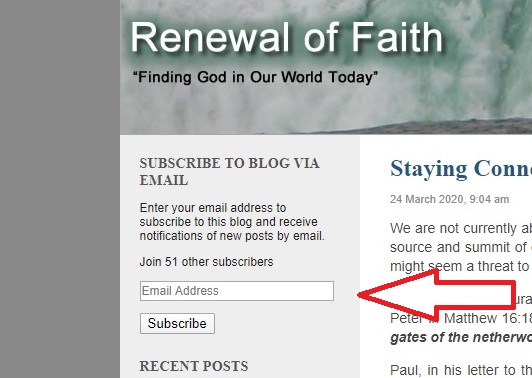
There are also 54 people who are subscribed to the blog.  “Subscribed” means that when I post a new article, they receive it by email without needing to go to the blog itself.  Anyone can sign up to receive the emails in the left side of the screen.  Make sure you click subscribe after entering your email.  Then, you will receive an email asking you to confirm.  (There is an “unsubscribe” option at the bottom of the emails if you no longer want to receive the emails).

A screenshot of a cell phone

Description automatically generated

The 54 subscribers include parishioners of St. Luke’s where I currently serve.  It also includes parishioners of St. Michael’s and Immaculate Conception parishes where I previously served.  Most of the subscribers are Catholic but I know for a fact, there are some that are not.  There are some people that I have no idea who they are (all I see is an email address and how long they have been a subscriber).  I assume they find it through Internet searches.  I also know there is at least one subscriber who forwards the emails onto her friends.  That’s a good way for anyone to help share our faith.  There are also some who share the Facebook posts.

Anyone is welcome to read the blog.  I pray that the Holy Spirit use it to help all to know Jesus with a deeper understanding and appreciation for our Catholic faith.

I imagine most readers of this blog know that I also maintain the website www.renewaloffaith.org.  What is the difference?  The blog tends to be composed of my homilies and articles that are reflective in nature.  The website contains articles and videos of presentations that I spend more time researching before writing or delivering the presentation.  (When I post new material on the website, I generally mention it on the blog, so you know it is there.)

So, why am I telling you all this?

I would welcome input on what you think of the blog articles as well as anything available on the website.  Is what I post helpful?  There are a couple of people who will email me to share comments but I never hear from most of the readers.  There are a couple of people who will post comments to blog articles (you do this by clicking on “comment” at the end of the article).  I am not looking for a lot of comments that just say “nice job.”  I am not looking for a lot of comments here.  From time to time, I just like to know a variety of people find what I write helpful and a little bit of why.

It is my plan to keep writing.  I feel it is an important part of the ministry God calls me to.  I rely on the Holy Spirit for inspiration.  That inspiration is the source of what you read.  Pray that I always listen to the Spirit.  However, when the Coronavirus shutdown ends, that means I will have other things to do.  It would help me make it a priority to keep writing to know that people find benefit from my blog and website.  So, I invite you to take a moment to comment to this post with any suggestions or comments you have.  Always feel free to comment or ask a question on any article.  Please note if you post a comment, it does not appear till I approve it because of spam comments.

Peace,

Fr. Jeff

2nd Sunday of Easter (Divine Mercy) Homily – Year A

2nd Sunday of Easter – Divine Mercy Sunday
Acts 2:42-47
Psalm 118:2-4, 13-15, 22-24 (1)
1 Peter 1:3-9
John 20:19-31

The disciples are in distress.  A lot has happened in the last few days for them.  They had come to believe that Jesus was the long-awaited Messiah.   They thought He would get rid of the Romans. 

Instead, Jesus was arrested and put on trial.  He was beaten, mocked, scourged, and crucified.  This was devastating to them.  They didn’t understand.

Now, now Jesus’ tomb has been found empty.  Yes, Jesus spoke of the Resurrection but the disciples didn’t wholly understand the Resurrection.  So, the empty tomb brought more distress.

What did the disciples do? 

The good news is that they do not scatter and stop believing in Jesus.  They gathered together.  However, they do so behind locked doors “for fear of the Jews.”  They knew were afraid that those who had Jesus crucified would do the same to them.  So, they locked the doors.

There, in the locked room, ‘Jesus came and stood in their midst and said to them, “Peace be with you.”’

Jesus knew their fears.  In his mercy, He came to them to bring peace. 

Today we celebrate the Second Sunday of Easter.  St. Pope John Paul II set this day as Divine Mercy Sunday.  Sometimes we think of God’s mercy solely in terms of his forgiveness.  God’s mercy is more than just forgiveness.  It is his love for us.

In his love for his disciples Jesus came to them offering peace.  He knew they did not understand his Crucifixion and Resurrection.  He shows them “his hands and his side” so they could see the nail marks and where his side was pierced so that the disciples would know that it is him, the same Jesus who was crucified.

Peter writes in the second reading, “our Lord Jesus Christ, who in his great mercy gave us a new birth to a living hope through the Resurrection of Jesus.”  Jesus came to the disciples to do just this, to give the disciples, to give us hope.

There was one disciple who was not there in the locked room, Thomas.  The other disciples tell him what has happened.  He does not believe.  He says he must see and touch Jesus to believe.

Before we rush to judge Thomas for his doubt, put yourselves in his shoes.  Jesus had been crucified.  Thomas didn’t understand that.  No one had ever been resurrected before.  What the disciples tell Thomas would seem impossible.  Could they be sharing in a hallucination?  Thomas had reason to doubt their story (this is not the same as doubting Jesus). 

Jesus knew how Thomas felt.  A week later, Jesus comes again to the disciples in the locked room, again offering them peace.  This time Thomas is with them.

Jesus immediately speaks to Thomas.  He does not judge Thomas.  He does not condemn Thomas for his doubt.  In his mercy, Jesus invites Thomas, “Put your finder here and see my hands and bring your hand and put it into my side.”  Jesus wants to help Thomas believe.

Thomas immediately believes, saying, “My Lord and my God!

In his mercy, Jesus wants everyone to believe in him, not just those who have seen the Risen Jesus for themselves.  “Blessed are those who have not seen and have believed.”

2,000 years later we have not seen the Risen Jesus for ourselves but we do believe.  We know that “His mercy endures forever.” 

This does not mean that life is not without its challenges.  As Peter wrote, “you may have to suffer through various trials, so that the genuineness of your faith, more precious than gold that is perishable even though tested by fire, may prove to be for praise, glory, and honor at the revelation of Jesus Christ.

We face trials in this life.  What’s challenging for one person may not be for another.  We have different trials but we all have some trial.  Do we make Jesus the cornerstone of our lives, is Jesus what we center our lives on so that we have a solid foundation when we face trials?

I spoke earlier of how the disciples were in a locked room “for fear of the Jews.”  Fear can be a powerful motivator.  Fear can be a good thing.  For instance, we learn to fear being burned by fire.  This fear leads us to act in a way to protect us from being burned while still being around fire. 

Right now, “fear” of contracting the Coronavirus can lead us to smart “social distancing.”  God wants us to take care of ourselves.  So, we stay home.  When we need to go out, we practice social distancing. 

However, one might take the fear too far, becoming paralyzed by it.  There is where we need to turn to Jesus for “living hope”.  Jesus who is merciful will give us hope. 

What other fears do you have in your life?  Do your fears motivate you (with the gift of reason that God gives us) to act wisely?  Or do they cripple you? 

Our psalm today (118) speaks of another fear, fearing the Lord.  Sometimes I struggle with the idea of fearing the Lord.  God is all loving.  God is merciful.  I do not fear God as I fear a human being attacking me or fear danger from something like fire. 

God is all powerful.  God could hurt me but I know God does not want to hurt me.  God could punish us harshly.  People do end up in Hell but that is because of their lack of repentance.  God is merciful.

Fearing God’s punishment can be a powerful motivator to get us to stop sinning.  However, there is another way of looking at “fear” when it comes to fearing the Lord.

God is indeed all powerful and all knowing.  God is infinite.  We think of God and see the infinite greatness of God.  This leads us to “awe.”  Our “awe” of God then leads us to proclaim, “My strength and my courage is the LORD, and he has been my savior.”  Thus, God is with us as we face our fears, whatever they may be.

God is always with us.  We might feel like we are stuck behind locked doors at home right now.  Maybe we have a completely different fear that makes us feel locked up and alone. 

We are not alone.  We pray for one another, united in spirit. 

We are not alone.  In his mercy, Jesus comes to each of us who make him our cornerstone and cry out, “My Lord and my God.

Is Society Losing Its Appreciation of Ritual?

In late February through early March, I wrote a series of blog articles on the question, “How do you evangelize a culture that used to be Christian?”. (Here’s a link to the final article in the series that in turn includes links to every article in the series.)

In that series, I discussed some reasons people are turning away from faith. One article in the series, “Answering Those Who Say They Don’t Get Much Out of Mass,” addressed some questions relevant to today’s question, “Is society losing its appreciation of ritual?”.

Sometimes we lose our appreciation of something because we don’t understand its symbolism or purpose. We don’t know why we do it. We don’t see a benefit. Rather than explore its meaning, people choose to stop doing the ritual. Perhaps before we stop doing it, we should put some effort into finding out its symbolism and meaning. Then, perhaps we can understand its purpose and find value in it.

As Catholics we have lots of rituals, including devotions. Our Sacraments are all celebrated with specified rites (rituals). I am a priest but it is not within my authority to change how the Sacraments are celebrated. What I can do, what I have tried to do in my current series of presentations, Sacraments: Channels of God’s Grace, is help people understand and appreciate what the Sacraments mean for us.

We do not celebrate rituals for the sake of the ritual itself. We celebrate ritual to bring us closer to God. That’s why understanding the meaning and symbolism of the ritual is important.

In my article, “Answering Those Who Say They Don’t Get Much Out of Mass,” I mentioned the concept of “feel good” liturgies. By “feel good” I point to a superficial way of feeling that might make us happy in the moment but doesn’t bring us a true and lasting peace. Properly celebrated, rituals are more about helping us have a deep and ongoing relationship with Jesus so that when we face difficulties in our lives, we already know that Jesus is with us.

There are people today who place less emphasis on institution and put more emphasis on personal freedom. For them, the fact that something has been done for generations doesn’t necessarily have any significance. I think this might be a key factor in the loss of appreciation for ritual.

Also, very important here is how many people look at “freedom” today. They think there is no truth and that one should be able to choose to do whatever one wants. We call this “relativism.” In response, please know there is truth, The true “Truth” comes from God (see my presentation, Where Do We Go For Truth?). Secondly, yes we are free to do whatever we want. God gives us “free will.” However, that does not mean we should do whatever we want.

Our actions have consequences. Good actions have good consequences and bad actions have bad consequences. Sometimes we feel the consequences ourselves. Other times, our bad choices create bad consequences for others.

To know the difference we need to have a well-formed conscience (see paragraphs 1776-1802 of the Catechism of the Catholic Church). We also need to have made Jesus the cornerstone of our lives. Ritual helps with this. Ritual helps us let go of this world and connects us to God in prayer.

The above being said, not all rituals are required. The Sacraments are necessary for salvation (see Catechism of the Catholic Church, 1179). However, not all ritual devotions are required. For instance, there are several different chaplet devotions. For instance, there is a chaplet to St. Michael. Not only is this chaplet not required, I suspect many people have never end heard of it. You are free to find out about different ritual devotions. Find what helps you to have not just a superficial relationship with God but a deep relationship with God.

Going back to how I began this article asking, “Is society losing its appreciation of ritual?,” I believe the answer is yes for many people. However, while I have offered some possibilities for why here, I’m not sure what the answer really is. What do you think?

Peace,

Fr. Jeff

The Liturgical Books for Mass

I just created a new video for my website called “The Liturgical Books for Mass.”

It’s about eleven minutes long but it has been a longtime coming. Three years ago I created a seven minute video, “So What’s on the Altar?” that describes the liturgical vessels and linens we use at Mass. It was my intent at that time to create similar videos about the Mass. You can see I am just getting to it.

Why now? Perhaps it is God’s timing. Right now, we continue to not be able to celebrate public Masses because of the Coronavirus. We pray for the day to come soon when we can gather again. For now, we yearn for the Mass and the Eucharist. Perhaps this is a good time for us to learn more about what we do at Mass. Do you take what goes on at Mass for granted or do you understand and appreciate it?

With that in mind, I’ll provide a couple of links to articles I have written in the past on our celebration of the Mass:

Peace,

Fr. Jeff

Answering a Comment About Real Presence Through the Internet

I am writing this blog to provide an extended answer to a question asked in a comment under my most recent blog article, “Whom Are You Looking For?”

In case you haven’t seen the question, I include it here:


My question is are we experiencing the Real Presence when viewing Mass or Adoration online. I had always felt and think I was told that online/tv was at best second class worship. I understand things are different now but the distance issue also creates a unique feeling.

I want to believe we are sharing and experiencing the Real Presence. Why else would our priest and so many other priests be working so hard to share the Eucharist with us?

Change and past thought/teachings are often hard to expel. In addition perpetual adoration online does not have the added beauty of the church and the calm and quiet feeling.

Linda asks a very good question. It manifests her true desire to receive the Eucharist. It is both an easy and a difficult question to answer. Actual physical presence of the person in the church and physically receiving the Eucharist is always what we desire. When one has a choice between coming to church to experience the fullness of the Real Presence but chooses to remain at home, watching online out of convenience or laziness, there may be something lacking in their desire to receive Jesus. I think that is where what you mentioned as “second class worship” comes in. It IS NOT second class on God’s part. It is second class on the person’s part when they could choose to do more but don’t.

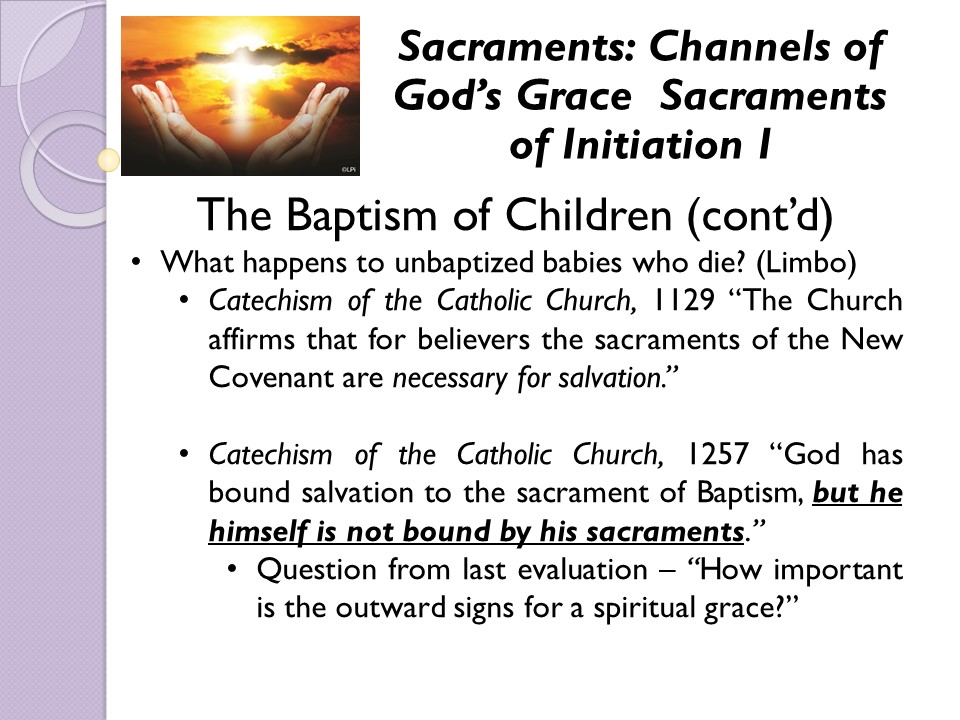
However, when one is not allowed to come to church because of the Coronavirus, other illness, severe weather, or lack of a church within a reasonable distance, one is making their best effort. When we make our best effort, God makes our effort fruitful. Here I include an image from a slide from my presentation on Baptism from my series, Sacraments: Channels of God’s Grace.

This information from the Catechism centers on the question of Baptism for babies who die without Baptism. I think the same is true for the Eucharist. We need the grace of the Eucharist. However, God is not bound by the Sacraments as the only way to give us the Real Presence of Jesus.

When we watch Adoration online, it might not feel the same. It’s not that Jesus isn’t there. First, it can be easier for us to open ourselves to Jesus in our church than sitting in a recliner in our living room. This is not a limitation on God’s end. It is our humanity. Here I reference Linda’s comment, “In addition perpetual adoration online does not have the added beauty of the church and the calm and quiet feeling”

One might think about how when a husband and wife are separated by distance, they can use the Internet to see each other live. However, they do not experience each other in the same way as they can in person.

However, when it comes to experiencing God, God transcends time and space. We cannot bring ourselves to God but God can come to us. God can give us the grace of Spiritual Communion (see explanation of an Act of Spiritual Communion). God can give us the full experience of his grace wherever we area.

So, does one truly share in the Real Presence from watching Mass or Adoration on television or online? In this case, yes. Remember, Jesus becomes present in the bread and wine through transubstantiation because God chooses to make it so.

A different question may be found in Linda’s comment, “I understand things are different now but the distance issue also creates a unique feeling.” The “unique feeling” is because watching online or on TV is not the same as coming in person. That doesn’t mean something is lacking on God’s part. The physical separation is a barrier for us. It is not for God. Again, God transcends time and place.

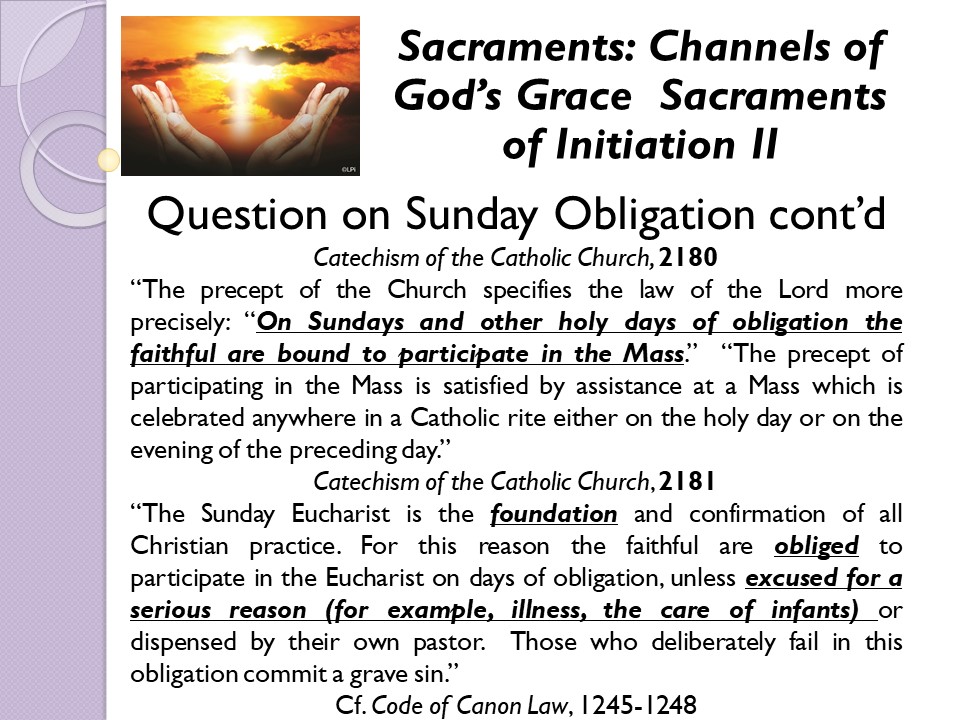
Looking ahead to the day when we can again gather together for Mass and Adoration, then you need to come to receive the fullness of what is offered unless you cannot because of illness or extreme weather. Until then, God gives us the grace you need in “attending” Mass online or on TV. It is not the same but God provides his grace to nourish our souls. Here I end with a slide from my presentation on the Eucharist regarding the Sunday Obligation to attend Mass.

Peace,

Fr. Jeff

Whom Are You Looking For?

The gospel for tomorrow, Tuesday of Holy Week (April 14, 2020), John 20:11-18, is the passage that follows the gospel we heard on Easter morning (John 20:1-9).

On Easter we heard that Mary of Magdala went to Jesus’ tomb “and saw the stone removed from the tomb.” She went to Simon Peter, who, along with the beloved disciple, ran to the tomb and found it empty.

Peter and the other disciple returned home but Mary Magdalene remained at the tomb. In Tuesday’s gospel we hear of her encounter with Jesus at the tomb. She is weeping as Jesus comes to her. She doesn’t understand what has happened. She thinks someone has taken him. She does not recognize him, perhaps in part because she isn’t expecting to see him.

He asked her, “Whom are you looking for? This is the same question Jesus asks as his Passion begins (see Good Friday Gospel) of those who come to have him killed. He freely tells them that He is Jesus the Nazorean whom they are looking for.

Of course, Mary Magdalene is looking for Jesus, actually perhaps it is more accurate to say she is looking for his body for she does not wholly understand the Resurrection yet.

Jesus calls her by name. At that moment she recognizes him, calling him ‘”Rabbouni,” which means Teacher.‘ She knows she has seen the Lord and tells others the good news.

So, “whom are you looking for?“. Since you are reading this, I assume you are looking for Jesus. In looking for Jesus, what are you looking for? Are you looking for one to bring you peace in times of difficulty? Are you looking for someone to keep you company during the Coronavirus shutdown? Are you looking for someone to fix your problems?

Or are you looking for a savior?

Jesus is our Savior (see my recent blog, ” Who is Our Savior?“). Jesus comes to save us. He saves us from our sins when He sacrifices his life for us on the Cross and He raises us in the Resurrection. He raises us in this world when we stop making things of this world our priority and seek God.

In the past I have written about how I think everyone is searching for something, everyone is looking for that which brings them fulfillment. We are created in the image of God. Knowing and loving God is the only thing that can truly fulfill us. We know this. This is why Jesus is the one whom we are looking for.

Unfortunately, a lot of people don’t know this. They look for fulfillment in earthly things. Some of them even deny there is a god, professing to be atheists.

I wonder what they are doing during this Coronavirus pandemic. Are they feeling lonely and isolated? We might all feel a little lonely since we aren’t going out to spend time with family and friends. However, we have Jesus. Who do they have?

Now, we aren’t supposed to force our faith on them. What we can do is be good witnesses. If they see us happier than they are and ask what makes us happy, we can say it is the peace of Christ. If they don’t ask, we can see if the door is open. One way to do this might be to simply tell them we are praying for them as we all deal with the effects of what is going on with the Coronavirus.

From there, if they ask more, tell them what Jesus means to you. Don’t be afraid that they might ask questions you don’t have the answers to. If you are supposed to give them the answer, God will give you the words (see Matthew 10:19 and Mark 13:11). If you aren’t able to answer their questions, point them to good Catholic resources starting with the Bible and the Catechism of the Catholic Church. Point them to this website or other good Catholic websites. You don’t have to save them all by yourself. You are not their Savior. Jesus is. You just need to put them in touch with Jesus.

Peace,

Fr. Jeff