Are All Bibles the Same?

Last week I shared some thoughts on why it is important for us to read the Bible (see “Have You Read From the Bible Lately?”). Today I would like to offer some thoughts about which Bible we use.

Which Bible? Is there more than one? In the sense of the Bible as inspired by God to lead us to be good disciples, of course, there is only one Bible. However, there are many different translations. Even when printing Bibles, publishers may choose to include different materials such as maps and introductions to include. How we select a Bible?

The first question is the language translation. 39 of the 46 books found in the Old Testament were originally written in Hebrew. Remember, Hebrew was the language of the Israelites. The remaining 7 books of the Old Testament were written in Greek, a common language of the time these books were written. The New Testament was written in Greek. If you can read Hebrew or Greek, I encourage you to read the Bible in its original languages.

After Emperor Constantine legalized Christianity with the Edict of Milan circa 313 A.D, Latin (the common language of the Roman Empire) began to be used in Christian writings and the Mass. St. Jerome was largely responsible for assembling a complete Latin translation of both the Old and New Testaments. It was known as the Vulgate and was used for many centuries.

After the Protestant Reformation in the 16th Century (along with the invention of the printing press in 14th century), translations of the Bible into various languages were produced. Perhaps the most common English translation from the reformers that is still in use today is the King James Bible. It was a common translation for Protestants. The common 20th century translation of the Bible for Protestants that I am aware of is the New International Version.

In the United States, the New American Bible Revised Edition (NABRE) is the official translation produced by the United States Conference of Catholic Bishops. It is the translation used for the Lectionary from which our readings at Mass are taken. I like it for that reason as well as its inclusion of footnotes, cross-references, and introductions to each book of the Bible (I will talk about these shortly).

Another common Catholic translation into English in North America is the Revised Standard Version (RSV) or the New Revised Standard Version (NRSV). If you look at the RSV or the NRSV translation, please be sure you are have a Catholic version as there are Protestant versions (you can find these as well as many other translations on www.biblegateway.com).

What’s the difference between the Catholic and Protestant translations? There are some minor differences in some books such as the Book of Daniel and how the 150 psalms are numbered. The most significant difference lies in what I mentioned above regarding the Old Testament books written in Hebrew and Greek. As Christianity formed and grew, the Septuagint was the common version of the Hebrew Scriptures (what we call the New Testament) in use. Thus, it was the version used by Christians. It was written in Greek. Thus, it included all 46 books. The Protestant Reformers chose to use only the 39 books of the Old Testament written in Hebrew. They did not recognize the 7 books (1 & 2 Maccabees, Judith, Tobit, Baruch, Sirach, and the Wisdom of Solomon) as inspired by God. Thus, they do not include them in the Bible (some publishers do include them in an appendix).

So how does one know what is a good translation? For Catholics in the United States I recommend the NABRE I mentioned above. For Catholics you can also look for a nihil obstat and/or imprimatur that show the content has been reviewed and is in keeping with the Catholic faith. These are normally found on the same page as the copyright information.

Other translations might include some notes showing they have been approved by a national committee of a church or similar body. Does it really matter? Anyone can translate a Bible to suit their needs and personal beliefs. In choosing to use an official translation, one seeks to keep to a common understanding through the Holy Spirit rather than the personal beliefs of a specific translator.

In choosing a Bible, I recommend Bibles that include footnotes and cross-references between bible passages, as well as an introduction to each book of the Bible to help you understand God’s Word. The NABRE Bible includes all these. I encourage you to use a Bible where the publisher also includes maps of the regions mentioned in the Bible (the St. Joseph Edition of the NABRE does this).

Biblical footnotes are standard type footnotes providing explanation and context. Introductions to each book help provide the setting (time, place, struggles and successes of the time).

The cross-references I refer to help us connect different verses in the Bible, such as Old Testament passages that lead to something in the New Testament or where the same stories are told in different parts of the Bible. One example of this can be the four Suffering Servant passages in the Book of Isaiah that are some of our first readings during Holy Week that prophesized the sufferings Jesus endured in his Passion.

In the NABRE, cross-references are noted by a superscript letter in the body of the Bible passage. At the bottom of the page, you will find the same letter followed by the related Bible verse citations.

Such cross-references are important to help use understand the value of both the Old Testament and the New Testament. Both are important. We need both to best understand our faith. The New Testament does not supersede the Old Testament. The use of the labels “new” and “old” merely signify which was written first. With that in mind, I will end today with the following quote from the Catechism of the Catholic Church:

“Christians therefore read the Old Testament in the light of Christ crucified and risen. Such typological reading discloses the inexhaustible content of the Old Testament; but it must not make us forget that the Old Testament retains its own intrinsic value as Revelation reaffirmed by our Lord himself.  Besides, the New Testament has to be read in the light of the Old. Early Christian catechesis made constant use of the Old Testament.  As an old saying put it, the New Testament lies hidden in the Old and the Old Testament is unveiled in the New ” (129).

Peace,

Fr. Jeff
5th Sunday of Easter, Year A

5th Sunday of Easter, Year A
Acts 6:1-7
Psalm 33:1-2, 4-5, 18-19 (22)
1 Peter 2:4-9
John 14:1-12
May 10, 2020

Today’s gospel is a familiar one to many, at least the first half.  The first six verses are often chosen as the gospel reading at funerals.  In that setting, our hearts are troubled because we have lost a loved one.  At a funeral, Jesus’ words, “that I am going to prepare a place for you,” are words of great comfort, assuring us that Jesus has a place in Heaven for all who believe in him as “the way and the truth and the life.”

Of course, the death of a loved one is not the only thing that might cause our hearts to be troubled.

Our hearts might be troubled by a broken relationship.

Our hearts might be troubled because of a serious illness, the loss of a job, or uncertainty in the future.  We might face the suffering ourselves or it might be a loved one who is suffering.  Either way, we embrace Jesus’ words, “Do not let your hearts be troubled.  You have faith in God; have faith also in me.

Sometimes we feel like we face our troubles alone yet we know God is always with us.  Sometimes we face our troubles together like with the Coronavirus.  We don’t all face identical troubles because of the Coronavirus but we know that we are not alone.

After Pentecost the early church “continued to grow.”  Unfortunately, the long-term trend right now is that we are a shrinking church.  Fewer and fewer people come to church.

We might all be wondering what attendance will be like after we reopen.  It doesn’t necessarily have to shrink.  There are those who faith is being made stronger (https://catholiccourier.com/articles/polls-show-faith-is-getting-americans-through-the-coronavirus-crisis?fbclid=IwAR3GbA4jgxb8rP4GFrTZf7tcXvSp_lj78InpvM8sk5uK0XQ28EqPmvSr2Tk).  There are also those who hadn’t been coming to church who are watching Mass now.  We welcome them back.

The Coronavirus is a struggle that causes us trouble.  We cannot gather as we would like.  We cannot serve one another as we would like.  Collections are affected (thank you to those who have continued to give and we pray for those who are out of work and can’t give). 

Yet the Coronavirus might lead to more ministry.  With your faith made stronger, you might look for a new way to help.  For example, you might think about how you feel trapped at home and use that as motivation going forward to care for those who are permanently homebound.

There are various ways to minister.  We don’t all need to do the exact same things.  The Twelve were devoted “to the ministry of the word.”  When there were problems with the “daily distribution”, they didn’t try to take care of it by themselves.  They appointed seven others to this task.

It isn’t the job of priests to do everything.  It isn’t for the parish staff to do everything.  We all need to work together to build up the Kingdom of God.

We might feel down right now but think of the good things that the Lord has done for us, and “give thanks to the Lord” with an “attitude of gratitude”.

Yes, things may be tough right now.  People are turning to Jesus who is “a living stone, rejected by human beings but chosen and precious in the sight of God.” 

Do we make Jesus our cornerstone?

Do we, as Peter writes, “let yourselves be built into a spiritual house”?

Sometimes we think we need to fix all our problems ourselves.  In doing so, we try to build ourselves into what we want to be.  How does “what we want to be” correspond to the Lord’s Prayer where we say “thy will be done”?

So, instead of building ourselves into what we want to be, we need to allow God to build us into what He wants us to be.

We need to put effort into this.  The effort begins with knowing God so that we come to know what He wants us to do.  Our effort needs to include prayer to allow us to discern what God calls us to do individually and as a church that spans the world.

Jesus is “the way and truth and the life.  He shows us the way.  He shows us the Father.  The Father and the Son send us the Holy Spirit to guide and strengthen us.

God has a plan. 

I do not believe God caused the Coronavirus but He does have a plan to get us through it and what to do after the virus.

I end with the words of Peter from the end of today’s second reading, “You are “a chosen race, a royal priesthood, a holy nation, a people of his own, so that you may announce the praises” of him who called you out of darkness into his wonderful light.

Have You Read From the Bible Lately?

As we find ourselves in isolation from the Coronavirus, how are you doing with your faith? Are you struggling? That’s understandable since we can’t gather together for the Eucharist.

Some are finding their faith stronger (see article – “Polls Show Faith is Getting Americans Through the Coronavirus”).

As we look for ways to strengthen our faith, my topic today is reading the Bible. Are you reading it? It’s an important book. The letters “bible” can be an acronym for “basic information before leaving Earth.” By “basic”, we mean information that we need to have if we wish to enter into eternal life.

In this blog article (and likely others to follow), I am not going to offer a “course” on the Bible. If you want that, you can watch my presentation, Navigating the Bible, that I did three years ago (run time 1 hour 22 minutes). You can also read my article “The Bible”.

Today I want to focus on why we should read the Bible. I already said it is an important book. It has information like the Commandments that we need to know.

It also tells us about many people. It tells the stories of their lives but it is not just their story. It also tells us about God. It is not just God’s story. While it tells stories of various historical stories, it is not written to be a history book.

What is the Bible then? Together all the parts of the Bible tell us the story of Salvation History.

As salvation history, it tells the story of God’s relationship with his people. In the stories of creation in the first two chapters of the Book of Genesis, there are two stories of creation. They are not written to provide a scientific explanation of creation. These stories are written by human authors inspired by God to provide meaning for us.

The story of the Exodus tells not just how the Israelites were set from slavery in Egypt but to speak of how God hears his people’s cry. The laments of the people in the desert for food and water remind us how we don’t always trust in God in the way we should.

This brings us to a very important point. The stories of the Bible include stories about many different people. However, it is not just their story. It is our story.

We are all children of God. The Bible tells how God has cared for his people throughout the ages. God did not create and walk away. Even when the people sinned, God was always with them, with us. When things became difficult, often because of their sins or lack of trust in God, God was there but He didn’t always rescue them immediately. He allowed them to suffer so that they might learn from it.

It is the same with us. God is always with us. He knows our struggles. God uses our struggles to make us better disciples. This is the story of Salvation History.

I expect to write more on the Bible in coming days (let me know what questions you might have). For now, I simply encourage you to read the Bible. If you are not sure where to start, I suggest spending a few minutes each day with the daily readings for Mass. They can be found online at http://www.usccb.org/bible/index.cfm.

Peace,

Fr. Jeff

The Final Video in My Series on the Sacraments

Last night was the final presentation in my series, Sacraments: Channels of God’s Grace, We covered the Sacraments of Service, Marriage and Holy Orders.

We are still under the Coronavirus shutdown so there was no in-person presentation. Instead, we did as a live webinar on Zoom. I am grateful that all went well for the first time I hosted a webinar myself.

Here is the link to the video and slides – www.renewaloffaith.org/sacramentsservice.

Peace,

Fr. Jeff

Cafeteria Catholic? Not!

You may have heard the term “Cafeteria Catholic” (Protestants would say Cafeteria Christian) and wondered what it means.

We go to a restaurant and order what we want. If we don’t like something, we don’t have it. The strongest example of this might be a buffet. You can pick and choose everything you eat. It’s great for that one meal in terms of personal satisfaction but is it good for our long term health?

That would depend on what you choose to eat. Do you pick a balanced meal? Certainly, only eating cake is not healthy. Would you only eat meat, say chicken wings? Would you pick any vegetables? Fruit? If we want to live a long and healthy life, we need to make good choices about the food we eat.

So what’s a Cafeteria Catholic? Our faith offers many teachings. Do we embrace all of them or just the teachings we like? Yes, some teachings are harder to understand and accept.

Here I think of the Bread of Life Discourse in chapter 6 of the Gospel of John. Jesus tells his disciples, “I am the Bread of Life” and that we must eat his body and drink his blood. Many find this difficult. In John 6:66-71, we hear that many disciples left Jesus because his teaching was teaching to understand. Jesus asked the Twelve if they wanted to leave also. Peter responded, “Master, to whom shall we go? You have the words of eternal life.  We have come to believe and are convinced that you are the Holy One of God” (John 6:68-69). We may not always understand but we can believe. After all, the word “faith” means to believe in what cannot be proven.

We can believe Jesus. We can trust him. Why? Remember the words of Matthew 7:28-29, “When Jesus finished these words, the crowds were astonished at his teaching, for he taught them as one having authority, and not as their scribes.” Jesus has authority from God. How do we know we can trust him?

Because He was willing to die for us on the Cross. “No one has greater love than this, to lay down one’s life for one’s friends” (John 15:13).

When they pick and choose what they believe, some say the Bible is outdated. If that is true, would it mean that God’s offer of salvation through Jesus’ Crucifixion and Resurrection is outdated? Is salvation no longer possible?

Absolutely not! Jesus’ sacrifice on the Cross is still valid. God is still willing to forgive us if we repent and seek to follow his teachings.

We hear many different voices telling us different things about right and wrong. Some of those voices, the relativists, even say there is no “truth,” that there is no universal right and wrong. One might rely on psychology to justify their behavior. Others might rely on biology to explain their preferences.

Some separate moral behavior from faith. They profess a faith in God spiritually but see no relationship with God and moral behavior. (See my article, “God’s Commandments” or my video presentation, Are They Rules or a Way of Life? for more on how the Commandments are good for us.)

We need to rely on experts for guidance in living good lives but with many different opinions, where do we go for truth? (see my video presentation Where Do We Go for Truth)?

Of course, the answer when we want Truth, Truth with a capital “T”, is that God is the one we go to. God’s Truth is not a burden. In fact, God’s “truth will set you free” (John 8:32).

We have a conscious. In paragraph 1782, the Catechism of the Catholic Church says we must be free to follow our conscious. Paragraphs 1783-1785 go on to speak of having a well-formed conscious. Have we studied church teaching? Have we sought out how God calls us to live?

Jesus is “the way and the truth and the life” (John 14:6). Jesus is the gate (John 10:1-10).

In the Lord’s Prayer, we pray “thy will be done.” Do we mean it? Are we willing to make what has been called by some, a “genuflection of the will”? Are we willing to set aside human will and desire to submit to the Father’s Will?

As I mentioned in my homily this Sunday, during our current Coronavirus shutdown, some people are finding their faith stronger. There are others who haven’t been to church in a while who are watching Mass now. The Coronavirus is leading us to realize that, in our humanity, we do not have all the answers. So, we turn to the one who does have all the answers, God.

It is not always easy to believe, especially when we don’t understand. Yet, knowing how much God loves us, we can count on him to lead us to the Truth. In faith, we believe. We believe all that God teaches us.

Let us conclude with an old traditional prayer known as an Act of Faith (taken from USCCB – http://www.usccb.org/prayer-and-worship/prayers-and-devotions/prayers/acts-of-faith-hope-and-love.cfm)

O my God, I firmly believe
that you are one God in three divine Persons,
Father, Son, and Holy Spirit.
I believe that your divine Son became man
and died for our sins and that he will come
to judge the living and the dead.
I believe these and all the truths
which the Holy Catholic Church teaches
because you have revealed them
who are eternal truth and wisdom,
who can neither deceive nor be deceived.
In this faith I intend to live and die.
Amen.

Peace,

Fr. Jeff

Look Beyond and Finding Meaning

As Catholics we have many rites for how we do things. For instance, we have specific rubrics as to how we celebrate Mass (see “The Roman Catholic Mass Explained”). We have particular rites for every Sacrament. It is important for us to know how we do our rites. The same is true for devotions like the Rosary and the Divine Mercy Chaplet. Some of what you will find on this blog and my website, www.renewaloffaith.org, is composed to help you know what we do and how.

It is also important that we don’t just learn what we do. We also need to understand why we do the rites. The “why” is what I try to bring alive on my blog, website, and in my presentations about Mass, Sacraments, and rites. As part of this, we also need to occasionally take a step back and reflect on some of the basic things we do so we don’t just take them for granted. Here, I think of the recent short videos, “A Tour of the Church” and “The Liturgical Books for Mass” that I did. I know of some lifelong Catholics who found them helpful to reflect on what we do and not take them for granted.

These videos show items we use at Mass. I also think of the things we do at Mass with some of my recent blog articles like, “The Sign of Peace” and “Silence, How Much and When.”

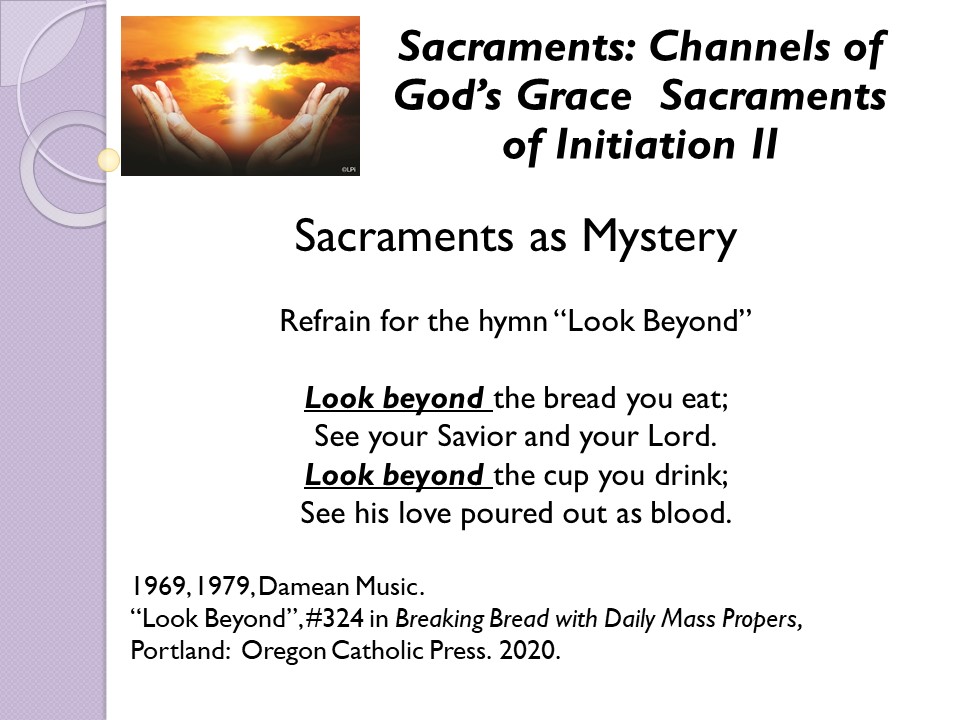
There are many things we do as Catholics. If we look at them only on a physical level, we miss the mystery. There are those who think science has all the answers. They are wrong. We need to value the physical but to look beyond it. If all we see on the altar is bread and wine, we miss the “Source and Summit of our faith (Lumen Gentium, 11). We miss the mystery (for more on mystery and what the bread and wine become see my presentation, Sacraments: Channels of God’s Grace – Initiation II).

By looking beyond the physical items we use at Mass, by looking beyond the things we do at Mass to find meaning, we become more active participants in what it is we celebrate. I hope it brings the Mass alive for you.

With this in mind, I would now like to take a moment to look at the Offertory at Mass. Some people think of the “Offertory” as the collection taken up at Mass so that the parish can pay its bills.

The Offertory does include the collection but it is more than the collection. Yes, we take up a collection but what is brought forward is more than just money. The bread and wine that will become the Body and Blood of Christ are brought forth. Over the bread, the priest will say (note music may be played at this point so you may not hear these words as the priest holds up the paten with the bread on it):
“Blessed are you, Lord God of all creation
for through your goodness we have received
the bread we offer you:
fruit of the earth and work of human hands,
it will become for us the bread of life.”

Similar words are said then said over the wine. We must first realize we only have bread and wine to offer because God, in his goodness, has given them to us. Yet, the “work of human hands” was also involved in taking what God has given us in creation, the soil, the seed, the water to grow the seed into what becomes bread and wine. We thank God, we bless God for what He has given us.

Likewise, the money contributed by the parishioners is not simply money. The people made that money from the gifts that God has given them to do good work.

Looking beyond the money, the collection is not simply about giving money. Rather, the money makes it possible for us, us being the Church, to fulfill the mission that Jesus has given us to proclaim his gospel.

We should also realize that what we contribute in the offertory is not just the money we give. It is everything we offer in sacrifice (see previous article “More on Sacrifice”) when we contribute our time, talent, and treasure for the building up of God’s Kingdom.

Just as the Sign of Peace is much more than just wishing the people around us well; just as silence at Mass is much more than just waiting for the next thing to happen, so too is the Offertory much more than just giving money.

Peace,

Fr. Jeff

Fourth Sunday of Easter, Year A – Homily

4th Sunday of Easter, Year A
Acts 2:14a, 36-41
Psalm 23:1-3a, 3b-4, 5, 6, (1)
1 Peter 2:20b-25
John 10:1-10
May 3, 2020

Today is the Fourth Sunday of Easter.  Every year on the Fourth Sunday of Easter we read from the Good Shepherd discourse in chapter 10 of John’s Gospel.  Thus, today is also called Good Shepherd Sunday.

In the portion of the discourse that we hear today, Jesus speaks of the relationship between the sheep and the shepherd. 

Jesus speaks of those who, instead of entering through the gate, try to enter the sheepfold by climbing over elsewhere.  He describes them as thieves and robbers.

Think of the sheepfold as Heaven.  Jesus is the gate.  He is the way we need to follow if we wish to enter eternal life in Heaven.  However, today there are people who think everyone gets into Heaven.  They think they can live however they want and still get into Heaven.  Perhaps they are the thieves and robbers Jesus speaks of.

The shepherd knows his sheep.  He knows their names.  Jesus knows each and every one of us by name and He seeks to lead us to be who God calls us to be.

Jesus says that the sheep recognize the voice of their shepherd and follow only him.  They will not follow a stranger.

Today, we hear many voices telling us many different things.  It is important for us to know which voice is God’s.  Otherwise, we might get overwhelmed by all the different voices or we follow the wrong voice without even realizing it.

What does it take to recognize God’s voice?

We need an ongoing relationship with Jesus.  We need to pray regularly so that God is not a stranger to us.  In prayer we learn to recognize God’s voice.

With the Coronavirus shutdown, I suspect a lot of people are praying more often.  I saw a survey Friday that said 27% of Catholics say their faith is stronger now than before the virus.  I would even say right now there are people praying who haven’t prayed or been to church in a long time.  This is the silver lining of the cloud (Coronavirus) that we live under right now. 

Perhaps some of you watching this Mass are among them.  Are you praying more?  Has the Coronavirus brought you back to church?  We are thankful that you have joined us today.  We long for the day when we can gather in person.

Of course, praying does not bring the instant fix we would like.  We need to be patient.  We need to trust in Jesus as our shepherd.

Probably the most well-known Psalm is Psalm 23.  The response today is very familiar to many, “The Lord is my shepherd, there is nothing I shall want.”   

Nothing I shall want….

Really?  I can think of something I want, something that I think we all want, an end to the Coronavirus.  It will come.  We need to be patient.

What does this say about Psalm 23 saying, “I shall not want”?

This does not mean that we get everything we want.

God gives us everything we need.  He gives us repose.  He refreshes our souls.  He guides us in right paths.

When we listen to God, when we pray, when we have an ongoing relationship with God, He guides us in right paths.  It’s not that He gives us everything we want.  When we listen to God, we learn what is most important and we come to not want unnecessary stuff.

Of course, we still need to pray for an end to the Coronavirus.  It will come.  However, with God as our shepherd, we “fear no evil.” 

This is not an easy time.  We might feel like we are suffering when we have done nothing wrong.  Here Peter says, “If you are patient when you suffer for doing what is good, this is a grace before God.” 

Remember, Jesus was without sin, but He was willing to suffer for our sins.  It was not easy for him.  Think of his Agony in the Garden.  He prayed for the cup to pass but then surrendered to the Father’s Will.  The Coronavirus is not caused by God but He is present with us through it. 

Returning to the relationship with God as our shepherd and we are his sheep, have we gone astray?  Certainly, well before there was the Coronavirus, many were going astray. 

How do we get back on track?  We repent.  We seek forgiveness.  We ask the Lord to guide us in right paths.

At the beginning, I said today is the Fourth Sunday of Easter. It is also known as Good Shepherd Sunday. 

It is also a World Day of Prayer for Vocations.  For many, the word “vocations” means priesthood and religious life.  These certainly are vocations from God.  Please pray for our clergy and religious.  Pray that more people respond to the call.

However, vocations include more than just ordained and religious life.  God calls everyone to use the gifts He has given them to work for the building up of the Kingdom of God.

Do you ask God to guide you as you make life choices?  Do you pray about being married?  Do you pray about having children and how to be a good Christian parent?  Do you pray about how you might help others? 

Remember Jesus’ words, “I am the gate.   Whoever enters through me will be saved….I came so that they might have life and have it more abundantly.

The Right Atmosphere

Earlier this week I wrote a blog article, “Silence, How Much and When” where I talked about silence in private prayer as well as silence at Mass.

Now, I would like to discuss how silence at Mass needs to be balanced against other considerations. Specifically, today I am writing about silence before Mass.

I like to pray before Mass begins. It helps me center myself and to hand over my struggles to God. It can be hard to do this when there is a lot of noise from others talking in the church. I arrive at church early when no one else is there so I am able to pray in silence. However, not everyone can get there that earlier.

I also like to greet people before Mass. I believe it is important to greet people to provide a “welcoming atmosphere.” It is this “welcoming atmosphere” that we need to balance against “sacred silence.” A good balance of the two creates “the right atmosphere.”

The main way I try to work on the balance is by greeting people in the entry way or outside. That way, it isn’t disturbing people praying in the pews. Does that mean we don’t greet people in the pews before Mass? No, but we need to think about what and how much we say in the pews.

I think it can be appropriate to say hello to people next to us in the pews. It is polite and welcoming. Beyond saying hello, we might think about the content we are talking about. Are we expressing sympathy to someone whose loved one just died? That is Christian. Or are we talking about a party or sporting event? Is just before Mass the best time for that? Maybe you do need to confirm a date and a time but how long do you need to talk about it? Are we talking about Jesus or are we catching up on the latest gossip?

The right conversation before Mass can be part of being a good Christian. If you know it is going to take a while maybe you can find a place to do it where you aren’t disturbing others who are praying. Here, I wish more churches had large gathering areas for welcoming before and after Mass. Or how about people socializing after Mass?

Some people reading this might hope that I would say we shouldn’t talk in the pews before Mass. On the other side, some people will say the conversations they have before Mass is what they enjoy about the parish community. There are arguments both ways. I am not going to provide a black and white answer as I am not sure there is one definitive answer. What I do want to do is ask you to think about how much you do or don’t talk before Mass. God has given you the gift of reason. Please use that gift to think about what you do. There is a parallel here to what I wrote about last week in “The Sign of Peace”. We need to think about what we do and why. How best do we build up our parish communities?

I will end with a thought I have heard as one possibility, “Talk to Jesus before Mass. Talk to your friends after Mass.”

Peace,

Fr. Jeff

Forgiveness Can Be Hard

The Coronavirus shutdown continues. Some states are beginning to lift restrictions. New York State, where I live, continues under shutdown. We are now around the six week mark. Of course, the challenges caused by the pandemic started before we actually shutdown. We had started social distancing and the shelves in the grocery stores went bare (I still wonder where all the toilet paper is).

With so much cancelled, we find ourselves stuck home and without much to do. (I hope you have used some of the time to work on your relationship with God and pray more).

Thus, our patience might be tried. Perhaps we find ourselves getting “frustrated” with the people we live with. We need to forgive them. Or maybe we are the ones who need to be forgiven. Forgiveness is not always easy.

Maybe you get “frustrated” when you encounter empty shelves at the grocery store. Where has all the stuff gone? If the frustration gets to you, remember to forgive, to let go.

With a lot of time on our hands, perhaps you have been thinking of your own sins and how you need forgiveness from others and God. The good news is God is eager to forgive. He is the father who can’t wait to forgive the prodigal son (Luke 15:11-32). Are you the wayward son who needs to be forgiven? Are you the father who is eager to forgive? Or are you like the older brother who doesn’t want to forgive?

A couple of years ago I did a presentation called, Why Is It So Hard to Forgive Myself (and others)? (available on video here). In this presentation, I talked about various reasons we might struggle to forgive ourselves and to believe that God wants to and does forgive us. The reasons can be the same for why we struggle to forgive others. In the presentation, I go so far as to say sometimes it is easier for God to forgive us than it is for us to forgive ourselves. We must realize that God’s forgiveness is a gift that He chooses to give us.

In the presentation, I also talk about “what forgiveness is not”. Sometimes, our struggle to forgive is because we equate “forgiveness” with “forgetting”. While there is overlap, they are not the same. The one thing I would like to add today to what is included in the presentation is something I heard more recently on how we know we have forgiven someone.

I forget the source but they listed three things required for forgiveness.
1. We wish good for them.
2. Be willing to be polite to them.
3. Be willing to and actually do pray for them.

No grudges. We might not want to be around them but when we are, we are polite. We pray for them. What do we pray for? Our goal in praying for them should not be that we are proven right. We pray that everyone involved realize the error of our ways and turn our hearts to God. We pray for them to turn their lives over to God. If that brings reconciliation between us, that is wonderful. Above all, we pray for God’s Will to be done.

Forgiveness is not easy. However, it is necessary. It is necessary not just for the one who needs the forgiveness. It is necessary for the one who has been wronged to let go of the hurt.

Peace,

Fr. Jeff

New Video – A Tour of the Church

I just finished making a 20 minute video giving a tour of the church. We may know what the names of items in the church are but how often do we think about why we have them in church.

Together with my previous videos, “So What’s on the Altar?” and “The Liturgical Books for Mass” I think we have covered all the common items in church.

Peace,

Fr. Jeff