Pentecost, Year A – Homily

Pentecost, Year A
Acts 2:1-11
Psalm 104:1, 24, 29-30, 31, 34 (30)
1 Corinthians 12:3b-7, 12-13
John 20:19-23
May 31, 2020

In the Old Testament we hear of God.  He is called by different titles but He is generally understood in the sense of “one person.”  Then comes Jesus.  Now, at Pentecost, comes the Holy Spirit.

In today’s gospel we hear about all three persons in the span of five verses.  Jesus comes and stands in the midst of the disciples and speaks of the Father who sent him.  Jesus does not act on his own.  What He does is the will of the Father.  Then Jesus “breathed on them said to them, “Receive the Holy Spirit.””  The Holy Spirit proceeds from the Father and the Son.

Faith is a gift.  As Paul says, “No one can say, “Jesus is Lord” except by the Holy Spirit.”  It is our choice whether or not to accept faith through the Holy Spirit but it begins with God offering us the gift of faith.

We need faith, we need the Holy Spirit to truly live as we are meant to live for as the psalm says, “If you take away their breath, they perish.”  For Pentecost, we have a special sequence before the gospel.  In it we hear, “Where you are not, we have naught.  Nothing good in deed or thought.”  It is God who breathes life into us through the Holy Spirit. 

We need the Holy Spirit to help “Bend the stubborn heart and will” (sequence).  We hear that and we might think of others who we think are being stubborn.  What about ourselves?  We need to let the Holy Spirit into us to “renew the face of the earth.

God creates.  Humans sin.  Jesus comes to forgive to restore what was meant to be.  Then, we are created anew with the Holy Spirit.

Jesus came to the disciples behind locked doors.  The Holy Spirit comes to us wherever we are at. 

The Holy Spirit came at Pentecost as a “strong driving wind…as tongues of fire.”  Through the Holy Spirit the disciples spoke in many tongues.  The Holy Spirit bridges over the many different languages so that the gospel can be heard by all.

The fact that the disciples spoke in tongues and with a new boldness made the Holy Spirit evident in them.

Our own reception of the Holy Spirit is often much more subtle.  We first receive the Holy Spirit at Baptism.  Given that most of us were baptized as infants, we don’t remember it.  Our parents were there, along with others.  They most likely did not see an immediate profound external change in us.  Yet, it is a grace filled moment.  They bring us for baptism knowing it brings grace, grace they want us to have.

We are confirmed later, sealed with the Holy Spirit.  Again, we might expect a profound change.  We may not perceive the change.  Just because we don’t always “perceive” the change, doesn’t mean it doesn’t happen. 

The Holy Spirit gives us gifts that can bear fruit in our lives and in the world.  Paul speaks of “different kinds of spiritual gifts…different forms of service…different workings” that all come from the same Spirit, Lord, and God.

We are called to pool our gifts to work together for the building up of God’s Kingdom.  We are baptized into one body to do the Father’s Will.

Yet, there are gifts common to all.  The Seven Gifts of the Holy Spirit are knowledge, wisdom, understanding, courage, counsel, piety, and fear of the Lord.

We need knowledge, wisdom, understanding to know what God’s will is for us.  We need good counsel (right judgment) to help us make wise choices. 

Just as the disciples were in a locked room for “fear of the Jews,” we might have things we fear.  We count on the gift of courage to help us overcome our fears.  Without these gifts we are naught.

With these gifts, we can do wonderful things.  Open to these gifts, the Holy Spirit bears fruit in us.  The fruits of the Holy Spirit are charity, joy, peace, patience, kindness, goodness, generosity, gentleness, faithfulness, modesty, self-control, and chastity.

We can have all these fruits in faith.  Faith in God who rescues us from sin just as He rescued his people from slavery in Egypt.  We have faith knowing that Jesus died for us.  We have faith knowing that the Holy Spirit proceeds from the Father and the Son to renew the face of the earth.

“Come, Holy Spirit, come!”
A Stressful Time

We live in stressful times. The Coronavirus is causing us stress in keeping us home from work, school, and leisure activities. Restrictions are beginning to ease but we will continue to be affected by the virus even after things open for at least a few weeks with precautions. The precautions have merit. God gives us the ability to reason. We need to rely on the gift of counsel (right judgment) from the Holy Spirit to make wise choices to keep people healthy.

Yet, the Coronavirus is not the only thing causing us stress. Well before the Coronavirus we faced stress. Stress that comes from a nation divided. Partisan politics is part of this. We need to work for unity, unity that is not based on one group or party’s position. We need to seek one will, the Father’s Will (thy will be done).

We can also have stress because of violence in the world. This is what I want to focus on today. We have been dealing with Mass shootings for a while but it seems to increase. Violence begets violence. Sometimes it comes because of mental health issues. We need to work and pray for all to receive good mental health care.

Sometimes the violence happens because of people becoming radicalized in their beliefs. This can be a group or an individual. Just this week, in the area where I serve, the police encountered a trucker in a routine traffic stop that led to a dangerous chase ending in shooting. We give thanks to God that no one other than the perpetrator was injured. From what I hear the police handled the incident well.

Unfortunately, while the vast majority of police are good people, there are some bad apples. We saw this recently in the killing of George Floyd by a police officer. This has led to protests across our nations. There is good intent in the protests, a voice that needs to be heard for equality and justice.

We need change. No one should have to live in fear of any sort. The protests start peacefully with a message that needs to be heard. However, sometimes they get hijacked. Peaceful protests become riots and looting. I don’t understand this. Maybe part of it is the problem of “mob mentality” taking over. Maybe it is a few bad apples intentionally leading things out of control. I don’t know. I don’t understand. It is not for me to judge. I pray for the police and all whose job it is to deal with this to do so as God directs.

I’m writing this because one thing has become different for me in these protests than in the past. There have been protests in our region before on similar issues but I don’t think the protests have gotten out of control before. That changed last night. Last night in Rochester, NY, less than an hour from where I am, a peaceful protest turned violent with cars flipped, set on fire, and looting. The police and local officials have spoken well of the original protesters. They recognize that others led things astray.

So, why I am writing about this on a Catholic blog? Because it shows we need God. We need God to help us change the hate into love. We need to love God and we need God’s help to love our neighbor.

Today is Pentecost, the coming of the Holy Spirit. We need the Holy Spirit. We need the gifts of the Holy Spirit. I already mentioned the gift of counsel (right judgment) above. We also need the gifts of knowledge, wisdom, and understanding to help us know how God calls us to respond. We also need the gift of courage to face our fears.

When we embrace the gifts of the Holy Spirit, the fruits of the Holy Spirit are manifest in us. The fruits are are charity, joy, peace, patience, kindness, goodness, generosity, gentleness, faithfulness, modesty, self-control, and chastity. The list begins with charity, meaning love.

We hear of love in 1 Corinthians 13:4-7, “Love is patient, love is kind. It is not jealous, [love] is not pompous, it is not inflated, it is not rude, it does not seek its own interests, it is not quick-tempered, it does not brood over injury, it does not rejoice over wrongdoing but rejoices with the truth. It bears all things, believes all things, hopes all things, endures all things.

The fruits of the Holy Spirit include peace. This morning the Rochester news media indicates things have calmed down locally. Thanks be to God. We show patience to wait through the violence (and the Coronavirus). Good self-control comes when we let the Holy Spirit be at work in us.

We need God. We need the Holy Spirit. Even in these days when we cannot gather together in church, God is still with us. I read a couple of comments on other Facebook pages posted in response to what happened locally in Rochester seeking our churches to be opened immediately. We long for the day, we are preparing for the day to reopen our churches. However, we must realize that the protests this week did not go astray because of the Coronavirus or the shutdown. Such things happened before there was a Coronavirus.

We must also remember God is with us wherever we are at. Wherever you are at right now, God is listening to you. Offer a prayer for the end to violence. Ask God to help you know what to do. Ask God to help the police and government officials to know what to do. Pray that everyone opens their heart to Jesus.

I end with the words the begin the special Sequence for Mass today on Pentecost, “Come, Holy Spirit, come!

Peace,

Fr. Jeff

The Sunday Sabbath

“‘Take care to keep holy the sabbath day as the LORD, your God, commanded you. Six days you may labor and do all your work; but the seventh day is the sabbath of the LORD, your God. No work may be done then, whether by you, or your son or daughter, or your male or female slave, or your ox or ass or any of your beasts, or the alien who lives with you. Your male and female slave should rest as you do ” (Deuteronomy 5:12-14).

These are words from scripture. These are God’s own instruction giving through Moses for the third of the Ten Commandments. What does keeping the Sabbath holy mean for you?

This is a topic I reflect on myself from time to time. It began formally with an article I wrote, “Keeping the Lord’s Day: What Does It Mean to Me?” in 2007. In that article, I wrote about the “technical” understanding of what it means to keep the Sabbath holy, including frequent use of Pope John Paul II’s document, Dies Domini.

Today I will likely repeat some of what I wrote then. However, my goal is more reflective, with some discussion of the Sabbath in the context of the shutdown from the context of the Coronavirus. First, some quotes from the Catechism of the Catholic Church that I used in my presentation on the Eucharist.

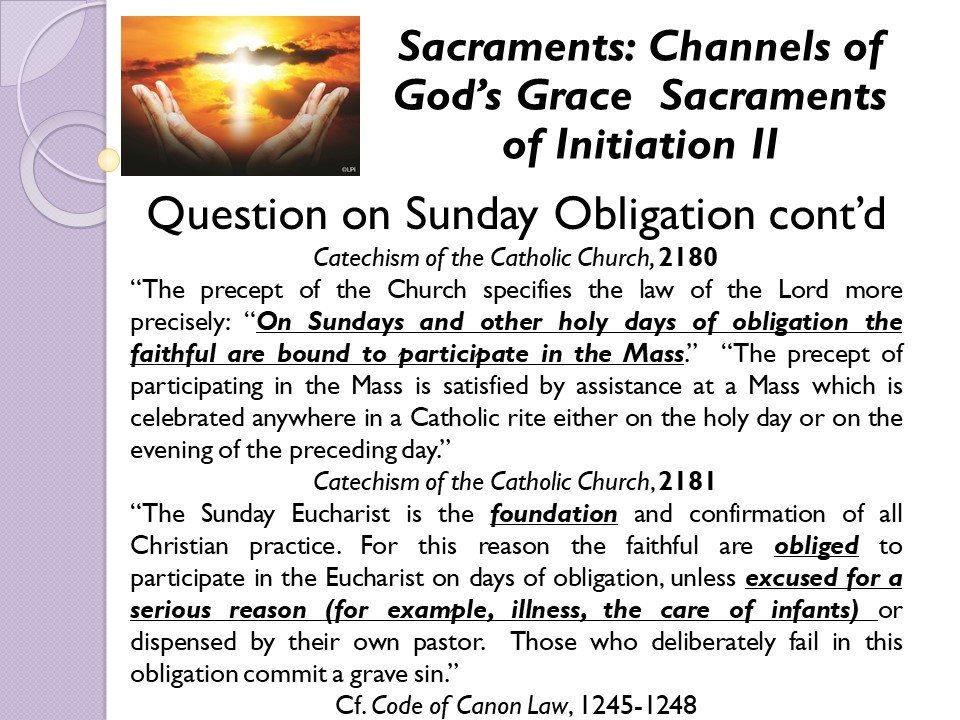
While some people think that the obligation to attend Sunday Mass was relaxed (some even seem to think it was eliminated) after the Second Vatican Council, it was not. What did change was our understanding that if we are sick, confined by severe weather (where I live that means major snow), or otherwise unable to attend Mass, it is not a sin (no – sports, play practice, or golf do not count as “unable”). God understands.

We are currently under an example of what it means to not be able to attend Mass that I never imagined, the Coronavirus pandemic. It is a matter of public health that we have not been able to attend Mass in person.

I stress “in person” because most people have the option to watch Mass on TV or livestreaming. It is not the same as coming to church but it is making your best effort. God always wants us to make our best effort. I encourage those watching Mass from home to make sure you make it your focus. Watching from home, it can be tempting to work on something else while Mass is going on. Please don’t do that. How do you feel when you are talking to someone who is doing something else? Do you wonder if they are really paying attention to you? During Mass, let us keep our focus on God.

What about the community aspect of Mass? When we come to church, we see other people. We interact with them. When we watch from home, we can’t see those other people. That’s does not mean we are alone. There are other people watching the same Mass. Even beyond that, when we celebrate Mass, we need to look beyond that one Mass. When we celebrate Mass on Sunday in the Latin Rite of the Roman Catholic Church, every Latin Rite church is hearing the same readings and same prayers. We are united through the Holy Spirit into one body.

What about before and after Mass? What do you do before Mass? Whether you watch on TV, livestreaming, or are able to attend Mass in person do you take time to prepare yourself by praying and/or looking at the readings?

After Mass do you discuss what you heard in the readings and homily if you are with others? Do you live out what you heard and received at Mass?

Now, perhaps the more difficult question in a normally busy world. What do you do the rest of the day on the Sunday Sabbath? Do you take it as a day of rest? Are you lazy or do you honor God with what you do, taking time to appreciate what God has given you? How has the Coronavirus affected what you do on the Sabbath?

Are you just as busy on Sunday as other days, just with something other than work? What does it mean to rest or relax? For some people working in the flower garden might seem like work. For others, it is in the garden that they encounter God.

What about shopping? I am one of those people who don’t like to shop. I am in and out of the store as fast as practical. Because it seems like a chore to me, I avoid it on the Sabbath. Of course, for some working people, it might seem like your only chance to get your shopping down. How do you do it in a way that honors God?

What about health care workers? In Matthew 12:1-14, Jesus speaks of rescuing the animal trapped in a pit and healing the sick as good things to do on the Sabbath. God wants us to help others. Still, please find a way to give some time to the Lord. One example would be to pray for those you are helping. For those who work on Sunday, you might also think about making some time for God whenever it is your day off.

For those who aren’t working, whether it be in retirement or out of work, sometimes the days of the week just run together. This might seem especially true when we are “stuck home” because of the Coronavirus. Make Sunday special. Do something extra special to acknowledge it as the Lord’s Day.

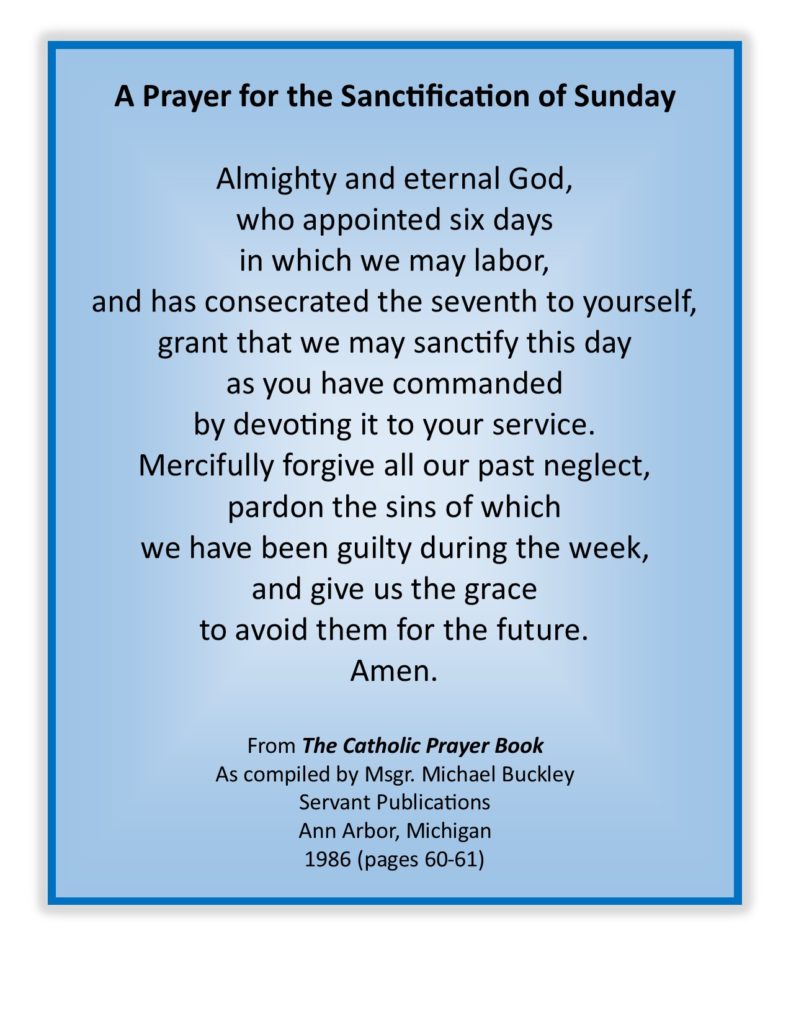
I end below with a “Prayer for the Sanctification of Sunday” taken from The Catholic Prayer Book.

Peace,

Fr. Jeff

The Need for Trust

To function as a society we need to be able to trust one another. Otherwise, we would always live in fear of what others might do.

What do we need to be able to trust others to do?

Here I think of some of the Ten Commandments. For instance, the seventh commandment says, “Thou shall not steal.” It is wrong to take what does not belong to us. I relate this to trust in that we need to be able to not to live in constant fear that someone might steal something, especially materials for basic human needs. If we cannot trust others not to steal, it affects the way we live. We have to protect ourselves.

Then, there is the sixth commandment, “Thou shall not commit adultery.” Adultery is wrong because it focuses on sexual activity outside a loving marriage. It involves trust because sexual intimacy with someone other than the person one is married to fails to honor the marriage covenant. It is a breakdown in commitment. The breakdown in commitment can lead to a breakdown in trust.

The ninth and tenth commandments tell us not to covet our neighbor’s spouse or property. Coveting affects our relationships with others. If we covet what they have, do we respect them as a person? Or are we only interested in our own interests? If we are only interested in what is good for ourselves, can we be trusted?

The eighth commandment says, “Thou shall not bear false witness.” How can we function if we cannot count on others to tell the truth? I use as an example the story of Susanna found in chapter 13 in the Book of Daniel. Two elders in the community accused her of committing adultery. Others assume that the two elders were telling the truth. However, they were lying. Fortunately, God sent Daniel to bring their lie to public. We need to be able to trust others to tell the truth for society to function well.

We need to be able to trust people to do the right thing. Right now, we have been under shutdown because of the Coronavirus for over two months. Things are beginning to reopen. As businesses and activities reopen, we need to be able to trust one another to take proper precautions. Reopening is not an instantaneous thing where everything goes “back to normal” immediately. We need to take proper precautions ourselves and we need to be able to trust that others are also taking proper precautions. God gives us the ability to reason. We need to use our “reason” well.

We need to be able to trust that anyone who has the Coronavirus will stay home. If someone knows they have been exposed, they need to complete proper quarantine. We all need to wear face masks when we are in public and cannot practice social distancing. We do not do this in fear. We do it out of concern for one another. Just because one does not have any symptoms does not mean what is not carrying the Coronavirus. There are people who refuse to wear a face mask and gather in large groups. I know we want our normal lives back but things like wearing a face mask is simple. It may not be attractive but it is reasonable.

I offer one more thing we need to be able to trust one another during the Coronavirus. We need to be able to trust one another not to hoard basic items like food, cleaners, and toilet paper. If we purchase more than we need, others may not have enough. When we go to the store, we should purchase only what we will need in a reasonable time period and trust others to do the same.

Trust…trust is necessary for society. Let us pray that we all act wisely and trust one another.

Peace,

Fr. Jeff

7th Sunday of Easter, Year A – Homily

7th Sunday of Easter, Year A
Acts 1:12-14
Psalm 27:1, 4, 7-8) (13)
1 Peter 4:13-16
John 17:1-11
May 24, 2020

On Thursday we celebrated the Ascension of Jesus.  The apostles witnessed Jesus ascend to Heaven.  Today we hear that they then “returned to Jerusalem” and “went to the upper room.” 

Remember how after the tomb was found empty, they gathered in the locked room for “fear of the Jews”.  Are they doing any different now?  How come they aren’t going out to proclaim the gospel?

They are not hiding.  In fact, they are doing what Jesus instructed.  Just before his Ascension, “he enjoined them not to depart from Jerusalem but to wait for “the promise of the Father about which you have heard me speak; for John baptized with water, but in a few days you will be baptized with the Holy Spirit.

They are waiting for Pentecost.

They had experienced much in recent days.  Jesus celebrated the Last Supper, giving us the Eucharist.  They were in agony when He was crucified.  They were confused over the empty tomb until Jesus appeared to them risen.  Then, He spent forty days with them teaching them how the scriptures were fulfilled in all that happened and what it meant.

Now…now they wait.  One might think of it as a retreat as they “devoted themselves with one accord to prayer.

We are now in this time between Ascension and Pentecost.  This year has brought a Lent and Easter like no other.  We have been in waiting in sort of an in-between time since mid-March when the Coronavirus led to the shutdown of life as we were used to.

Before the Coronavirus, we knew what we had and we were used to it.  At the center of our church life was the public celebration of the Eucharist.  Now, we are in this time of waiting.  The shutdown will end.  Public celebration of the Eucharist will return.  The date remains uncertain but we are making preparations.

For now, we wait.  It is not easy.  As part of our waiting, we do what the apostles did between Ascension and Pentecost.  We devote ourselves “with one accord to prayer.”

In their prayer of waiting, one would expect they did a lot of reflecting on their experiences with Jesus.  The prayer we hear Jesus offer in today’s gospel would have been part of their experience.

Chapters 14-17 of John’s Gospel are a farewell discourse from Jesus.  He knows his hour has come and He prepares his disciples with a final discourse.  What we hear today comes from chapter 17, which is known as Jesus’ High Priestly Prayer.  It is a prayer that Jesus offers to the Father but the disciples are there to witness this prayer.

Jesus begins his prayer by acknowledging “the hour has come.”  He prays “give glory to your son, so that your son may glorify you.

As a human event, crucifixion was a humiliating event.  For Jesus, with the Resurrection, it is a glorifying event.  It shows his total surrender to the Father’s Will.  For this, Jesus is glorified and raised up in the Resurrection.  This validates all that Jesus did.  It shows that everything Jesus did gives glory to the Father.

Jesus expresses this in his words to the Father, “I glorified you on earth by accomplishing the work that you gave me to do.”  It was not easy.  Jesus suffered greatly.  We are to do the work that God has given us to do.  In doing so, we too glorify the Father.  It may not be easy.  We may suffer for it.  Our willingness to suffer in the name of Christ is something we rejoice in.  We might not like the suffering but we rejoice in God’s presence with us as we suffer. 

Right now, we face difficultly from the Coronavirus.  Is it suffering?  In human terms, it is at least challenging.  It isn’t punishment for being Christian (all religions are being treated the same) but our response does show our faith.

I have to admit that at times I find it very difficult.  I miss you.  I just want things “back to normal.”  As we make preparations to open, it wears on me to think about the precautions.  There will be no cup, no Sign of Peace, and we will be social distancing with face masks.  When we reopen, it will be with reduced capacity.  How will we deal with that?  We are working on that.  As we work on this, please pray for our parish leadership, pray with one accord like the apostles.

It is a challenge.  Yet, I know our efforts will be successful because God is with us. 

Remember John 3:16, “For God so loved the world that He gave his only Son, so that everyone who believes in him might not perish but might have eternal life.

Remember Jesus’ words that He will not leave us orphans, that He will ask the Father to send us another Advocate, the Holy Spirit.  The first disciples received the Holy Spirit at Pentecost.  We receive the Holy Spirit in Baptism and are sealed with the Spirit at Confirmation. 

We can struggle in earthly things.  We do so remembering Jesus’ words “I pray for them.”  Jesus is seated at the right hand of the Father, also interceding for us.  Let us pray for the Holy Spirit to guide us to accomplish the work the Father has given us so that we glorify him.

Where is God’s Hand in the Coronavirus?

Why are we faced with this Coronavirus pandemic? We believe God to be all-powerful and all-knowing. So, why doesn’t He end the Coronavirus? This question involves what is referred to as the “the problem of evil.” Carried to the extreme, there are people who take the presence of evil to indicate that either God doesn’t exist, or, if he does, he is not all-powerful because he can’t stop the evil.

God does exist. So, how do we respond to “the problem of evil?” First, God does not cause evil. God gives free will to make our own choices. Unfortunately, sometimes we make bad choices. There are consequences to our bad choices.

For example, my mother lived her final years with emphysema. In her final weeks, she had lung cancer. Why? Because she smoked for thirty years. Now, I know that no everyone who smokes gets these diseases but it can be expected. God didn’t give her lung disease to punish her. It came because of her choices.

What is evil? First, we need to realize that material things are not evil in and of themselves. They simply are. We make choices on how to use material things, sometimes for good, sometimes for evil. For instance, money is used in the natural course of transactions. It is a means for the exchange of goods. Thus, it can serve a good purpose. However, sometimes we get greedy and we make bad choices. Here I shared Paul’s words in 1 Timothy 6:10, “For the love of money is the root of all evils, and some people in their desire for it have strayed from the faith and have pierced themselves with many pains.” Our love of money can lead us to evil activity so that we might have more money.

In the same way, a gun is not evil in itself. A gun can be used to provide food for one’s family. This is good. A gun can be used for protection. However, a gun can be used in terrorism, theft, and violence. Using a gun in this way is evil but not the gun itself.

What about the Coronavirus? Is it evil? I would say that the Coronavirus is not good or evil. It simply is. However, it comes with many bad consequences. Is the devil at work here? (See the Book of Job in the Bible.)

What about God? In the Old Testament, one hears of plagues. Did God create the Coronavirus to punish us? Honestly, I can’t answer that question but I tend to think not. It is natural for viruses to mutate. If someone intentionally creates a deadly virus, there may be evil in their action. That is for God to judge.

However, God can use the Coronavirus pandemic to get us to think about how we have been living our lives. Is God our top priority? Or have we let earthly things be our biggest priority? Has being shut in led you to change your priorities? Have you used the time to work on your relationship with God?

We pray for an end to the pandemic. In the meantime, we pray for all those affected. We ask God to give each person what they need to persevere. Evil will not prevail. God is victorious. God walks hand in hand with us.

Peace,

Fr. Jeff

Amen

Amen.

How many times do we say “amen” when we pray? How many times do you say it on your own? How many times do we say “amen” together at Mass? I don’t know how many times you say “amen” on your own but I can tell you that at every Sunday Mass we say “amen” at least thirteen times (daily Mass – eleven).

Do you know what “amen” means? We say it often at the end of prayers. How much are you praying on your own? Has the Coronavirus pandemic led you to pray more often? Do you say “amen” multiple times in your prayer or just once as you end the prayer?

Because we say “amen” at the end of prayers, one might think the word “amen” means “the end.” It does not. “Amen” means “I believe.” In saying “amen”, we are saying we believe in what we (or the presider) just said/prayed.

Let’s examine this by looking at each time we say “amen” at Mass.

#1 – After the initial “Sign of the Cross” – We begin Mass with the Sign of the Cross. This is a simple action but it says a lot about our faith. The Cross is the place where Jesus, out of his love, gave his life for our sins. Including the words, “In the name of the Father, the Son, and the Holy Spirit, we say we believe in a triune God, three persons yet one God. In saying “amen” after we make the Sign of Cross, we are saying that we believe that Jesus, sent by the Father, gave his life for us, and the Holy Spirit is with us always.

#2 – Penitential Rite – The priest invites us to “acknowledge our sins so as to prepare ourselves to celebrate these sacred mysteries.” After our response, the priest says, “May almighty God have mercy on us, forgive us our sins, and bring us to everlasting life.” In saying “amen”, we are saying yes we believe that God is merciful and forgives our sins when we repent.

#3 – Gloria – Our “amen” at the end of the Gloria says yes to what we said/sang in the Gloria, Jesus is the begotten Son of the Father, that He takes away the sins of the world, that God alone is the most high just to name a few points.

#4 – Collect (Opening Prayer) – the words of the prayer vary from week to week and are taken from the Roman Missal. Our “amen” here says we share together in the prayer that the priest says. It is not just the priest praying. The priest says the prayer but it is the prayer of all of us.

#5 – Creed – There are two creeds we can say at Mass, the Apostles’ Creed and the Nicene Creed (generally it is the Nicene Creed that is used). We say this prayer together. The Creed states what we believe about the Father, the Son, and the Holy Spirit. It speaks of how they relate to one another. The creed ends with us stating our belief in “one, holy, catholic, and apostolic church” as well as our belief in forgiveness, resurrection, and eternal life. In saying “amen” we affirm that we truly believe what we have said. They are not just words we say. They profess what we believe.

#6 – General Intercessions (Prayers of the Faithful) – our “amen” at the end says these are not just the prayers of the person reading the prayers. We make them our prayer.

#7 – Offertory Prayer – this is the prayer said after the gifts of bread and wine have been brought to the altar and prepared. This prayer follows the same pattern as the Collect mentioned in #4 above.

#8 – Great Amen at the end of the Eucharistic Prayer – The priest says the Eucharistic Prayer which includes the prayers consecrating the bread and wine to be transubstantiatied into the Body and Blood of Jesus. The prayer is addressed to the Father, and asks the Holy Spirit to transform the bread and wine as well as to transform us into the Body of Christ. So, our “amen” at the end of the Eucharistic Prayer says that we believe in the Real Presence of Jesus in the Eucharist and that we count of God.

#9 – The Sign of Peace – The priest offers the prayer reminding us that Jesus offers us peace, asking God to look not on our sins and to bring us to unity. Our ”’amen” says we seek this unity with God and with our neighbor.

#10 & 11 – Receiving Communion – When we come forth to receive Communion, the minister says “The Body of Christ” and, if the cup is offered, “The Blood of Christ.” In both cases, we respond “amen”. This is not a “thank you.” Yes, we should be thankful for the gift of the Body and Blood of Jesus. We say “amen” to say yes I believe it is not just bread and wine. It truly is Jesus.

#12 – Prayer after Communion – this prayer also varies (see #4 & 7 above) from Sunday to Sunday. The general theme is that we embrace what we received and, strengthened by it, go out into the world to live as God calls us to.

#13 – Final Blessing with the Sign of the Cross – see #1 above.

It is hard to do justice to what all of our “amen’s” mean at Mass in this short article. It is not my intent here to summarize everything we believe at Mass. Rather, my goal here is to help you understand the significance of saying “amen” at Mass and in other prayers. Amen is a profound statement of our faith.

Peace,

Fr. Jeff

6th Sunday of Easter, Year A – Homily

6th Sunday of Easter, Year A
Acts 8:5-8, 11-17
Psalm 66:1-3, 4-5, 6-7, 16, 20 (1)
1 Peter 3:15-18
John 14:15-21
May 17, 2020

Jesus calls us to proclaim the gospel message.  Just before his Ascension, Jesus tells his disciples to go out and baptize all nations in the name of the Father, Son, and Holy Spirit.

The early church went out.  Today we hear of how “Philip went down to the city of Samaria and proclaimed the Christ to them.”  Remember, the Jews and Samaritans did not associate with one another.  That is no more.  The gospel is meant for all.

Philip was empowered to drive out demons and cure many people.  This got the attention of many people such that they “paid attention to what was said by Philip.

The Coronavirus has gotten the attention of many people.  It has got people to open themselves to God.  For some practicing Catholics, they are finding out how important their faith is to them.  Some people who hadn’t been going to church are watching Mass via live streaming.  This is good news.

We need to do more to proclaim the gospel.

Unfortunately, because of the Coronavirus, we can’t go out right now as Philip went out.  As a parish we are making use of livestreaming, Facebook, and our website to share our faith.  Perhaps, you use social media to share your faith.  Yet, still, we can’t go out physically.

That shouldn’t stop us from the work of proclaiming the gospel, the work of evangelization.  There is another way to evangelize.

For this we turn to Peter’s words, “Always be ready to give an explanation to anyone who asks you for a reason for your hope, but do it with gentleness and reverence, keeping your conscience clear.

In this time of the Coronavirus pandemic we need hope.  God gives us hope.  We are united in hope through our celebration of Mass.  If we share our hope in God, we are proclaiming the gospel.

Yet, we still can’t go out.  How are we to share our hope?

First, we are not to be pushy.  We are to “do it with gentleness and reverence.” 

We share our hope by declaring what God has done for us as the explanation for our hope.

You probably aren’t seeing a lot of people in person.  However, how many people are you talking to on the phone or online?  What do you talk about?  Do you talk about how you are dealing with the shutdown?  Is God part of the conversation? 

What if you are talking with someone who may not go to church or is sounding depressed?  Again, we are not to be pushy with our faith but would you ever consider simply saying, “I’m glad I have my faith to help me through this.”  If they don’t respond, that is their choice.  You have opened the door.

Of course, our hope would be that they would respond.  They might talk about their own faith.  They might ask about your faith.  This is where you give an explanation for your hope. 

You don’t have to give a big theological discourse.  Going back to our first reading, Philip went out to Samaria but he didn’t have to do all the work of evangelization all by himself.  Once the apostles in Jerusalem heard of the success of Philip’s efforts (through God’s grace), they sent Peter and John to join him.

So, what is the reason for your hope?  Only you can speak about your personal experiences of faith.  For me, I think about how God has filled a void in my life.  I think about how, when things go bad because of human choices, God has always been there with me.  For instance, it took me a long time when I graduated from college for engineering to find a job.  However, I didn’t get depressed.  I didn’t have to live on the streets.  I didn’t realize it then but now I can look back on those days and see how God was walking with me.

What about reasons for our hope that apply to all of us?

First and foremost is that we know that Jesus died for us.  He was willing to lay down his life for us.  What greater love could He ever shown for us?

We also know that even though Jesus has ascended into Heaven, He has not abandoned us.  In today’s gospel, Jesus tells us, “I will not leave you orphans.”  He returns to his place at the right hand of the Father.  There He asks the Father to “give us another Advocate to be with you always.”  He gives us the Holy Spirit who is always present with us.

These are the things God has done for us.  These are the explanation for our hope.  Life in this world is not perfect.  We suffer.  We can choose to see the cup as half-empty, thinking about what we don’t have.  Or we can choose to see the cup as half-full, giving thanks for what God has given us.  We need to “shout joyfully” and “sing praise” for all the good things God has done for us.

Jesus died for us.  He did this to lead us to our Father.  Jesus speaks of how He and the Father are one and that we are in him as He is in us.

We give praise, we “shout joyfully” for all that God has done for us.

Who Wrote the Bible?

Who wrote the Bible? The answer to this question depends on what one means by “wrote”. Are you referring to the person who physically wrote the stories? Or are you referring the source of the content? If the latter, do you mean the earthly source or the heavenly source?

So, what might seem like a simple question, “who wrote the Bible?”, has multiple levels to it.

Of course, ultimately, “God is the author of Sacred Scripture” and the books of the Bible “have been written down under the inspiration of the Holy Spirit” (Catechism of the Catholic Church, 105). God wanted the story of Salvation History written down so that we might know how He has always loved and cared for his people.

As to who physically wrote the stories down, “God inspired the human authors of the sacred books. “To compose the sacred books, God chose certain men who, all the while he employed them in this task, made full use of their own faculties and powers so that, though he acted in them and by them, it was as true authors that they consigned to writing whatever he wanted written, and no more” (Catechism of the Catholic Church, 106, italics my emphasis).

It was by God’s hand, through the Holy Spirit, that the human authors wrote the Bible. Yet, they are human and the stories are written from the context of their experience. Thus, we need to appreciate the culture from which they wrote and rely on the Holy Spirit (see Catechism of the Catholic Church, 110) to help us understand what the human authors wrote and to apply it in our lives today.

Who are the human authors? Even that question can have two levels to the answer. There are 73 books in the Bible (see “Are All Bibles the Same?” for an explanation why some Bibles have 73 books while others only have 66). Some of the books share authorship, for example thirteen of the New Testament letters are attributed to Paul. On the other hand, the gospels are attributed to four different authors.

Some of the books of the Bible are known to be written by the person whose name they bear. For example the Gospel of Luke was actually written by Luke (Luke also wrote the Acts of the Apostles). However, biblical scholars are uncertain to who physically wrote the other gospels. I emphasize “physically” because we still see the disciple for whom the gospel is named as the one who compiled all it contained and shared it with their communities. They may not have simply written it down because they expected Jesus’ Second Coming to happen immediately so it was not important to write it down. We thank God for inspiring those who did write them down so that we would have them today.

For this, we need to understand the importance placed on oral tradition in those days. We need to remember that most people could not read or write. Stories were handed down by oral tradition. However, recognizing the stories in the Bible as stories of the divine, great emphasis was placed on the accurate oral telling of the stories. We also trust in the inspiration of the Holy Spirit when the human authors wrote the stories down for us.

We should also be mindful of the sense in which scripture is written (see Catechism of the Catholic Church, 115-119). There can be a literal meaning. There is a spiritual meaning. Many passages contain a moral meaning. We must also be mindful of literary devices such as allegory and simile. Think of the first two chapters of the Book of Genesis. They each tell the story of creation differently in physical terms. They are not meant as scientific explanations. They are to provide meaning in the divine order of creation.

We should use consider how we view the Bible as revealing doctrine, history, and spiritual experiences (For more on this see the section entitled “Models of Revelation” in my article “The Bible”).

Lastly, when we are looking for something in the Bible, we should realize that we won’t always find the specific word we are looking for. For instance, we won’t find the words “Trinity” or “consubstantial” in the Bible but that doesn’t mean they aren’t talked about in the Bible. They are. The Bible just doesn’t use those exact words (I will talk about what the Bible does say about the Trinity and “consubstantial” in my upcoming webinar Praying With the Trinity on June 3, 2020).

Other examples of words that are not explicitly found in the Bible include “sacrament” and “Eucharist.” However, the institution of the Sacraments, most especially the Eucharist, have clear origins in the Bible. You can find the origins in my series, Sacraments: Channels of God’s Grace.

With this I think I will conclude my current series of articles on the Bible. I hope it has helped you to better appreciate what the Bible offers us as God’s Word. If you haven’t already, don’t forget to check out my video presentation, Navigating the Bible as well as the article on the bible I mentioned above.

Peace,

Fr. Jeff

Connecting the Old and New Testaments

In my last article, “Are All Bibles the Same?”, I began to talk about connections between the Old Testament and the New Testament. We need one to understand the other. Here, I think of the story of the two disciples on the road to Emmaus who, unknowingly, encounter Jesus (Luke 24:13-35). The disciples did not understand the Crucifixion and empty tomb. Thus, in Luke 24:27, Jesus, “beginning with Moses and all the prophets, he interpreted to them what referred to him in all the scriptures.” Here, the “scriptures” would have been solely the Old Testament.

Here I think of the four suffering servant passages in the Book of Isaiah that I mentioned last time, (Isaiah 42:1–4, 49:1–750:4–1152:13–53:12). As Christians, we see these passages fulfilled in Jesus’ Passion. However, Jesus’ Passion are not the only way they are applied. Think of it this way, Isaiah was a prophet. For the people to know this, they would need to see at least some of what he prophesied fulfilled in some way. If they never saw anything Isaiah said fulfilled, they would not believe him. Jesus would not come until over 600 years later. Biblical scholars say that in some way this suffering servant passages began to be fulfilled in the suffering enduring by the Israelites as a nation and/or by Isaiah himself. Yes, Jesus fulfilled these prophecies but they were not without meaning before He came.

There are numerous stories in the Old Testament that have great significance of their own but also prefiguring Jesus. Here I think of the story of Abraham sacrificing his son Isaac (Genesis 22:1-18). God tells Abraham to sacrifice Isaac. Abraham is willing to do it. Isaac himself carries the wood for the sacrifice (22:6) just as Jesus will carry the Cross when He sacrifices his life for us. When Isaac asks in verse 7 where the sheep for the sacrifice is, Abraham replies in verse 8, “God will provide the sheep.” God does indeed provide the ram (22:13) that day. Ultimately, God sacrifices his Son Jesus for us.

The story of the Crossing of the Red Sea (Exodus 14), crossing through the waters, represents the Israelites being set free from slavery in Egypt as they head to the Promised Land. This prefigures Baptism where we are set free from sin and enter to eternal life.

In the desert the Israelites find themselves hungry. God provides the manna as bread from heaven (Exodus 16). This prefigures Jesus as the Bread of Life to feed our souls (John 6).

Each of these events had huge significance for the people in the story. The stories are very important for that reason alone. However, they are also very important for us to understand Jesus.

With this is mind, I again include here the quote I used last time from the Catechism of the Catholic Church

“Christians therefore read the Old Testament in the light of Christ crucified and risen. Such typological reading discloses the inexhaustible content of the Old Testament; but it must not make us forget that the Old Testament retains its own intrinsic value as Revelation reaffirmed by our Lord himself.  Besides, the New Testament has to be read in the light of the Old. Early Christian catechesis made constant use of the Old Testament.  As an old saying put it, the New Testament lies hidden in the Old and the Old Testament is unveiled in the New ” (129).

I offer one last connection between what happens in the Old Testament and the New Testament. In Genesis 3, we hear the story of the first sin, the original sin. Adam disobeyed God and was expelled from the God. In Philippians 2:5-11, Jesus obeyed God and was exalted. Adam sought to become like God. Jesus humbled himself to become one like us. Adam brought sin into the world. Jesus brought life.

These are just some of the connections between the Old Testament and the New Testament. I hope I have helped you understand that the Old Testament is of great value by itself but that it also helps us understand Jesus. Thus, we read from both the Old Testament and New Testament at Mass.

Peace,

Fr. Jeff