
Receiving a Penance

After we have confessed our sins in the Sacrament of Reconciliation, we receive a “penance.” We are not just “given” or “assigned” a penance as punishment for our sins. We must receive the penance. By “receive” I mean we willing accept the penance as an admission of our sins and our desire to change.

If we think of the “penance” as something we are “given” or “assigned,” it might go with an attitude that the penance is “punishment” for our sins. It does serve as punishment but it is more than that. I already mentioned that the penance serves, in part, as a sign of our desire to change.

The word in Greek from which our understanding of “penance” comes is “metanoia.” It is seen as a “shifting of the mind,” a “conversion.” In the case of the Sacrament of Reconciliation, it is our desire for conversion from sin to the Father’s Will. It is this desire that God seeks when we come to him in the Sacrament of Reconciliation.

Now, I would like to broaden our discussion of the purpose of “punishment” to include our judicial and prison systems and what we look for when we have been wronged by others.

In her book, The Moral of the Story: An Introduction to Ethics, Nina Rosenstand refers to five purposes or approaches to “punishment” (277-279. Third Edition, Mountainview, CA: Mayfield Publishing Company. 2000. Please note I am citing the third edition as that is the one I have as a textbook from seminary. There are newer editions). They are deterrence, rehabilitation, incapacitation, retribution, and vengeance.

Deterrence seeks to motivate people to not commit crimes out of the fear of stiff punishment. At times, parents use this to discipline their children. However, it only works when the punishment is feared. (See my recent article “More Shootings, More Stress” as it relates to people who don’t value their own lives.)

Rehabilitation seeks to help the person to change for the better. This is the point of the penance we receive in the Sacrament of Reconciliation. This is why I do not assign lengthy penances. I look for penances that help the person think about how to do better. Turning to our prison system, I believe rehabilitation must be a key component of prison life. If we expect the person to commit no future crimes, we must give them the tools they need to change. Yes, they deserve punishment for the crime they committed but we need to help them change for the better.

Incapacitation is a form of punishment that seeks to protect others by taking away the ability for the criminal to continue committing crimes. For example, we incarcerate a serial killer to stop (incapacitate) them from being able to continue to murder. This is a necessary action when the criminal refuses to change but it should not be the only element.

Retribution is seen as paying for one’s sins. People cite Leviticus 24:20, “an eye for an eye, a tooth for a tooth,” to justify retribution (cf. “Does God Change?”). People need to make amends for their sins and crimes. However, if amends is all we seek, does that do anything to help the person change for the better to follow Jesus as the way and the truth and the life? Retribution is logical but more is needed for conversion than logic.

Lastly, I see vengeance as the emotional desire behind seeking retribution. Unchecked, it moves one from seeking fair retribution to revenge. (For more on vengeance, see my recent article “Does God Change?”.)

Rosenstand speaks of the first three (deterrence, rehabilitation, and incapacitation) as forward-thinking while retribution and vengeance are backward thinking. While seeking retribution can be appropriate, it only seeks to address the past. It does not, along with vengeance, do anything to make the future better.

Incapacitation is forward-thinking in that it seeks to protect the innocent in the future. Deterrence is forward-thinking in that it seeks to prevent future crimes. Both incapacitation and deterrence focus on the external actions (crimes and sins). They do not have as their primary goal to change the heart of the person. This is where rehabilitation comes in. Rehabilitation seeks to help the person change what is in their heart, removing evil desires. For those who steal or commit crimes or sins out of basic needs, rehabilitation in the form of education also helps the person become better in giving them skills so they can have what they need without resorted to theft or violence.

God is motivated in the way He punishes us out of his love for us. A good parent disciplines their child out of love. Let us pray that the way we treat others when we have been wronged always be rooted in love. Let us pray for the same for our judicial and prison system.

Peace,

Fr. Jeff
22nd Sunday in Ordinary Time, Year A – Homily

22nd Sunday in Ordinary Time, Year A
Jeremiah 20:7-9
Psalm 63:2, 3-4, 5-6, 8-9 (2b)
Romans 12:1-2
Matthew 16:21-27
August 30, 2020

Last week Jesus asked his disciples, “Who do you say that I am?”.

Peter replied, “You are the Christ, the Son of the living God.”

Peter gave a great answer.  He gave the right answer.  Good for him.  It would seem Peter has gotten it.  He understands who Jesus is.

Or does he?

Today’s gospel passage picks up where we left off last week after Peter’s confession of Jesus as the Christ and Jesus giving Peter “the keys to the kingdom of heaven.

Jesus then “began to show his disciples that he must go to Jerusalem to suffer greatly from the elders, the chief priests, and the scribes, and be killed and on the third day be raised.”  This is the first time Jesus tells his disciples about his coming Passion and that these things must happen.

Peter, who had just professed Jesus to be the Christ, takes Jesus aside and rebukes him. 

Really?  He’s just (correctly) identified Jesus as the Christ and now he is rebuking him.  How does one rebuke someone you profess to be the Christ?  Why would Peter do this?

For one, Peter has been attached to Jesus, he cares about Jesus, he won’t want anything bad to happen to Jesus. 

Secondly, the Jews, including Peter, expected the Christ to become a great earthly king.  Taken at face value, what Jesus says must happen, his suffering and death, would go against the Jewish expectation.    

Thus, we see Peter doesn’t fully understand.  It was not what he wanted to hear.  Prophets like Jeremiah had been delivering unpopular messages for centuries.  The messages weren’t popular because it wasn’t what the people wanted to hear. 

What does preaching an unpopular message get a prophet?  For Jeremiah, he became “an object of laughter” and he is mocked.  It brings him “derision and reproach.”  So much so that Jeremiah wants to quit being a prophet. 

What happens when you speak about your faith?  Do you ever feel like “an object of laughter” and mocked for your faith?

We should not give up.  Jeremiah tried to stop prophesizing but found he couldn’t.  Jeremiah found the fire for the Lord continued to burn in his heart.  He had to continue.  Do you keep your faith?

Returning to Peter’s rebuke of Jesus, I don’t think Peter intended to reject what Jesus said.  Rather, it is an emotional reaction to news he didn’t want to hear.  A less emotional reaction might have been to say to Jesus, “I don’t understand this.  How can it be?”  Instead, Peter thinks “not as God does, but as human beings do.

Do you attempt to think as God does or do you think only in human terms?

When you see or hear something you don’t like, what is at the core of your response?  Is your response purely emotional?  Is it logical, does it make use of reason?  Is your response spiritual?

If we wish to come after Jesus, we must be willing to deny ourselves, take up our crosses, and follow him.  We must be willing to lose our life in this world to gain eternal life.

Let’s think about how we respond to a common “cross” that we all must face, the Coronavirus.

I think it is safe to say nobody wants what is going on with the Coronavirus.  It might affect some more than others but it is a Cross to each of us in some way. 

Certainly, those who get the Coronavirus and become sick face a cross.

During the shutdown, most people were stuck home (a cross to bear).  Even those who had to work bore a Cross in risking exposure.  We are grateful for what they do.

Even now, the Coronavirus continues to be a cross to bear.  The virus is still out there.  So, some must still remain home for the safety of their health.  For those of us who can gather together, we must wear face masks, social distancing, and not sing together.  It remains a challenge, a cross to bear.

There are those who think all the precautions are absolutely necessary.  On the other extreme think none of it is necessary. 

What does God think about the precautions? 

I think God wants to us to use our reason but to trust in him.  We need to be willing to make sacrifices for a greater good.  Yes, the face masks and social distancing are annoying but they must work some because states they didn’t require them are in far worse shape right now than New York. 

How long all the precautions will be necessary I don’t know.  I pray for both our secular and religious leaders to be guided by God in making good choices. 

I pray that it be over soon.  I pray that the day come soon when we can shake hands, exchange the Sign of Peace, and sing from the hymnals.  Until then I am willing to “deny” my desire for these things, a small cross for the greater good of public health.  I don’t want to, but I will.  It seems to be the fastest way through the pandemic.  I pray that God brings some good of this.

Jesus didn’t want to suffer on the Cross.  He prayed in agony in the garden.  But He willingly sacrificed himself on the Cross for us.  We need to be willing to sacrifice for a greater good.

Seeking the Lord’s Help in Suffering

I recently read a book about Franciscan Spirituality relating to our care for the environment. I am not going to focus on that topic today but I mention the book (Care for Creation by Delio, Warner, and Word, Cincinnati: St. Anthony Messenger Press. 2008) because it included a particular quote from St. Francis that I want to use to reflect on suffering. St. Francis prayed,

“Lord…make haste to help me in my illnesses, so that I may be able to bear them patiently” (81 – they cite the quote as from “The Asissi Compilation,” 83, in FA:ED, vol. 2, p.185).

I was immediately struck by what was not in the quote. St. Francis did not ask for his illnesses to be taken away. Isn’t that the way we generally start our prayers when we face suffering? Even Jesus prayed in the garden, “My Father, if it is possible, let this cup pass from me” (Matthew 26:39a). Yet, Jesus did not end the sentence there. He concluded, “yet, not as I will, but as you will” (Matthew 26:39). Following Jesus’ example, I think is good for us when facing a new suffering that we begin our prayer by asking God to take away the suffering if it is not meant to be. Then, we submit to God’s Will.

I emphasized “new” because, in providing this quote, the book says Francis offered this prayer about year before his death. At that time, he was facing illnesses that made him intolerant to daylight so he had to stay inside (81). It seems these illnesses had been ongoing so maybe St. Francis had already come to accept them as God’s Will. Does that mean he had given up on God’s help? No, he still asks for God’s help. What we need to think about is the type of help he prayed for. He prayed for God to help him “bear them patiently.” What help do you need to face any suffering in your life? I know I need help to bear sufferings patiently.

Right now, an example of suffering where I need help with is the Coronavirus. From the beginning I had concerns about the Coronavirus. I certainly didn’t want to get it myself but I also didn’t want it to become a pandemic. However, “patience” about the Coronavirus wasn’t a problem for me at that time.

Even when we started precautions like suspending distribution of the Precious Blood and the Sign of Peace at Mass, I was not happy but I was patient. Even when Masses were first suspended, patience wasn’t my problem. I figured it would be over relatively quickly.

It wasn’t over quickly. It did begin to try my patience as time went on with Masses being suspended in my diocese for three months. It was a good day when we resumed public Masses with precautions in place.

Was that the end to my problem with being patient about the Coronavirus? My patience did get a little better but, now two months later, we remain under the same precautions. Our attendance at Sunday Mass is ranges between 30 to 50% of normal. I long for the day when everyone will be able to come to Mass without fear of the Coronavirus. Lord, make haste to help me bear this waiting during the Coronavirus patiently.

Going back to what I said about asking God to take away our sufferings, why is it that we are reluctant to face sufferings?

The obvious, and understandable, answer is that we don’t like anything that hurts or keeps us from living the way we want. For those who do not get the virus, suffering from the Coronavirus comes more in the latter part. We can’t live the way we want.

Suffering can be good. The suffering of Jesus on the Cross certainly is good because it saves us from our sins. In fact, Jesus’ suffering is not just “good.” It is redemptive.

The sufferings we face as individuals can have value. For instance, when one faces a terminal illness, choosing to put the time of our death in God’s hands can be a powerful witness to our faith in God while choosing assisted suicide says we think we know better than God.

Suffering can actually make us stronger. Paul writes, “Three times I begged the Lord about this, that it might leave me, but he said to me, “My grace is sufficient for you, for power is made perfect in weakness.” I will rather boast most gladly of my weaknesses, in order that the power of Christ may dwell with me. Therefore, I am content with weaknesses, insults, hardships, persecutions, and constraints, for the sake of Christ; for when I am weak, then I am strong” (2 Corinthians 12:9-10).

Does the Coronavirus make us stronger? It can in the sense that it can help us realize that things we thought were important we don’t really miss. It can free us up to give more to God.

It can also teach us about the value of sacrifice. During the shutdown, we gave up things we enjoy. Even now, with precautions still in place, we can’t do all the things we enjoy. This can mean suffering. Does this suffering have value when we accept it in faith?

Yes, by our willingness to wear a face mask, practice social distancing, and refrain from activities we enjoy to practice social distance, we have flattened the curve. States with these requirements in place have fewer cases now. How many more would have gotten sick without the precautions?

The Coronavirus is a cross that we each must bear in our own way. Let us take up our Cross and follow Jesus (cf. Matthew 16:24).

So we pray, “Lord, help all of us to accept our sufferings, to bear them patiently, trusting that you are with us.”

Peace,

Fr. Jeff

How Well Do You Know God?

How Well Do You Know God?

What does it even mean to know God?

Is it a matter of how much we know about God? We need to learn about God but knowing God is not just a matter of the quantity of information we know. To know God involves finding meaning to go with what we know about God.

This past Sunday (8/23/20 – 21st Sunday in Ordinary Time, Year A), we heard Jesus ask his disciples, “Who do people say that the Son of Man is?” In my homily, I began by talking about why Jesus asked this question. He knew people were talking about what He did (miracles) because as the word spread, great crowds came to see him. What He wants to do is to lead them to recognize the significance of the miracles in terms of recognizing who He is.

To know who Jesus truly is leads us into relationship with him. How would you respond to Jesus’ question, “But who do you say that I am?” Would you share in Peter’s response, “You are the Christ, the Son of the living God.”? What other words might you use to describe Jesus? Savior? Redeemer? King? Friend? Brother? Or is He your safety net when you fall into sin?

Now, I would like to move from the question, “How well do you know God” to what does it mean to “know”, whether it is God, other people, or things.

To do so I will use definitions as found in the Merriam-Webster Dictionary app (Android version). I will offer five definitions and some discussion about them in terms of what it means to know God.

“To be acquainted or familiar with”
“Acquainted” may be as simple as overhearing someone include reference to “god” in a conversation with. “Familiar with” would suggest some notion of who “god” is without necessarily having “faith in God.” God might simply be seen as a being who exists on a different level than us. It might also be a god who created but then walked away.

“To have a practical understanding of
What is the significance of God? Do you see him as creator? Do you see him as a source of “Truth”, what is right and wrong? Do you see God as active in your life? Do you know that God loves you? Knowing God as Christians, a practical understanding would include knowing common prayers, knowing what to do at Mass, and knowing his Commandments.

“To have experience of”
How have you experienced God? What does it mean to “experience God”? Certainly God comes to us in the Sacraments but are we always aware of his presence as we receive the Sacraments? What about experiencing God in ordinary moments of life? It might be a sense of divine peace when we face a difficult situation. Sometimes we recognize something as an experience of God only after the fact. For example, when we realize something turned out better than we could have expected from human involvement. Experiencing God doesn’t mean all our problems go away but we do see our problems in a different way. When we experience God in our sufferings, it puts them in a new light.

“To have understanding of” and “To recognize the nature of”
I put these two together as I seem them both as expressing our moving from simple practical understanding of God, from just knowing our prayers, knowing what to do at Mass, and knowing God’s Commandments to understanding what they mean for us. To recognize the nature of God and have real understanding of who God is takes us to another level. We begin to transcend earthly things to enter into a deeper relationship with God.

For instance, at Mass we kneel at the proper times. Early in our faith lives we are taught when to kneel. Over time it becomes habit and we do it without needing to think about it. However, how often do you think about why we kneel? It is not simply something we do because God says so. We kneel in humility, recognizing God is greater than us. Thus, we kneel before him, surrendering ourselves to him. (I’ll be taking more about the meaning of what we do at Mass in my upcoming three part series Uncovering the Treasures of Mass” with a webinar starting on September 23rd.)

In proclaiming, “You are the Christ, the Son of the living God,” Peter shows that he has begun to move from merely a practical understanding of who Jesus is to a deeper understanding of who Jesus is, to a deeper relationship with him. How does this happen? Jesus provides that answer, “For flesh and blood has not revealed this to you, but my heavenly Father.”

God offers us the same thing. Are you open to it? Do you seek to know God more fully in your life? Do you seek a deeper relationship with him? This is what it really means to know God. It is not simply a matter of knowledge. It is to be in relationship with him.

Peace,

Fr. Jeff

21st Sunday in Ordinary Time, Year A – Homily

21st Sunday in Ordinary Time, Year A
Isaiah 22:19-23
Psalm 138:1-2, 2-3, 6, 8 (8bc)
Romans 11:33-36
Matthew 16:13-20
August 23, 2020

Jesus asks the question, “Who do people say that the Son of Man is?”  I pose a slightly different question, why do you think He asks.

Jesus is not running for election.  So, He’s not checking the polls to see how He is fairing.  He isn’t concerned about popular opinion.  He is only concerned with doing the Father’s will.

So, why does He ask the question?  I think He wants them to be talking about who He is, not just what He has been doing. 

People are indeed talking about him, wondering if He is one of the prophets returned. 

Jesus then moves from asking his disciples what others have said to what they think, saying, “But who do you say that I am?

Of course, Peter is the one who answers, and he gives a great answer, “You are the Christ, the Son of the living God.”  Peter gets it!  He gets that Jesus is the long-awaited messiah, the Christ

How does Peter know these?  Jesus provides the answer, “For flesh and blood has not revealed this to you, but my heavenly Father.” 

Yes, Peter has witnessed what Jesus has done as “flesh and blood.”  These acts clearly show Jesus as a powerful man (hence those who identify him with the prophets) but something more is needed to get from human actions to “the Christ.” 

As Paul says of God, “How inscrutable are his judgments and how unsearchable his ways!  For who has known the mind of the Lord.”  God gives us the gift of reason.  He wants us to use reason to see him in creation and in what He does for us.  Still, reason alone is not enough to move from Jesus as a human to Jesus as “the Christ, the Son of Living God.

We make this leap of faith because God chooses to reveal himself to us.  Peter has begun to make this leap.

Hearing Peter’s confession of Jesus as the Christ, Jesus knows it is time to assign Peter his role.  He says specifically to Peter, “You are Peter and upon this rock I will build my church and the gates of the netherworld shall not prevail against it.  I will give you the keys to the kingdom of heaven.”  Jesus does not say this to all the disciples.  He says it specifically to Peter.  Peter is to be leader of the disciples.  He is to the first Pope.  He is not Christ but he is to be the vicar of Christ. 

The symbolism of the “keys” is essential here.  Who is in charge?  The one who has the keys.  You can’t do anything if you can’t open the door.

Peter is given the keys to Heaven.  Isaiah speaks of the keys to the House of David.  Shebna had been the “master of the palace.”  He holds the keys.  Yet, he fails in his duties so God calls another, Eliakim.  He invests Eliakim with the robe and sash as symbols of the authority He gives to Eliakim.  All priests today wear a chasuble (robe) and stole (sash) as symbols of their role as priests.

But not all priests are given the keys, that is for one alone.  For almost 2,000 years, the popes from Peter to Francis have served as the holder of the keys. 

It hasn’t always been a perfect situation.  There has been corruption in the church.  Not to make excuses but the popes are human too.  They alone do not entirely know “the mind of the Lord.” 

Thus, they are not infallible in all things.  The pope is not infallible in all the little things of daily life.  The Church does say (Vatican I) the pope speaks infallibly on matters of “faith and morals.”  Even then, the pope is not infallible on his own.  He is infallible in consultation with the bishops and most importantly guided by the Holy Spirit.

How has the Church survived for 2,000 years through scandal and human sin?  The church has survived because of the work of the Holy Spirit. 

God has not called us to be a bunch of individuals, each choosing on our own beliefs.  No, we are called to be a united people. 

We prayed in our opening prayer, “O God, who cause the minds of the faithful to unite in a single purpose.”  What is that single purpose “fixed on that place where true gladness is found?” 

It is to do God’s Will.  We are to be a united people.  Having one pope over the whole church is to be a point of unity.  A bishop is in complete charge of his diocese but does not act in isolation but with the whole church with the pope over all as the vicar of Christ.

Where would we be without this unity?  Would the church have ever survived?

Just look at the secular world.  Is there any real unity?  Where has it led society to think that everyone is free to choose to do whatever they want? 

Yes, God has given us the freedom to do whatever we want.  We call it free will and it is a gift.  We use a gift well when we use it as it intended. 

The pope is not just a figurehead.  He is our leader, let us pray that the pope is always led by the Holy Spirit as he leads our church as the holder of the keys to the Kingdom of Heaven.

More Shootings, More Stress

It’s hard to know but it seems like I have heard of increasing numbers of acts of violence (mainly shootings). I currently serve in a parish about thirty minutes outside of Rochester, NY. Last weekend, Rochester had three separate shootings in 24 hours. I grew up in the Southern Tier area of New York State. Elmira, part of the Southern Tier, likewise seems to be growing in the number of shootings.

Why?

I think there may be several reasons. First, while some things have reopened, our lives are still very much impacted by the ongoing Coronavirus pandemic. We need to wear face masks and social distance in public (I stress need because it is one thing we can all do to limit the spread of the virus). Other things to consider include the fact that some people are still out of work, leaving them without things to do and with financial problems. There are no or little sporting events, concerts, or movie theaters to go to relax. All of these can cause stress. When our stress levels are high, it affects our ability to deal with things. Things that might not normally be hard to deal with suddenly become harder. How much this relates to increasing number of violent acts I don’t know but it is a real possibility. It is not an excuse but someone who is stressed might be more likely to “blow up.” Think of this example, you have a bad day at work and are stressed. You go home hoping for a quiet evening. Instead, the kids are acting up. Isn’t it harder to properly interact with the kids when you come home stressed?

We also face ongoing racial tensions. This might make us more fearful in our interactions with people of other ethnicities or race. We rely too much on stereotypes. Even when we are not racist or prejudice, the stories of protests and riots, can cause us stress and impact our ability to deal with things that ordinarily won’t bother us that much.

I also wonder about the relationship of drug use and violence. I see at least two possible connections. First, if one is high on drugs (or intoxicated), it impairs our judgment. We react poorly, including the use of violence. The second possibility is one’s addiction to drugs may lead them to steal to obtain drugs. The stealing may include the use of violence. What difference can we make here? First, we shouldn’t use drugs or drink alcohol in excess to avoid impaired judgment. Secondly, look for opportunities to improve the lives of others so that they might not turn to drugs or alcohol to relieve their stress. We need to help people have healthy ways to relieve their stress (not to mention that reduced drug use can result in less theft, and, thus, less violence).

We should also consider how desensitized we have become to news of violence. As we hear more about it in the news, we can become used to it and no longer pay attention. Or to avoid hearing about it, we stop paying attention to the news. Either way, the danger is that we also don’t pay attention to what is going on that leads to the violence. We lose perspective on how we might help people have better lives, avoiding violence.

Now, I turn to where my own recent thoughts on the increasing violence started, the lack of respect for all life. If one does not value life in general, then murder might not seem so bad.

One might think here of racist attitudes that might say a person of different color or ethnicity is of less value. Yes, some people incorrectly think that way. They are wrong. All human life is sacred. It does not matter what language we speak. The color of our skin does not matter. Our dignity comes from God and that cannot be taken away. This is true even when one does not believe in God. God still loves them. All life is sacred.

There is another point that I wonder if you have considered. Yes, maybe the shooter doesn’t value the life of their victim(s). Have you ever considered that maybe they don’t even think their own life matters? Maybe they have never felt loved? Maybe their life has been so hard that they figure life is not worth living? They won’t care if they were killed. Maybe they think no life if sacred.

Here, I will never forget a conversation I had with a man several years back. He was a volunteer, as I was, at a food pantry. His had been a life of drugs, adultery, and hardship. He actually said to me that he figured things would have been better if he had never been born.

I will never forget that. What can we do to help others to have a good life so they don’t feel this way? We need to show them God’s love and our love. This means showing that we can. They aren’t going to believe anyone loves them if they don’t have a home, or even food to eat.

I don’t know how much violence is related to what I have written here today. I do know some is, especially regarding respecting life. What can you do to help others know you care and that God cares? Do what you can to help others. It may not seem like much but God can multiply your efforts, thirty, sixty, or a hundred fold.

Peace,

Fr. Jeff

How Do We Experience Church?

The question for this article is how do we experience Church? As we explore this question, please note that I capitalized the word “Church”. This is because, ultimately, it is a transcendent “Church” that we are called to belong to. The Church founded by Jesus Christ is more than physical buildings and hierarchical institutions.

The physical buildings are important. Our physical church buildings are the places that have been specifically built to house the praise and worship we give to God. Our church buildings are a place where we come together, forming a community (community is an important aspect of the “Church” as described in the Acts of the Apostles). We need “church” in this sense to help us encounter Jesus.

In this article, I am focusing on our tangible experience of “church”. To frame this, how would you answer the question, “What church do you belong to?”

The question can be answered on several levels. I suspect many people immediately thought of the church they go to on Sunday (I go to St. Michael’s…I go to St. Ann’s…). There is nothing wrong with this. We do this because the church building where we worship is generally our most tangible experience of church.

It used to be the name of the church building was the same as the name of the parish. With declining number of parishioners (as well as fewer priests), parishes are combining. When this happens, generally a new name is taken for the parish as a whole while each church building maintains its name. When you answer the question, “what parish do you belong to?,” do you respond with the name of the individual church or the parish?

This brings us to the question, how are parishes defined. Most Catholic parishes are geographically defined. People are expected to attend the parish where they live. Historically, the one exception to this that I know of is ethnic parishes. It was not uncommon in years past in our country that immigrants would gather together by the language they spoke, united as a community through that language. For example, you might have a German parish and an Italian parish very close to each other.

I think most people today still tend to go to the church closest to them out of convenience (as Canon law says we should). There are exceptions. For instance, I know people who live in a town near where they grew up so they choose to drive to the parish where they received their Sacraments growing up because of its sentimental value to them. It is the community that they know. It feels like home.

There are some people who will “church shop” for a church that agrees with their beliefs. Now, we should all look for churches that hold to the Truth that God offers. That is different than what I mean when I say people shop for a church that agrees with their beliefs. It might be beliefs that go against our church teaching on issues like pro-life or sexual morality.

What we need is a church that holds fast to God’s teaching. This may challenge us. It might be hard for us to understand all the teaching but we need to listen to what God teaches.

Returning to the question, “what church do you belong to?,” do you ever think of an answer besides the physical church where you worship? Looking at it more broadly, do you think of the diocese to which you belong? Do you think of the bishop of your local diocese as the leader of your church? What about the universal church? Do you think of yourself as Roman Catholic (or by what “rite” you belong to, if you are Catholic but unfamiliar with the concept of “rites”, you are almost certainly Latin rite as most of the world is), united under one pope? The concept of dioceses and universal church are important to understand what it means to be Catholic. We are part of something bigger than ourselves. Church is not about “me.” Church is where we encounter God.

There is also the “domestic church.” This is your home. Is your home a place that expresses your faith? Do you have religious objects such as a crucifix and Bibles in your home? Is your home a place of a prayer? Is your home a place where children can learn what it means to be Catholic?

I said in the beginning of this article that “Church” is more than physical buildings and hierarchical institutions. Church is to be an encounter with God. If you would like to hear more about “Church” in this sense and how we live out our faith, I invite you to watch my presentation from 2018, What It Means to be a Church (http://www.renewaloffaith.org/video—what-it-means-to-be-a-church.html).

Peace,

Fr. Jeff

20th Sunday in Ordinary Time, Year A – Homily

20th Sunday in Ordinary Time, Year A
Isaiah 56:1, 6-7
Psalm 67:2-3, 5, 6, 8 (4)
Romans 11:13-15, 29-32
Matthew 15:21-28
August 16, 2020

A Canaanite woman came to Jesus seeking help for her daughter who was “tormented by a demon.”

Many people came to Jesus for healing and exorcising demons.  What’s one more? 

What was Jesus’ response?  “Jesus did not say a word in answer to her.”  Why?  Because she was a Canaanite.  That would mean she was not a Jew.  Jews didn’t associate with the Canaanites.  So, to Jesus’ disciples, it would only seem natural that He would ignore her.

She was persistent in her request.  His disciples asked him to “send her away.”  He responded, “I was sent only to the lost sheep of the house of Israel.” 

She could have +given up here.  She did not.  She “did Jesus homage” and continued, “Lord, help me.”  Jesus responded, “It is not right to take the food of the children and throw it to the dogs.”  These words would have been insulting to the woman but she still continued to plea for her daughter.

She persisted because she had faith that Jesus could help her daughter.  She was not interceding for her daughter to just anyone.  She was interceding to Jesus, whom she calls “Lord, Son of David.”

Jesus answered her prayer and her “daughter was healed from that hour.

Jesus hears our prayers.  Jesus hears the prayers of all.  Jesus knew what He would do for the woman.  The Lord tells in Isaiah that even foreigners will “join themselves to the Lord.”  Before healing the Canaanite’s woman daughter, He used it as an opportunity for her to give witness to her faith. 

We can pray in different styles.  There is an acronym, ACTS, representing four types of prayer; Adoration, Confession, Thanksgiving, and Supplication.

The last, supplication, is probably the most common form of prayer.  It is intercessory prayer where we pray for the needs of others and our own needs.  This is the form of prayer offered by the Canaanite woman for her daughter. 

It may be the most common form of prayer but in the acronym ACTS, note that it is the last one of the four.

What is first?  Adoration.  Adoration here means to praise God.  The Canaanite woman addressed Jesus as “Lord, Son of David,” recognizing him as the Messiah, and did him homage.

We give God praise as we celebrate Mass.  We may come to Mass looking for something for ourselves but Mass centers on praising God.

The second form in the acronym is “confession.”  This is not a reference to only the Sacrament of Reconciliation where we confess our sins.  “Confession” in this sense is recognize that we are nothing without God, that we need God. 

The Canaanite woman began her prayer for her daughter with, “Have pity on me, Lord, Son of David.”  She knew she needed help. 

We need help.  We come to Mass seeking help.  We come knowing we sin at times.  We acknowledge this in the Penitential Rite at the beginning of Mass with our responses to the invocations of the priest (or deacon), “Lord have mercy….Christ have mercy….Lord have mercy.”

The third form of prayer in the acronym is “thanksgiving.”  What do you have to be thankful for?  Sometimes it might seem hard to find something to be thankful for.  Several years ago, a woman told me she kept a spiritual journal.  At the end of every day she would write down five things she was thankful for.  I was very surprised she said she found five things everyday.  Sometimes it can be hard to find one thing.  I think part of the problem is we look for the big and impressive things and fail to see the little things God does for us. 

We need to be aware of the little things.  When we can see them, it can change our whole attitude from one of negativity to gratitude.  It makes life joyful.

ACTS – adoration, confession, and thanksgiving, lead us to our prayers of supplication (intercession) with a trust in God that gives us a sense of peace even in the midst of great need. 

It is this through the attitude we cultivate the proper attitude within us to do what the Lord says through Isaiah, to make joyful in his house of prayer.

Does God Change?

Does God change? God is eternal, without beginning or end. Does He ever change?

I ask the question because recently I was asked about God’s vengeance. There is some tendency to see God in the Old Testament as a punishing God while in the New Testament God is loving and forgiving. Why the difference?

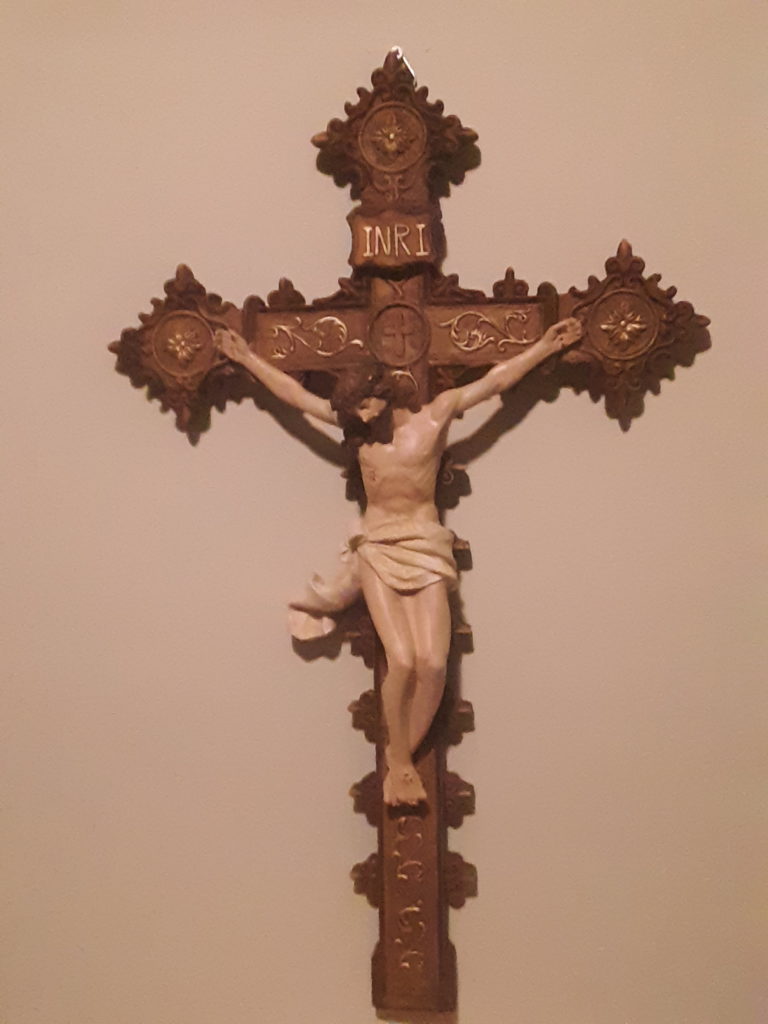
The Crucifixion. Through Jesus’ Crucifixion we have come to better know God’s mercy and forgiveness.

The Old Testament does describe God as one of vengeance. Psalm 94:1 says, “Lord, avenging God, avenging God, shine forth!.” Isaiah 24:1 says, “Now, therefore, says the Lord, the Lord of hosts, the Mighty One of Israel: Ah! I will take vengeance on my foes and fully repay my enemies!.

In Deuteronomy 32:35 we read, “Vengeance is mine and recompense.” Vengeance is retribution for a wrong done. We are to seek “justice.” However, I think “vengeance” is seen today in a negative connotation based on anger.

God does speak of retribution in Leviticus 24:19-20, “Anyone who inflicts a permanent injury on his or her neighbor shall receive the same in return: fracture for fracture, eye for eye, tooth for tooth. The same injury that one gives another shall be inflicted in return.” This verse seems to call for equal retribution for a crime. As such it is used by some to justify the death penalty as punishment for murder. However, we should understand that God is not calling for the death penalty. This verse is offered to limit punishment. People were responding to crimes with a worse punishment than the original crime so God said an “eye for an eye” to limit the punishment.

When are we seeking “revenge” over “justice”? Here, I think of a news story I saw in recent weeks where a person in federal prison was scheduled to be executed for murder. Normally, the victim’s family is allowed to be present at the execution. Because of the Coronavirus restrictions in place, the victim’s family was not able to travel to be there when the execution was scheduled. They asked for it to be delayed. I ask, if the purpose is justice, why does the victim’s family need to be there? Is it justice they seek or revenge?

Returning to my original question, “Does God change?”, I already brought up the two different images held by some from the Old and New Testaments about God’s forgiveness and punishment. We hear Jesus’ response to Leviticus 24:19-20 in Matthew 5:38-42, “You have heard that it was said, ‘An eye for an eye and a tooth for a tooth.’ But I say to you, offer no resistance to one who is evil. When someone strikes you on [your] right cheek, turn the other one to him as well. If anyone wants to go to law with you over your tunic, hand him your cloak as well. Should anyone press you into service for one mile, go with him for two miles. Give to the one who asks of you, and do not turn your back on one who wants to borrow.” Jesus calls for a gentle and compassionate response.

So, does that mean that God does change from a punishing God as witnessed in the great flood (see Genesis chapters 6-9), or in the Fall of Kingdom of Israel to the Assyrians and Babylonians (See Books of Isaiah, Jeremiah, and Ezekiel) to a gentle and forgiving God in the New Testament?

We read in Romans 12:19 (recalling Deuteronomy 32:35 above),  “Vengeance is mine, I will repay, says the Lord.” God still maintains the right to avenge in the New Testament but we trust in his mercy.

Now, let us explore the question is forgiveness ever shown in the Old Testament.

We see forgiveness offered by humans in Genesis 45 when Joseph forgives his brothers for having sold him into slavery. We see David spare Saul’s life in 1 Samuel 26. How about God’s forgiveness?

In Genesis 4, we hear the story of Cain and Abel. Does God kill Cain for having murdered Abel? No, in fact, in Genesis 4:15 God says, “Not so! the Lord said to him. If anyone kills Cain, Cain shall be avenged seven times.”

In Leviticus 19:18, we hear God say, “‘Take no revenge and cherish no grudge against your own people. You shall love your neighbor as yourself. I am the Lord.

In Exodus 32, the Israelites make a golden calf as their idol. God prepares to destroy them for their sin but relents when Moses pleads for his mercy.

Through the prophets God promises an end to the Exile that was punishment for sin. He does indeed set them free from exile.

Yes, God punished people in the Old Testament but He also forgave. He does the same today. God who is all-knowing punishes when appropriate and forgives when fit. We need God’s forgiveness.

Peace,

Fr. Jeff

Threat and Opportunity

The Coronavirus shutdown our Masses for three months. It continues to impact attendance as people stay home to protect themselves. For those who do come in person, attendance hovers about 30-40% of normal. There are others who continue to watch our Mass streaming on our new parish YouTube channel.

From this, we can consider the Coronavirus a threat to continuing participation in person at our Masses. We pray for an end to the Coronavirus pandemic and we pray that when it is over, everyone will once again attend Mass. Yet, we know some may not. There is the threat.

What about the opportunity? During the shutdown, people had more free time. Some took the opportunity to pray (more). People began watching livestreaming Mass who hadn’t attended Mass in a long time looking for God during the Coronavirus. Some of those who had been regularly attending Mass found a deeper appreciation for the Mass and for the Eucharist. In this, the Coronavirus has created an opportunity for Evangelization.

That’s a good thing. We are supposed to be evangelizing. As St. Pope Paul VI wrote in Evangelii Nuntiandi,

“Evangelizing is in fact the grace and vocation proper to the Church, her deepest identity. She exists in order to evangelize, that is to say, in order to preach and teach, to be the channel of the gift of grace, to reconcile sinners with God, and to perpetuate Christ’s sacrifice in the Mass, which is the memorial of His death and glorious resurrection (14, italics and bold my emphasis).

Evangelization is at the heart of my ministry. It is the reason for this blog and website. We have a wonderful faith to share. We don’t have to create a new faith. The faith is the same faith that God has been offering since the beginning of creation. We do not need a new message. The message is Jesus’. However, we do need to look for new ways to communicate the message. As Pope Francis wrote in Evangelii Gaudium,

“In her ongoing discernment, the Church can also come to see that certain customs not directly connected to the heart of the Gospel, even some which have deep historical roots, are no longer properly understood and appreciated. Some of these customs may be beautiful, but they no longer serve as means of communicating the Gospel (EG, 43).”

In Made for Mission: Renewing Your Parish Culture (Huntington, IN: Our Sunday Visitor Publishing. 2019), Tim Glemkowski describes four steps in the catechumenate (RCIA process), Pre-Evangelization, Evangelization, Discipleship, and Apostolate (81). My ministry focuses on evangelization and discipleship but today it is “pre-evangelization” I would like to focus on.

Glemkowski describes Pre-Evangelization as “all of the preparation, especially the removing of obstacles, to make way for receptivity to the Gospel message” (95-96). To put it simply, before we can have any success in sharing the faith, the person must be open to hearing what we offer.

In reflecting on his work teaching young Catholics, Glemkowski writes

“I realized one of the core problems was that I was trying to teaching objective moral tenets to teens who did not believe in an absolute objective morality” (98).

If we want to bring people to a relationship with Jesus, we need to build trust and help them encounter Jesus (Glemkowski, 90). Among other things, the sexual abuse scandal broke trust for many people in the church. We need to rebuild that trust. However, I think the trust needed here is not simply trust in the Church. It also includes the trust people have in each of you. You have relationships with other people. Those relationships involve some level of trust. They are willing to listen to you. As to helping them encounter Jesus, I encourage you to share your own experiences of God that they might relate to. This is not about forcing faith on anyone. It is about seeing who is looking for depth and meaning in them and offering them Jesus.

Here, Glemkowsi offers his four A’s to Pre-Evangelization (100-101):

1. “Appeal to the Heart” – this is where I mention looking for those searching for depth and meaning.

2. “Appeal to the Intellect” – for people who need a reason or argument for everything, we need to learn “arguments” like St. Thomas Aquinas argument for a first cause. One might think the Big Bang Theory answers the question of creation but what caused the Big Bang?

3. “Address wounds” – we must realize that someone’s struggle with faith might be rooted in past hurts such as the abuse scandal or misunderstanding of church teaching. Those hurts needs to be recognized as real and addressed.

4. “Always build the relationship first” – Church teaching is important. It is essential, but we need to build a relationship before people will listen to the teaching.

This is a lot to digest. For those who wonder what to tell people first about God, I offer Glemkowski’s list (103):

“1) God loves you and has a plan for your life.
2) Sin separates us from God.
3) Jesus Christ, in his life, death, and resurrection, saved us from sin.
4) By turning away from sin and toward God and his Church, we can live a new life as adopted sons and daughters of the Father.”

Tell them the truth. Tell them that God loves them and so do we.

Peace,

Fr. Jeff