I started my new series of webinars, Uncovering the Treasures of the Mass, last night. You are view the recording of the webinar on my website at www.renewaloffaith.org/masspart1.
Peace,
Fr. Jeff
I started my new series of webinars, Uncovering the Treasures of the Mass, last night. You are view the recording of the webinar on my website at www.renewaloffaith.org/masspart1.
Peace,
Fr. Jeff
Last week I wrote an article here, “The Easy Path or the Hard Path”, discussing morality. I said that I plan to offer more on morality but that I am unsure what form it will take or when. I remain uncertain of that but since posting that article, God gave me the idea for this article. Should not one begin discussion on a topic by defining what it is?
Since I am concerned with the decline of morality in society in general, it seems appropriate to start with a definition of morality from a secular dictionary.
Webster’s II New Riverside Dictionary (The Riverside Publishing Company. 1984.) begins its definition of “morality” with “1. The quality of being in accord with stands of good or right conduct. 2. A system of ideas of right and wrong conduct.”
I think this definition gets to the core of my concern about morality. To be moral is to know the difference between right and wrong and to choose the right.
However, this definition of morality says nothing about how right and wrong is determined. This gets to what I see as the core of morality in society today, “who determines what is right and wrong.”
There are those who believe there is no universal right and wrong. They say everyone gets to decide what is right and wrong for themselves. We call this “relativism.” They have rejected the very notion of “truth” (see my video presentation Where Do We Go for Truth? for more on “truth).
Paul speaks of those who reject sound doctrine in 2 Timothy 4:3, “For the time will come when people will not tolerate sound doctrine but, following their own desires and insatiable curiosity, will accumulate teachers and will stop listening to the truth and will be diverted to myths.”
Fortunately, not everyone has rejected truth.
Some rely on Psychology for answers. Psychology is a tool to help understand right and wrong behavior and to help us choose the right behavior. However, Psychology does determine what it is right and wrong.
Others will say right and wrong is determined by majority opinion. The first problem with this is that it means what is right and wrong can change as people’s opinion changes. How do even determine what the majority really thinks? What if it is a very slim majority? How does one count people who say they won’t do it themselves but feel others should be free to choose for themselves? An example of this is abortion. There are people who say they would never have an abortion but don’t feel they should impose their beliefs on others.
I emphasis “their” beliefs because if it were just “their” beliefs, they might be right. However, for morality, we have a higher source that we can turn to, God.
God’s Law is good for us. It tells us what right conduct is. Take a look at the Commandments (see “God’s Commandments”). For example, the commandment against stealing is good for society. If everyone went around stealing, we would not be able to trust one another. Trust is necessary for society to fully function. Likewise, telling the truth (“You shall not bear false witness”) is necessary for society.
When we observe commandments like these, people will see us as “a wise and discerning people” (Deuteronomy 4:6, see Deuteronomy 4:1-8 for whole passage). Yet, there are people who would disagree with some of the commandments like “You shall not commit adultery.”
We need to listen to God. Why should we? In John 15:13 Jesus said, “No one has greater love than this, to lay down one’s life for one’s friends.” Jesus did just this. He laid down his life for us on the Cross. He did this because He loves us. We can trust Jesus.
This points us to points us to a definition of morality found in the online Catholic Culture Dictionary. It begins its definition of morality, “Relations between a human act and the final destiny of a human being. It is the norm of behavior that flows from each person’s ultimate end, which is the possession of God in the beatific vision” (see full definition at https://www.catholicculture.org/culture/library/dictionary/index.cfm?id=34966).
Our morality is rooted in something larger than our actions and decisions at any one particular moment. Our morality is based on our “final destiny,” our “ultimate end.” Our morality is based on our desire to spend eternity with God.
Peace,
Fr. Jeff
P.S. For further reading see my article, “Do We Listen to our Conscience?”
25th Sunday in Ordinary Time, Year A
Isaiah 55:6-9
Psalm 145:2-3, 8-9, 17-18 (18a)
Philippians 1:20c-24, 27a
Matthew 20:1-16a
September 20, 2020
Jesus continues to teach us about the Kingdom of Heaven. Today He describes it using a parable of a landowner and his vineyard. The topic within the parable is fair payment for work.
In those days, standard practice was to pay the workers at the end of each day for that day’s work. Each morning the owner would decide how many workers they needed and hire them for the “usual day wage.”
Throughout the day, this landowner kept hiring more workers, agreeing to pay them “what is just” without discussion of what that would be. The assumption then (we would make the same assumption today) is that they would be paid in proportion to the number of hours worked.
The end of the day comes. He starts by paying those who only worked the final hours. They are paid the full “usual day wage.” The workers who worked the entire day were excited for “they thought that they would receive more.” That was not the case as “each of them also got the usual day wage.”
They are, and understandably so, upset. Simple fairness says that those who worked more would get paid more. We have the same expectation today. In fact, labor laws today require most workers to be paid by the hour.
So, why did the landowner pay them all the same?
He had agreed to pay the workers hired first “the usual day wage.” What was that wage based on? It was set by what a person needed to provide for their family’s needs.
The landowner agreed to pay the workers hired later, “what is just.” What is “just” is determined by what they need. They need to provide for their families. Yes, the landowner was generous in paying them the full “usual day wage.” He did so to provide for their needs.
So, we can take this parable to help us think about what a “just wage” is for human labor.
We can also use this passage to reflect on our eternal reward. If we follow Jesus as the way and the truth and the life, we will be welcomed into our place in Heaven. Everyone is equal in Heaven. Our place in Heaven is not something we earn. It is a gift. Anyone who dies truly believing in Jesus with a repentant and contrite heart enters Heaven.
It doesn’t matter if one only becomes a good Christian near death or if they are a lifelong believer. God will forgive their contrite heart and grant them a place in Heaven.
That might not seem fair if they waited until near death to become Christian. It might be tempting to think we can forget about God until we know death is coming and then repent.
Two problems with that.
First, we don’t know the hour of our death so you might die without the chance to repent.
Secondly, we are called to “seek the Lord.” We are called to do this now. If we think we can put off seeking the Lord today, planning a death bed conversion later, we are in fact turning away from God. We are thinking that our ways are better in this world but they are not. God’s ways are not our ways.
So, how do we seek the Lord? We can seek the Lord in the Bible. We can seek the Lord in finding opportunities to learn more about how God calls us to live and why. We aren’t going to understand everything about God. We don’t need to but we do need to seek him.
We seek the Lord in what we are doing right now.
We are celebrating the Mass. Looking at the “how” of the way we worship, I suspect most people here have a pretty good idea of what we do at Mass. You know when to stand and when to kneel. You know the proper responses to the priest’s invocation. You know that we hear readings from the Bible and you know the prayers that go with Communion.
You know the “what” (i.e. the “how”) but do you know the why? We can do things without knowing the meaning behind them. We most truly seek the Lord when we know not just what we do but also the “why.”
If you know the why, good for you. If you don’t, this is what the series, Uncovering the Treasures of the Mass, I am starting this week is all about. I invite anyone with a computer and Internet to join.
I know not everyone has a computer. God still invites you to seek him. If you have questions about what we do at Mass, don’t be afraid to ask.
The Lord offers us eternal life in Heaven. You don’t have to wait till then to receive God’s grace. Open yourself to the Lord. Seek the Lord in your lives now.
If you are reading this, then you are probably trying to live a Christian life. What does that entail? It includes prayer. It means that we believe that Jesus was crucified on the Cross and rose on the third day, revealing the Resurrection. It means giving praise and worship to God. It means trying to live as God teaches us.
Is it easy?
We want God to meet us where we are at. This is the easiest way for us. It doesn’t require a lot of effort on our part. Furthermore, I think people think that if God comes to them, they can stay where they are at. By this, I mean they can keep living the way they have been. They think that God coming to them validates their behavior.
God does not come to us to validate our behavior. God comes to us because He loves us that much. Think of the father in the Parable of the Prodigal Son (Luke 15:11-32). The father is so happy to see his younger son return that he runs out to meet him. He is so happy that he throws a party. However, never in that story does the father ever say what his lost son did was okay. His welcoming his lost son back into his house would come with the expectation of the son following the customs of the father’s house.
Yes, God comes us to where we are at in our lives, no matter our sins, but He loves us too much to leave us in our sin. In John 8:1-11, Jesus does not condemn the woman caught in adultery. However, neither does He say can continue her adultery. Instead He says, “Go, and from now on do not sin any more.”
There is “right” and “wrong” behavior. Following Jesus, in addition to prayer and worship, requires us to do what is right in God’s eyes. Being Christian requires us to be moral people as God defines moral. This is part of what it means to pray, “thy will be done” in the Lord’s Prayer.
Yet, it seems society has lost its moral compass. There is a loss of respect for life (abortion, death penalty, assisted-suicide). There is a loss of the sense of sexual intimacy as a gift from God and an act of love rather than just something one does for physical pleasure.
These topics are not without controversy. In fact, they can very controversial. Most people seek to avoid controversy so they say nothing to “keep the peace.”
Is that what Jesus did? Take a look at Luke 12:49-53. Jesus himself understands controversy. He himself says He came not to bring peace but “division.” Jesus wasn’t looking to start a fight but He know his teaching would bring division between family and friends. He did not let that stop him for He knew the people need to hear the truth.
It’s not easy to talk about morality. I haven’t always talked about Catholic moral teaching as often as I should because I too like to avoid controversy. I ask God for the gifts of knowledge, understanding, and wisdom from the Holy Spirit to know the right words to say. I also ask for the gift of courage to actually say it.
The world needs to hear the Truth (see my video, Where Do We Go for Truth?). This is true for people outside the Catholic Church as well as people within our Catholic Church. The approach of many people in the Catholic Church is to ask what is minimum I need to do to get into Heaven has gone on too long. It is not enough to go to Mass and pray when we are in need. We need to live our faith in everything we do.
We are not perfect. We are sinners. Thankfully, God comes to us in our sins and heals us. For, “as the saying goes, the Church is not a “hotel for saints,” it’s a “hospital for sinners” (18-19). I take this quote from a book, Good News About Sex & Marriage: Answers to Your Honest Questions about Catholic Teaching, by Christopher West (Updated, Revised & Expanded Edition. Cincinnati: Franciscan Media. 2018).
In this book, Christopher West talks honestly and boldly about Catholic moral teaching on sexuality. He discusses how male and female compliment one another and come together in a way two men and two women cannot. He talks about sexual intimacy as an act of love. He talks about how what we do with our bodies reveals who we are as a person.
Some people say the Church should say out of the bedroom. To think this way is to miss the point of our sexuality. It is to be an act of love. Love comes from God. God created us “male and female” (Genesis 1:27). Our faith is not just what we do for an hour on Sunday and in private prayer. Our faith is to be part of our whole life.
It may seem easiest to say nothing. However, the easiest path is not the most rewarding. Our greatest reward lies in the Kingdom of Heaven. The path of Christ can be hard. The reward is worth it.
It might seem desirable to form our own utopia (see my article “Looking for Peaceful Existence”) but we are called to build up the Kingdom of God in the world. We are not to force our faith on people but God wants us to offer his Truth to all.
I personally feel called to speak up as Ezekiel was in the Parable of the Watchman (see my homily for the 23rd Sunday in Ordinary Time). Yet, I am not sure how. Talking about our Catholic morality is not simple. Certainly, it includes homilies. I think it may also includes blog articles, longer articles on my website, and maybe even some presentations. Right now, I don’t know. So, I ask your prayers for me to know what God wants me to say and do to spread his Truth in a loving and kind way.
What do you think?
Peace,
Fr. Jeff
Recently I was watching the news about the wildfires on the West Coast. They say that over 4 million acres have burned this year. California has already passed their record for the number of acres burned in a single year with fires still burning. Oregon has passed it average and fires burn in Washington state.
As I watched the news I had a feeling of powerlessness. I want to do something to help but what am I to do. I am not a firefighter nor am I about to become one. I don’t feel called to become a relief worker. These fires burn over 2,500 miles away. What can I do?
Of course, we can and should pray. Sometimes that doesn’t seem like much. Here we must remember that while we might feel powerless, God is not.
I want to do something to help. Yet, in not feeling called or gifted to help in this particular situation (wildfires), I need to remember that while one person can make a difference, one person does not have to do everything. We must remember that as Paul says that we are many parts but one body (see 1 Corinthians 12).
The body has many parts that are not all meant to do the same functions. The hand does not serve the same function as the foot. The eye does not serve the same function as the ear. The heart does not serve the same function as the stomach. Yet, all working together, they are one body.
So, none of us can or need to do everything on our own. We are not supposed to. We are to work together to build up the Kingdom of God and to perform works of mercy to help those in need.
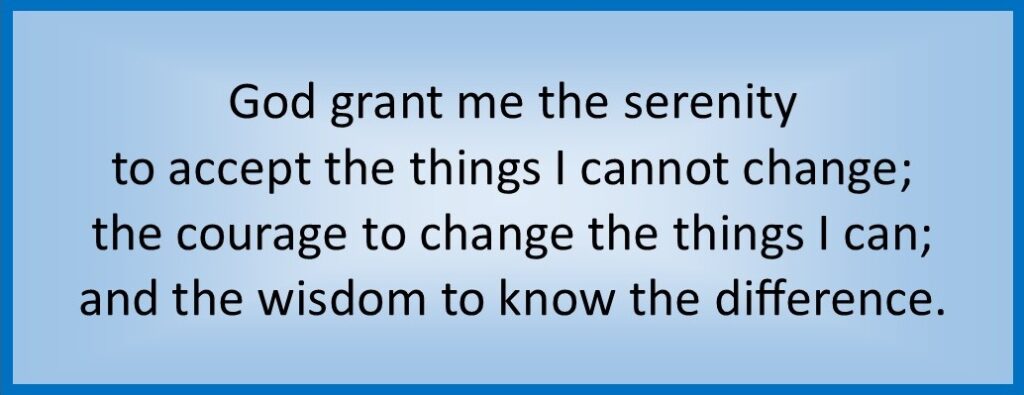
What we have to take to God in prayer is to ask for the gift of good judgment to know what God is calling us to do and to have the courage to do it. Here the Serenity prayer comes to mind.
When we discern that we are not called to respond to a particular situation, our prayer is not done. We are always called to pray for those who are called to respond. This is true for the wildfires as well as the large numbers of tropical storms/hurricanes (also nearing record levels) this year. We can pray for emergency responders, the relief workers, and for the health and safety of all those affected.
There may be times when we feel called to help but we are not sure what to do. At other times we have an idea how to improve a situation but not have the means to execute the idea. Both workers and people with ideas are needed. We pray that God connect the ideas with the people who can put them into action.
Where do you feel powerless in your life? Is it with the wildfires or the storms? Perhaps the Coronavirus? What about violence acts such as mass shootings? How about the issue of racism?
For me, I would say powerlessness centers on two things. The first is things I can’t understand, like why valid protests turn into riots and looting. The second is when I have an idea but people don’t seem to either listen to or understand what I am trying to say. For the former (not understanding), I ask for the serenity to realize I am not going to understand everything. For the latter (others not listening or understanding), I ask for the words I need from God to do what He calls me to do.
Do you feel powerless? Let us pray that God shows each of us what He calls us to do so that together, we build up the Body of Christ.
Peace,
Fr. Jeff
24th Sunday in Ordinary Time, Year A
Sirach 27:30-28:7
Psalm 103:1-2, 3-4, 9-10, 11-12 (8)
Romans 14:7-9
Matthew 18:21-35
September 13, 2020
It can be hard to forgive. It can be even harder to forgive the same person over and over for the same thing. Peter knows this. So, he asks Jesus, “How often must I forgive? As many as seven times?” To the Jews seven times would sound generous.
Is Jesus pleased with the “seven” suggested by Peter? No, He replies, “not seven times but seventy-seven times.” Wow! That’s a lot. If you are thinking, okay, maybe 77 but that’s it, you are missing where Jesus is trying to lead us.
Another way of looking at it is to ask yourself how many times you want to be forgiven. Would not your answer be to ask for forgiveness every time you sin, no matter how many times that is?
God wants to forgive us. God could seek to destroy us for our sins but, as the psalm says, “Not according to our sins does he deal with us.” It might be hard for us to imagine because we find it hard to forgive others but God “pardons all your iniquities.”
God does this because He loves us. Jesus dies for all our sins because He loves us.
We should be grateful for this. In gratitude we should be inspired to forgive others. Jesus tells the parable today to demonstrate this. A debtor owes his master “a huge amount.” When the master comes to collect, the debtor “fell down, and did him homage” asking for more time. The master is so moved with compassion that he is generous and forgives the whole loan.
One might think the debtor would be inspired by the master’s generosity but he is not. In fact, he goes and demands payment from someone who owes “him a much smaller amount.” He has just been forgiven a huge debt. He could afford to forgive but he does not. The master hears of this and hands him over to the torturers.
If we want God to forgive us, we need to be willing to forgive others. This is not new with Jesus. We hear about forgiving our neighbors in our reading today from Sirach, “Forgive your neighbor’s injustice, then when you pray, your own sins will be forgiven.”
Every time we pray the Lord’s Prayer, we say, “forgive us our trespasses as we forgive those who trespass against us.” We are saying we will forgive others. Why are we willing to forgive others?
The first answer comes from obligation, obedience to God. God tells us to forgive. We need to do as God says.
The second answer might be rooted in some selfishness. We forgive only because we want to be forgiven our own sins.
The third answer is because we seek healing from the Lord. Our hearts are hurting because of what has been done to us. But, as Sirach says, “Could anyone nourish anger against another and expect healing from the LORD?”
If we want to be healed of the hurt, we need to be willing to forgive.
We cannot hold onto grudges. We hurt ourselves when we hold onto our grudges for, as Sirach says, “Wrath and anger are hateful things, yet the sinner hugs them tight.”
Yet, we know it can be hard to forgive.
What does it even mean to forgive?
People tend to think forgiving requires forgetting. I think with the little things this can be true. Just let it go.
However, if someone commits a very serious sin like murder, I don’t think God expects us to just forget about it. There is to be appropriate action but for our own good we need to let go of the hurt.
So, what does it mean to forgive?
I read a list of three things required in forgiveness a few months ago that help put forgiveness into perspective.
The first thing is we need to be willing to do is wish good for the person. This can include their conversion from sin to God’s ways. It includes wishing for only good things in the future to happen to them.
The second thing is to be able to be polite to them if we see them. This doesn’t mean that we have to be best friends with them. It does mean that we need to take the high road.
The third thing is to pray for them. Again, this can include praying for their conversion but not only their conversion. Pray that God’s will be done in them.
I mentioned before how our motive in forgiving others might be entirely selfish, knowing at times, we need to be forgiven and that we need healing.
However, our motives to forgive others don’t have to have any selfish motive at all.
Why does God forgive us? Could God be forgiving us for selfish reasons? What would God have to gain by forgiving us?
No, God does not forgive us for selfish reasons.
God forgives because He loves us.
We can forgive others based on love. How does one love someone who has hurt us? Here, we need to realize there are different types of love. There is romantic love between a man and a woman as husband and wife. There is love within families. There is love between families.
There is love we are called to have for every single person. We care for them. We wish well for them. We pray for them. We forgive them.
We forgive them from our heart.
Forgiveness can be hard but it brings healing not just to the one forgiven but also to the one who has been hurt. God, give us the grace to forgive.
I remember back in my school days hearing about utopian societies. Such groups are the attempts of the members to form a perfect society. In my limited knowledge of them, they were small, insular societies. To me, the world didn’t seem like too bad a place so I did not grasp the point of trying to establish a utopian group. What were they trying to accomplish?
I want to offer two clarifications before continuing. First, when one thinks of small, insular groups, one might think of cults that are devoted to a person or particular movement, often professing a religious belief, that misuses it members. These are not utopias in the honorable sense that I mean.
One might also think of monasteries. They can be small, insular communities but their purpose is centered differently than the utopians I am talking about. One’s purpose in going a monastery should not be rooted in escaping society. The purpose of joining a monastery is to answer the call of God to live a particular lifestyle. Monastic life may share traits in common with utopian groups but it’s center is different.
That being said, in today’s society, the idea of a utopian society seems more attractive to me than in the past. I feel society is on the decline. We are losing a sense of morality. We hear about more violence and hatred. People are no longer listening to God. It seems our society is shaping our faith and beliefs when it should be that our faith shapes society. It can seem tempting to escape this by forming a utopian society.
Are utopias even possible or does their attractiveness fall under the saying that the grass is always greener on the other side of the fence?
Why won’t they be possible? My first thought is that, as human beings, we are called to be holy and to strive for perfection, but we are not perfect. Is it possible to have a perfect society with imperfect people? This should not discourage us. It’s just a reality that needs to be considered.
My second thought about the possibility of utopias is how does one relate to rest of the world? Would the group need to cut off all contact with the outside world? That would mean no cell phones and no Internet. Honestly, some days this might seem attractive but would you really want to cut off all contact with your family and friends outside the group?
Another thought I have about utopians is the sustainability of the group. How does the group provide for all its needs. Where does one get their electricity and heating fuel from? Can the group grow all the food it needs? What about clothing needs? Would they have to go to the outside world for some of their needs?
What about freedom in a utopia? Is absolute freedom really possible? At times doesn’t the greater good of society mean we need to give up some things we want? We can’t have everything we want. Sometimes two people may have two different wants that can’t both happen.
I’m not saying utopias are not possible. After all, we are called to live in this world but we are not of this world (see my article, “In the World But Not of the World”).
So, rather than trying to form our own utopia, I think we need to continue to live in this world. We need to work to make the world a better place. How is this possible?
Through grace.
How do we define what it means to make the world a better place? We should not look for the answer in purely human sources. To strive for perfection, we need to turn to the one who is perfect. We need to turn to God. God has the answers. This is why we pray, “thy kindgom come, thy will be done.”
God loves us. We are created to know his love. We move towards perfection when we strive to love God and love our neighbor. I think we are struggling to even know what it means to love in this way.
The task might seem impossible. That should not deter us for Jesus says, “For human beings this is impossible, but for God all things are possible” (Matthew 19:26, cf Mark 10:27, Luke 1:37, and Luke 18:27).
I don’t have all the answers but I do have faith. We can change the world but to do so we need to hand it all over to God.
Peace,
Fr. Jeff
One of the topics I have covered a few times during the Coronavirus is prayer (see https://blog.renewaloffaith.org/blog/?cat=12 for those articles & homilies). Today I would like to cover a particular form of prayer required of clergy and religious but an option for all, the Liturgy of the Hours, also known as the Divine Office.
We can pray in various ways (see “Prayer & Devotions” for some of the most common). Most of the ways are prayers we might do on our own. There are some, like the Rosary and the Stations of the Cross that are often prayed in groups as well as individually.
The Mass is the public prayer of the Church. It is done together with a congregation. We pray the Mass not as individual believers but as a community of believers. We are united not just with those in the same church building as us but with all Catholics for the Mass transcends time and space to unite all those who pray the same readings and prayers of the Mass.
The Liturgy of the Hours is also considered “public prayer.” The term “public prayer” does not mean it can only be prayed in groups. Even when we pray the Liturgy of the Hours alone, we pray the same psalms, readings, and prayers as others. Thus, even when we are alone, we still pray together.
As a member of the clergy, I am obligated to pray the Liturgy of the Hours. It is one of the things a clergy person obligates themselves to at their ordination.
After thirteen years of priesthood and seven years of seminary life before than, I will admit praying the Liturgy of the Hours has become routine for me. Thus, there can be days where I pray the Liturgy of the Hours more out of obligation than personal desire. This does not mean I don’t want to pray. It just means I need motivation. Are there not times when we might not feel like going to Mass but we do because we are obligated? We need to pray.
However, the obligation is not the only reason I pray the Liturgy of the Hours. I like knowing that when I pray the hours, I am not praying alone. I am part of something bigger than myself. This is part of what it means to be Catholic. There are times when a verse in one of the psalms, canticles, or readings really hit home with something I need to hear.
So, what is the Liturgy of the Hours? It calls the Liturgy of the Hours as it calls for prayers on a cycle throughout the hours of the day. Diocesan clergy pray five times a day (some religious, especially those in monasteries pray seven times a day). It keeps us in a spirit of prayer throughout the day, keeping with Paul’s words, “pray without ceasing” (1 Thessalonians 5:17). This is not unique to Christians. It comes from our Jewish origins. Muslims also keep a similar pattern of prayer throughout the day.
The Liturgy of the Hours centers on the 150 psalms in the Book of Psalms. It also includes canticles from other books in both the Old and the New Testament. Two of the hours include intercessory prayer for the needs of the world. Hymns are also included.
So, what are the five times a day when the Liturgy of the Hours is prayed?
The first is the Office of Readings (aka Vigils). For monasteries, it is prayed in the very early hour of the day (hence, it’s name, vigils, keeping vigilant through the night into morning). For diocesan clergy and the laity, it can be prayed at any time of the day. It includes three psalms/canticles (Here, I note that religious orders, especially monasteries can have their own cycles for the Liturgy of the Hours that may include a different number of psalms – see the page from the website of the Abbey of the Genesee for their version.). It also includes a hymn, two extended readings, one from the Bible and one from the early church fathers or more recent church documents.
The second cycle is Morning Prayer (aka Lauds) at daybreak. It includes a hymn, three psalms/canticles, intercessory prayer, a scripture reading and response, the Canticle of Zechariah taken from Luke 1:68-79, and the Lord’s Prayer.
The third cycle is Midday Prayer (aka Sext). It includes a hymn, three psalms/canticles, and a short reading. As the name suggests, it is prayed in the middle of the day. (Monasteries add two other cycles, one mid-morning known as Terce and one mid-afternoon, known as None.)
The fourth cycle is Evening Prayer (aka Vespers). It mirrors Morning Prayer and is prayed as the day progresses into the darkness. It includes Mary’s Magnificat from Luke 1:46-55.
The fifth and final cycle is Night Prayer (aka Compline). It includes a hymn, a penitential rite calling us to reflect on our day as it concludes, a psalm, short reading and response, and the Canticle of Simeon, found in Luke 2:29-32. At its conclusion, a Marian prayer/hymn is offered.
Traditionally, there are set books with all the palms, hymns, readings, and prayers properly laid out that you can purchase. I prefer to pray from a book but you can also find the Liturgy of the Hours online on websites/apps like ibreviary.org.
Peace,
Fr. Jeff
23rd Sunday in Ordinary Time, Year A
Ezekiel 33:7-9
Psalm 95:1-2, 6-7, 8-9 (8)
Romans 13:8-10
Matthew 18:15-20
September 6, 2020
Today we hear about how God calls us to respond to sin.
The first reading is sometimes known as the Parable of the Watchman. A watchman was assigned as a lookout to watch for danger. If he saw danger coming, the watchman was to alert the people to the coming danger.
The Lord speaks of how He appointed Ezekiel as a watchman for the house of Israel to warn them of their sins. Unfortunately, not everyone would listen. Some will harden their hearts against the Lord’s voice. That is their choice. The Lord says such people will die for their guilt. What He says to Ezekiel as watchman, and what we need to think about, is that we do not speak up for what is right, we will be held responsible for our omission. However, as long as we speak up for what is right, even if the person refuses to listen, we will be saved.
It is their choice to sin or not. What we do when we speak up is to help them know what their choices are. If they don’t know God’s way, they are not free to make a choice.
We seek to trust in God. We kneel before him who made us.
Yet, at times we do sin. How are we to respond when someone does sin?
Jesus gives us the answer in today’s gospel. He describes the first step, “If your brother sins against you, go and tell him his fault, between you and him alone.”
We are to start one-on-one. It is sometimes the case that the person doesn’t realize what they have done or how it may have hurt us. As soon as they do, they are sorry, and we can forgive them. There is always the possibility we misinterpreted their actions. In either case, there is no need to involve other people.
If they do not listen, then Jesus says, “take one or two others along with you, so that every fact may be established on the testimony of two or three witnesses.” We still keep it small. Here, I think we need to reflect on what our goal is.
Do we see the point of two or three witnesses as to prove we are “in the right”? As Jesus says, it is important to establish the facts but with what goal? We need to make sure we are right but the goal is not to prove ourselves right.
The goal that Jesus is guiding us towards is the conversion of the person who has sinned. Our goal is to help them see the error of ways so that they will change. Our motivation is not to be right ourselves. Our motivation is love.
If the person does not listen, step three is to tell the church. This is again rooted in the conversion of the sinner, to help them realize this is not just the opinion of one individual with two or three witnesses. It is what God teaches through his church.
If the person still does not listen, step four is to “treat him as you would a Gentile or tax collector.” What does that mean? Many of the Jews would have taken this to mean to shun them, to not eat or drink with them. That’s how the Jews treated sinners. However, what did Jesus do with sinners?
He ate with them.
He did not ignore their sins. What did He say to the woman caught in adultery? “Go, and from now on do not sin any more” (John 8:11). He does not condemn her but he does call her to change her ways. Why? Because He loved her.
Today we hear people speak of “tolerance” and not judging. Jesus tells us to stop judging. However, when done out of love, pointing out one’s sins doesn’t have to mean we are judging them. We hate the sin but we love the sinner. We speak out of mercy.
We learn of the Corporal Works of Mercy from Jesus’ words in Matthew 25:31-46. We are to feed the hungry and clothe the sick as some of these corporal acts.
Are you aware that there are also Spiritual Works of Mercy?
The third spiritual work of mercy is to admonish the sinner. One might see the word “admonish” as harsh but it should not be. It is an act of mercy because we care about the person. We want them to see the error of their ways so they too can be welcomed into the heavenly kingdom.
To help put it into perspective, as much as admonishing the sinner is one of the Spiritual Works of Mercy, so too is “forgiving injuries.” Before we admonish one who has wronged us, we need to be willing to forgive them.
We do all this in love for, as Paul says, “for the one who loves another has fulfilled the law.”
Has someone wronged you? Before you rush to judge, ask yourself what Jesus wants you to do. Is He calling you to speak up? If so, ask the Holy Spirit for the right words so your words and actions are rooted in God’s love.
At Baptism, we are asked six questions as our “baptismal promises.” (When we are baptized as infants, our parents answer for us.) At Confirmation we renew our baptismal promises ourselves. Each year at Easter time, we renew them.
We respond, “I do,” to each question. How much do we think about what we are saying “I do” to? Let’s take a look at the questions.
They come in two groups of three. For the first three there are two options. For reflection purposes I will focus on the first option. (In option B, the questions are “Do you renounce sin, so as to live in the freedom of the children of God? Do you renounce the lure of evil, so that sin may have no mastery over you? Do you renounce Satan, the author and prince of sin?)
Do you renounce Satan?
This should be an easy question. Who would choose evil? We do not want to do evil. However, Genesis 3:1 says, “Now the snake was the most cunning of the wild animals.” Satan is cunning. As he did with Eve in the Garden, (Genesis 3), he will twist God’s words and our own words to his advantage. Jesus himself refers to the devil as a “liar” (John 8:44). We need to be careful. Lord, help us resist the cunning snares of the devil.
And all his works?
If we recognize something as a work of the devil, we would try to resist it. The question is do we recognize it as a work of the devil? In the Lord’s Prayer, we pray, “lead us not into temptation.” What makes it tempting? Generally, it is because there is some pleasure. We want that pleasure. Hedonism is a way of life that puts pleasure as the supreme goal. We are called to put what is good ahead of pleasure. One way to look at it is to ask yourself how much you seek to accumulate money to use for pleasure while not caring who you hurt in the process. Power and greed are things of Satan.
And all his empty show?
Satan tries to make his way look attractive and even good. In Matthew 4:1-11, Jesus faces repeated temptations by the devil. First, Jesus has been fasting for forty days. Knowing this, the devil tries to tempt Jesus to use his power to become bread. He tries to tempt Jesus to use that power to satisfy his own hunger. Would it be that bad? It may not seem bad but it is not the Father’s will. Then, the devil uses scripture (where it says the angels would support you) to tempt Jesus to sin, going against the Father’s Will. Remember what I say about Satan being cunning? Lastly, the devil tries to tempt Jesus by offering him the whole world. Jesus refuses. Are you tempted by the offer of power?
Now, the three remaining questions shift specifically to our belief in the Father, the Son, and the Holy Spirit.
Do you believe in God, the Father almighty, Creator of heaven and earth?
First, I note, as I often do, that “believe” is a verb. That requires action. Do you just say you believe or do you live like you believe? Do you believe in God as “almighty,” the one who is all-powerful and all-knowing? If you believe in him as “all-knowing,” then you should count on him for the truth of what is right and wrong. Do you see him not just as a distant being but as your Father, meaning do you have a relationship with him? Do you see God as the Creator of all things and, thus, respect what He has created?
Do you believe in Jesus Christ, his only Son, our Lord, who was born of the Virgin Mary, suffered death and was buried, rose again from the dead and is seated at the right hand of the Father?
The name “Jesus” means “God saves.” Do you believe in Jesus as your savior? “Christ” is a title meaning “messiah” and “chosen one.” Do you believe that Jesus is the long-awaited messiah? In calling Jesus “Lord” do you believe him to be your Lord, your ‘ruler” to whom obedience is due? He was born of the Virgin Mary, meaning He willing gave up his divinity to come to save us (see Philippians 2:5-11). He willingly suffered because He loves us absolutely. He appeared in the Resurrection to his disciples so that we might have the hope of eternal life. Do you?
Do you believe in the Holy Spirit, the holy catholic Church, the communion of saints, the forgiveness of sins, the resurrection of the body, and life everlasting?
Do you know that in Baptism you received the Holy Spirit and were sealed with it at Confirmation? The Holy Spirit gives us gifts of knowledge, wisdom, understanding, courage, counsel, piety, and fear of the Lord. Do we accept these gifts and use them to make the world a better place, for the building up of God’s Kingdom? Do you believe that our Catholic Church is founded upon Jesus and guided by the Holy Spirit? Do you believe that God wants to forgive you (because He does!)? Do you seek your place in Heaven by following the truth that Jesus offers?
If you find yourself lacking in living up to these baptismal promises, do not be afraid. Jesus willing gave his life for the forgiveness of our sins. If you have fallen into sin, ask God for forgiveness with a contrite heart and He will.
Peace,
Fr. Jeff