The Solemnity of All Saints – Homily

The Solemnity of All Saints
Revelation 7:2-4, 9-14
Psalm 24:1bc-2, 3-4ab, 5-6 (6)
1 John 3:1-3
Matthew 5:1-12a
November 1, 2020

We gather today for Sunday Mass.  Normally we would be celebrating the 31st Sunday in Ordinary Time today.  However, today is different. 

It is also November 1st.  That means it is the Solemnity of All Saints.  Throughout the year, there are feast days of saints.  For daily Mass, the readings and some of the prayers may change for the saint.  However, when a saint’’ feastday falls on Sunday, the Sunday takes precedence and the saint’s feast is not normally celebrated.

All Saints Day is celebrated honoring all the saints, most especially those not known by name and, thus, have no feastday of their own.  Unlike most individual saint’s feastday, All Saints Day is a Solemnity.  Solemnities rank higher on our church calendar than Sunday.  Hence, we celebrate the Solemnity of All Saints today while also fulfilling our Sunday obligation.

I will take a moment here regarding a common misunderstanding of our Catholic understanding of saints.  We do not worship saints.  That would break the commandment to worship only the one true God.  We venerate the saints.  To venerate is to honor them for their devotion and example. 

Knowing they are in Heaven with God we ask for their intercession, meaning we ask them to pray to God for our needs.

Who are the saints?  Everyone in Heaven is a saint.  The Book of Revelation speaks of the ones who have the seal on their foreheads.  Here, I think of the Rite of Baptism of Children when the Sign of the Cross is made on the child’s forehead.

Who can be a saint?  Revelation speaks of the 144,000.  Are we to take this number as an exact number?  That won’t give us very good odds if only 144,000 people made it into Heaven considering there are over 7 billion people alive today.  

So, what does the number 144,000 represent?  144 is 12 times 12.  There are the twelve tribes of Israel and the Twelve Apostles.  Multiply 12 x 12 brings us to the 144 showing it includes all of them.  The thousand part shows it to be a large number.  Revelation goes onto speak of a “great multitude…from every tribe, race, people, and tongue.”  Anyone can get into Heaven regardless of where they are from, skin color, or language.  While not all accept God, God invites all to his kingdom.

We are the people that long to see the face of God.  So, “Who can ascend the mountain of the LORD?” 

If we wish to enter into Heaven, we must be “poor in spirit for theirs is the Kingdom of heaven.”  We must be “meek, for they will inherit the land.”  We must “hunger and thirst for righteousness for they will be satisfied.

To enter into Heaven, we need to follow God’s Commandments but not just as a list of rules.  We must make following Jesus a way of life.  This is what the Beatitudes represent for us.  (See my video presentation, Are They Rules or a Way of Life)

We need to be “clean of heart” to see God.  However, we cannot make ourselves clean.  Ultimately, we are sinners.  We cannot save ourselves. 

As the Book of Revelation says, “Salvation comes from our God.

To survive “the time of great distress” we must wash our robes to be made “white in the Blood of the Lamb.”  We are made clean when we give our sins to Jesus (“Sacrament of Reconciliation”) so He can wash us in his Blood shed for us on the Cross.

Then, we can be saints in Heaven.

Even now, we are part of the Communion of Saints, made so in Baptism.

Our faith speaks of three states in the Communion of Saints.  The first are those already in Heaven who see God face to face.  We ask them to pray for us.

The second state are those in Purgatory.  Purgatory may be something you don’t hear much about.  Our church has not abandoned its belief in Purgatory (see my article from July, “Purgatory as a Gift That Gets Us in Shape for Heaven” .

It is our practice to offer Mass intentions for our deceased loved ones.  We do this for their time in Purgatory.  It is also our custom that November is a special time of praying for the dead (tomorrow is All Souls’ Day).  We do this in November as the gardens have died and the leaves have fallen.  The barrenness may remind us of death, leading us to pray for our dead.

The third state is us, those who remain here on earth, baptized and striving to follow Jesus. 

We speak of three states in the Communion of Saints.  While three we come together as we here on Earth pray for those in Purgatory and the saints already in Heaven pray for us.

Let us be “poor in Spirit,” surrendering our lives to Jesus, seeking the Kingdom of Heaven with all the saints. 
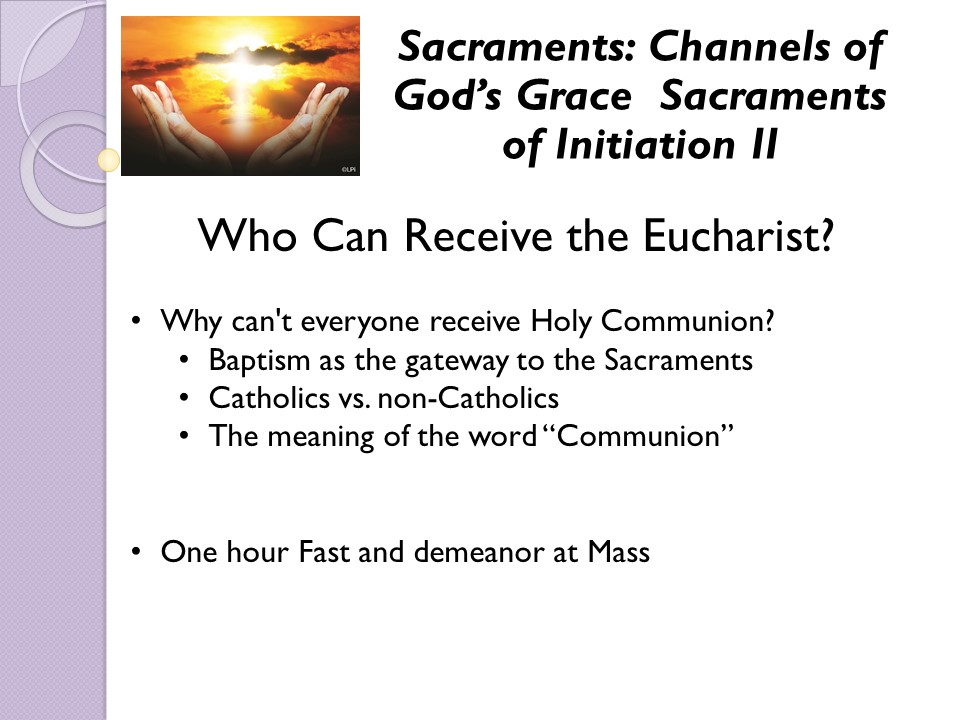
On Non-Catholics Receiving Communion

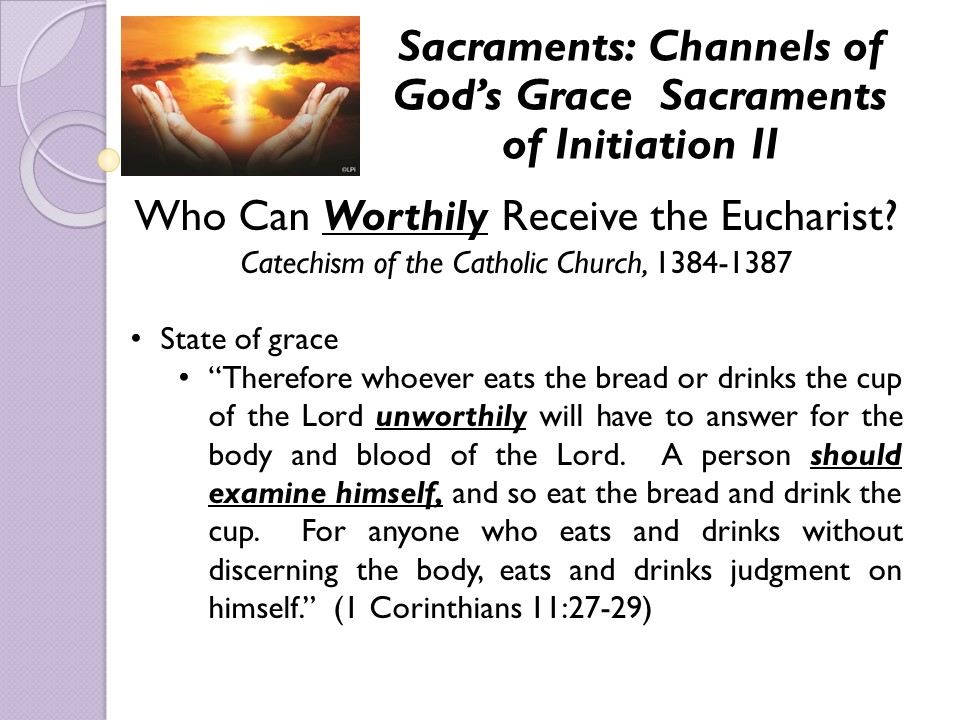
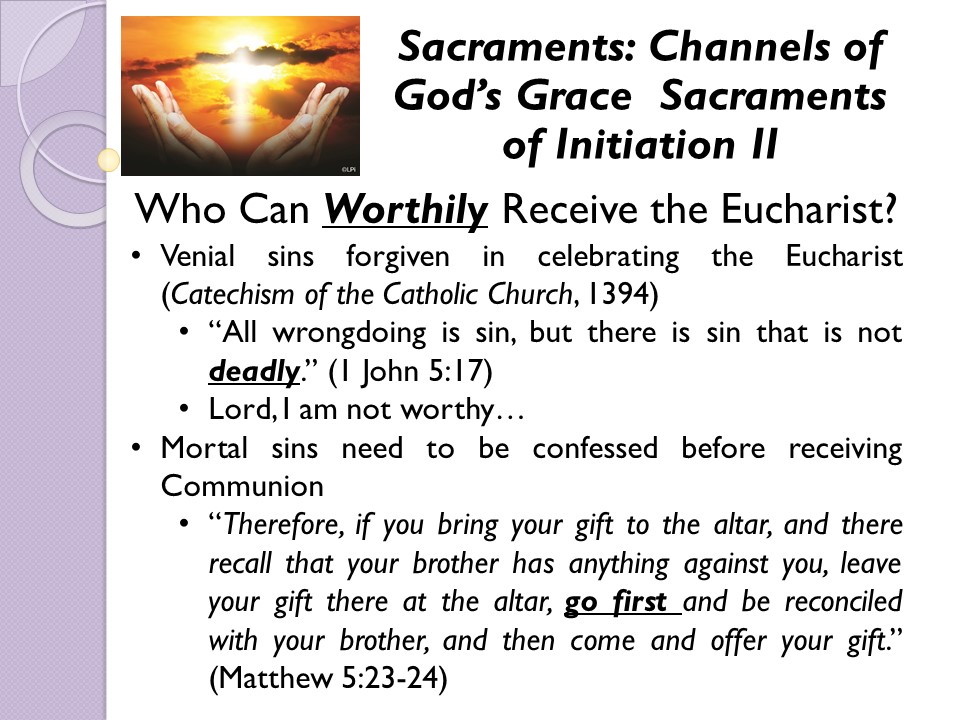
In the third video presentation in my series, Sacraments: Channels of God’s Grace, on the Eucharist, I addressed the question of “Who Can Receive the Eucharist” in slides 36-38.

I began with the general question speaking about the need to be baptized in the Catholic Church and what it means to be in communion in what we believe.

Then, I addressed the need to be in a “state of grace” and venial vs. mortal sin.

Today, I want to add a little more on the question of non-Catholics receiving Communion in a Catholic Church.

To do so, I must reiterate that our Catholic understanding of who can receive Communion is based on our belief in the Real Presence of Jesus in the Eucharist. It is not just bread and wine we receive. The bread and wine become the Body and Blood of Jesus through what is offered in the Eucharistic Prayer.

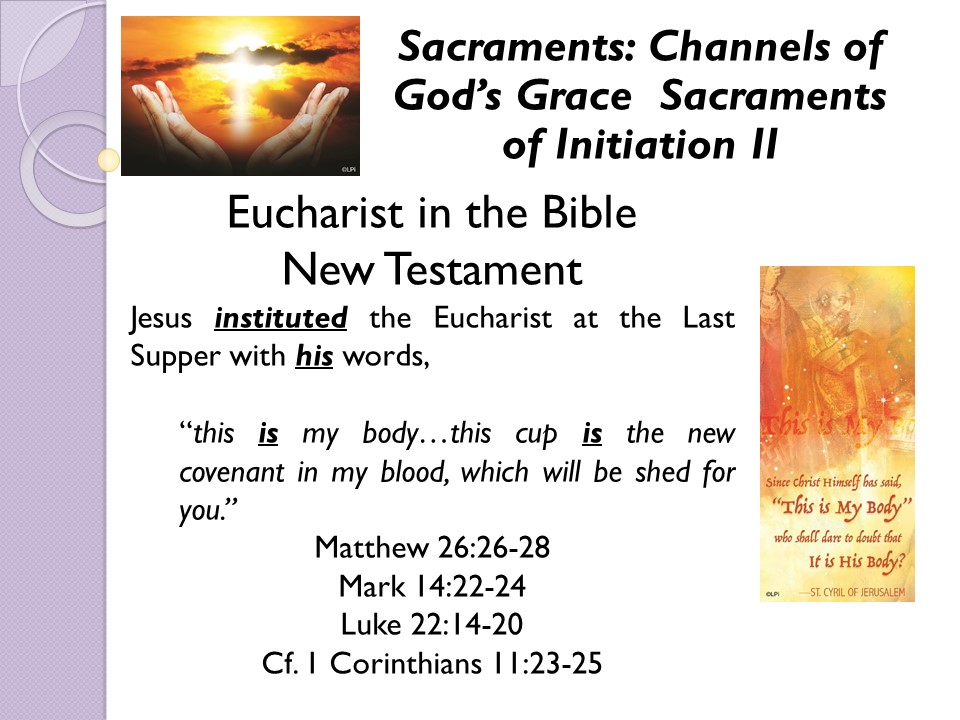
Our belief in the Real Presence is not based on human thought. It comes from Jesus’ own words at the Last Supper.

as well as Jesus’ Words, “Amen, amen, I say to you, unless you eat the flesh of the Son of Man and drink his blood, you do not have life within you” (John 6:53).

Because it is Jesus, we must think about our worthiness. This is why we need to be in a state of grace (see slides above).

So, what is it that I would like to add to what I said in my presentation on the Eucharist regarding non-Catholics receiving Communion?

Recently, as I was reflecting on another topic, I was reading Exodus 12, when I came to Exodus 12:43, “The Lord said to Moses and Aaron: This is the Passover statute. No foreigner may eat of it.” The Passover was to the Israelites what the Eucharist is to Catholics. It is essential to our identity. This verse from Exodus 12:43 tells us that the Lord himself prescribed that no “foreigner” could share in the Passover Lamb. I see this as laying a foundation for our Catholic teaching against non-Catholics receiving Communion.

This does not mean that a foreigner could never become an Israelite. Exodus 12:48 says, “If any alien residing among you would celebrate the Passover for the Lord, all his males must be circumcised, and then he may join in its celebration just like the natives. But no one who is uncircumcised may eat of it. ” What is essential to understand here is that circumcision should not be understood only as a physical act. In this case, it is seen as a mark of conversion, the alien becoming an Israelite. Then, they can eat of the Passover.

If a non-Catholic believes what our Catholic faith teaches, including the Real Presence of Jesus, then one is free to become Catholic and receive the Eucharist.

I don’t know if this, together with what I offered in my presentation on the Eucharist, answers all questions about non-Catholics receiving Communion but I hope it helps you understand this is not simply human teaching. Rather, it comes from God.

Peace,

Fr. Jeff

Jesus, Human and Divine

Last week I posted an article, “Do People Understand What Jesus Does for Us?” In that article, I discussed Jesus’ action to save us from our sins. My inspiration for that article came from Clear and Simple: How to Have Conversations That Lead to Conversion by Andre Regnier (Ottawa, Canada: Catholic Christian Outreach. 2018).

Now, I would like to offer some reflection on another idea presented by Regnier in this book. He discusses how many people profess faith in some way without really knowing “what they are saying “yes” to” (37). He calls their “yes” a “naive yes” (37), that it “lacks love or any kind of personal dimension. It is not the kind of assent Christ is asking for” (38).

What does your “yes” to God mean? How strong is your yes?

It is unfortunate that some people don’t take faith seriously. Everyone wants to get into Heaven but they want to do so on their own terms. This is nothing new. The Jews who opposed Jesus wanted a messiah but they wanted one according to their expectations. In the Old Testament, many prophets were persecuted when they called the people to repent and change their lives. People didn’t want to have to change.

Regnier goes on in his book to discuss how people seem to have lost, even denied the “divinity of Christ.” He points that without the “divinity of Christ, most everything we believe in crumbles” (75). Without his divinity, Jesus is just another human being. One might still consider Jesus a prophet but people have a history of not listening to prophets.

Jesus is divine.

There was much discussion of the two natures of Jesus in the first five centuries of Christianity. Is Jesus human? Is Jesus divine? Could He be both?

Jesus is both. In his days walking on Earth, Jesus was human and divine. Nothing changes that. However, in our human struggle to understand this, it took four to five centuries of the Church listening to the Holy Spirit to come to understand this.

There was much intellectual discussion about the two natures of Jesus Christ. However, believing in the two natures of Christ is not simply an intellectual question (cf. 93). It also requires conversion of “heart and will” (36). We must allow ourselves to be moved by the Holy Spirit.

If the Church spent four or five centuries working on understanding the two natures of Christ, where do we find what they came to know?

It is spoken every Sunday at Mass. It is the Creed. Here, I speak of the Nicene Creed. (The Apostles’ Creed is also an option for Sunday Mass but I look to the Nicene Creed for its fuller expression of the question of the divinity of Jesus).

Yes, Jesus is human. As we recite in the Creed, Jesus, through the Holy Spirt “was incarnate of the Virgin Mary and became man.” There is our faith in Jesus’ humanity.

What about his divinity? This too is found in the Creed. Jesus is identified as:

the Only Begotten Son of God,
 born of the Father before all ages.
 God from God, Light from Light,
 true God from true God,
 begotten, not made, consubstantial with the Father.

Jesus and God (along with the Holy Spirit as described later in the Creed) are one, “God from God, Light from Light.” Jesus is “consubstantial” with the Father, meaning they are of the same substance. We struggle to understand this in our humanity but we believe it in faith.

Why is it important for us to believe in Jesus’ divinity as well as his humanity? It is in his humanity that He suffered for us. It is in his divinity that we are saved through his suffering (for more on his suffering, see my recent article, “What Was the Worst Part of Jesus’ Suffering?”). It is because we know of his divinity that we know what He teaches comes from God. What Jesus teaches is not the teaching of one human being. It is the teaching of God. We should listen.

It is in believing that Jesus is fully human and fully divinity and knowing that He died so that we might have entire life that we find serenity (see my recent article “The Serenity Prayer”).

Peace,

Fr. Jeff
P.S. For more on the Creed, check out my five-part video series, We Profess, We Believe.

30th Sunday in Ordinary Time, Year A – Homily

30th Sunday in Ordinary Time, Year A
Exodus 22:20-26
Psalm 18:2-3, 3-4, 47, 51 (2)
1 Thessalonians 1:5c-10
Matthew 22:34-40
October 25, 2020

Last week we heard how the Pharisees were trying to “entrap Jesus in speech.”  As they did this, Jesus responded “knowing their malice.

Today, the Pharisees continue their efforts against Jesus.  “One of them, a scholar of law, tested him by asking, “Teacher, which commandment in the law is the greatest?”

Even though the motive in asking the question is bad, the question is a fair question.  Sometimes following all the commandments seems impossible.  Where do we begin?  Our desire should be to keep all God’s commandments but where do we start?

When we hear the word “commandments,” we might immediately think of the Ten Commandments given to Moses.  Which one of them is the greatest?

However, Jesus does not respond with one of the Ten Commandments.  His response is found in the Old Testament, specifically Deuteronomy 6:5.  Jesus says the greatest commandment is “You shall love the Lord, your God, with all you heart, with all your soul, and with all your mind.”

On his own initiative, Jesus tells us the second greatest commandment is like the first, “You shall love your neighbor as yourself.”  This too is not one of the Ten Commandments but it is found in the Old Testament in Leviticus 19:18.

While neither of the two greatest commandments given by Jesus are explicitly found in the Ten Commandments, they are what the Ten Commandments call us to do, love.  They sum up the Ten.

The first three of the Ten Commandments are about loving God.  Commandments three through ten are about how we love our neighbor.

How much are we to love?  With all our heart, soul, and mind.  Do we?  Is there something we are holding back on?

It can be hard to love.  Some people make it especially hard to love them but at times it can even be hard to love God.  Sometimes we just want to do our own thing.

Yes, it can be hard to love.  In our opening prayer, we prayed that God “increase our faith, hope and charity” (charity meaning love). 

God loves us.  As Paul says we need to become imitators of the Lord, meaning we need to follow his example of love.  Jesus shows us what it means to love with all our heart, soul, and mind when He freely gives his life for us on the Cross.

What about loving our neighbor?

Our first reading provides application of the Ten Commandments to love.  Regarding lending money, we hear, “you shall not act like an extortioner toward him by demanding interest from him.”  To do so is to steal. 

What does this say about banks charging interest on loans?  Today is a different world.  Charging interest is how banks make money to stay in business.  They rightly charge interest but it must be at a fair rate. 

What the first reading is speaking against is taken advantage of a person’s misfortune.  It speaks of neighbors helping each other not as a business but as love.  We should not advantage of our neighbor’s plight to make money for ourselves.  It only makes their situation worse.

The first reading also tells us, “You shall not molest or oppress alien, for you were once aliens yourselves in the land of Egypt.”  To be an alien to is to be a foreigner, meaning one is not in one’s homeland.  That can make life all the harder.  They might feel all alone.  We are not to take advantage of their misfortune.  We should think about how we treat immigrant and migrant workers today.  Do we pay and treat them fairly or do we take advantage of their situation?

The Lord reminds the Israelites how badly they were treated in Egypt.  They are not to treat others similarly.  What’s the Golden Rule?  “Do onto others as you would have them do onto you” (see Matthew 7:12, Luke 6:31).

The Israelites were oppressed as slaves in Egypt.  They cried out to God who heard their cry and rescued them, destroying their enemies. 

We are loved by God.  We are called to respond by loving God and our neighbor.  It is not easy to love.  When we do, we become “a model for all.”  When we love, people will see us as people who love and, we pray love others in kind.

It is not easy to love.  We do so only with our Lord as our strength, our rock, our deliver, refuge, and shield.

Lord, help us to love.

2020: What a Year!

Dear Lord,

It has been a challenging year and we still have two months to go.  The challenges have come in various ways. Perhaps the one most obvious to all is the Coronavirus Pandemic.  Our greatest concern is for those who have actually gotten sick.  We pray for them.  We pray for those who have died with the virus.  We pray for the health care workers who have worked hard to care for the sick despite the risk to themselves of catching the virus.  We pray for those working on cures and vaccines.  We pray for those out of work and those who are losing their businesses.  We pray for all secular and religious leaders to make wise decisions as the pandemic continues with new increases in the number of people testing positive.  Not far from here, Steuben and Chemung counties have just increased the restrictions, even entering a partial shutdown in some areas where the number of people with new positive tests has taken a sharp increase.  (Is this the second wave?) 

We also pray for those affected by the wildfires.  It is the worst year on record for wildfires.  We pray for the firefighters.  We pray for those who have had to evacuate, most especially those who have lost their homes, and, in some cases, their entire communities.  We also pray for the relief workers providing for the needs of those affected by the fires.

It has also been a year with a high number of tropical storms and hurricanes.  Like with the wildfires we pray for those who have had to evacuate, most especially those who have lost their homes.  We pray for all the emergency responders.  We pray for the relief workers.

It is an election year for the president of our country.  Partisan politics were already difficult.  The fact that it is an election makes it all the more prominent. 

As a church, the Coronavirus pandemic has taken what was already declining attendance into a sharp dive.  Our greatest concern is for our parishioners.   We wish we could gather together without Coronavirus precautions but we must be careful.  People are facing their own financial challenges with the loss of work from the pandemic.  We pray for their needs first while realizing the decreased giving seen in many parishes makes parish finances all the more difficult.

Independent of the Coronavirus, our church continues to deal with the clergy sexual abuse crisis.  Mistakes were made in how it was handled in the past.  We try to do better but it is hard.

Everything I have written so far here points predominantly physical struggles.  Our real concern is for the spiritual needs of your people.  Lord, how do we help them when our ability to come together in person is limited?  As you know Lord, I recently published an article on my blog reflecting on the Serenity Prayer (“The Serenity Prayer”).  We need peace.  Lord, help us to find serenity.

Where do we turn to?

Of course, it is to you our Lord we turn to.  Help us to trust in you.  When Jeremiah faced difficultly you said to him, “For I know well the plans I have in mind for you—oracle of the Lord—plans for your welfare and not for woe, so as to give you a future of hope.  When you call me, and come and pray to me, I will listen to you” (Jeremiah 29:11-12).  As you listened to the prayers of Jeremiah and responded, we ask you to do the same for us.  Help us to know that You have a plan.  Help us to know our part in your plan.

We might feel powerless but You have a plan.  Help us to know what you want us to do.  As we become fatigued, help us to persevere.  We can make a difference by wearing our face mask and using the gift of reason that You have given us to practice safe social distancing to do our part to limit the continuing spread of the Coronavirus.  We can make a difference with our actions and with our prayers.

Thinking of the wildfires, help us to live a lifestyle that respects what You have given us in creation.  Help us to not do anything to cause wildfires (such as leaving campfires smoldering).  The fires are worse in some places because of droughts.  I don’t know if this has anything to do with “global climate change.”  If it does, help me to make wise decisions.  The same is true for the high number of tropical storms and hurricanes.  You give us the gift of reason.  Help us to use it wisely.

What about the partisan politics?  Some would speak of the separation of church and state to say the two have nothing to do with each other.  Our faith must shape our values.  That includes how our government functions.  Lord, as Election Day draws near (with voting already started in some places), help everyone to make wise decisions in their votes.  Help us to follow your plan, your will in the way we vote.

Lord, your church is struggling.  Please help us to deal with where we went wrong with the clergy sexual abuse crisis.  Help us overcome the sins of the past and to do better in the future.  We also need your help with the declining numbers of people coming to church.  Our concern is for the people, not the numbers.  It was already a struggle before the Coronavirus pandemic.  Now, it is even more so.  How we reach out to these people?  Help us to listen to why they stopped coming and to deal with the challenges, not to appease their will but to help all know your love.  Lord, I referenced above the financial struggles of many parishes.  I will not explicitly pray for money here because money is not our goal.  What I will pray for is your help for us to find the resources we need as a church to fulfill the mission you have given us, whether those resources include money, other material goods, or the time and talents of our parishioners.  You know our struggles and You have a plan on how we are to deal with our struggles.  Lord, help us trust in you. 

Lord, again, it has been a difficult year.  As we suffer, help us to know that You are with us.  Jesus experienced the greatest suffering in his Passion, his Crucifixion for us.  Help us to turn our sufferings over to you.  You know how to get us through all these challenges.  Help us to trust in You.

Lord, I end with the words of the father whose son was possessed by a demon, “I do believe, help my unbelief!” (Mark 9:24).

Peace,

Fr. Jeff

Do People Understand What Jesus Does for Us?

With fewer and fewer people coming to church even before the Coronavirus, one asks the question, “Why don’t more people come to Jesus?” Jesus offers us something wonderful. Do people understand what Jesus offers us, namely, salvation?

I just finished reading Clear and Simple: How to Have Conversations That Lead to Conversion by Andre Regnier (Ottawa, Canada: Catholic Christian Outreach. 2018). Regnier says, “The fact is, just as an emphasis on sin is harsh and fruitless apart from a witness to God’s infinite mercy, a celebration of God’s saving grace is meaningless if there is nothing serious we need to be saved from” (68-69).

What is it we need to be saved from? Our sins. Our mortal sins break our relationship with God. Our venial sins damage, but do not break, our relationship with God. We cannot fix what our mortal sins have broken. We need to repent. We need to return to God with contrite hearts but only Jesus can save us. He does this when He lays down his life for us on the Cross.

The problem is people has lost the sense of sin. Relativism says there is no universal truth, that there is no one right or wrong. Thus, there is no sin. Relativism is wrong. There is a universal Truth. It comes from God.

Nonetheless, people have lost the sense of what sin is. Prior to the Second Vatican Council many people went to Confession often monthly if not weekly. They went out of obligation as much, if not more than a healthy sense of sin. After the council, the pendulum swung to the other extreme. Many people seldom go. Some seem oblivious to the existence of sin. Others think sin only applies to the absolute worst behaviors of murder (even there some fail to recognize abortion and assisted suicide as sins against life) and adultery (with a very narrow definition of adultery of infidelity in marriage).

Some people might be willing to say they aren’t perfect but downplay their sins. No one got hurt, right? Everyone gets into Heaven, right? If everyone gets into Heaven, why did Jesus die? Why did God give the commandments?

We pray that everyone does get into Heaven. God wants everyone to get into Heaven. God invites everyone to Heaven but we must accept the invitation (see my homily for October 11, 2020, 28th Sunday in Ordinary Time, Year A. See also “Choosing a Moral, Immoral, or an Amoral Life”).

God stands ready to forgive anyone who comes to him with a contrite heart. God gives us the gift of the Sacrament of Reconciliation for us to receive the gift of his forgiveness and mercy.

Regnier speaks of those who have heard the gospel but have not fully responded with the following words, “They have an intellectual grasp of the Gospel, and they have a heartfelt desire for the Lord, but no one has called a response from they, so they have not given it” (40). I think the same can be true for confession. People feel guilt. They want to be freed from the burden of their guilt. But no one has invited them to hand their guilt over to God by confessing their sins. I invite you to examine your conscience. Then, come to confession, and receive the precious gift of God’s forgiveness. Be freed from your guilt. This is why Jesus died for you.

Peace,

Fr. Jeff

The Serenity Prayer

In the 1930’s, Reinhold Neibuhr (1892-1971) developed the Serenity Prayer. The first four lines have become well-known.

God grant me the serenity
to accept the things I cannot change; 
courage to change the things I can; 
and wisdom to know the difference.

It seems harder and harder to me to find “serenity” in the world today. There is so much going on for us to face, the Coronavirus and hatred/division/partisanship seem to be at the forefront for me.

We need to turn to God. God is the one who can bring us “serenity” in the midst of turmoil. However, serenity doesn’t mean all our problems will disappear. That’s why we pray for God to help us accept the things we cannot change.

I am a fixer. I want to fix everything I can. It can be hard for me to realize that I can’t fix something. I know I am not called to fix everything myself. I just struggle to not let things bother me. I want solutions.

When we are called to change something, we ask for the courage to do what God asks of us. The changes God wants are not popular in this world. It takes courage.

I pray that God give me the wisdom to know what it is that He wants me to do.

So, that’s the first four lines of the Serenity Prayer. Did you know that there is more? Here’s the entire prayer:

God grant me the serenity
to accept the things I cannot change; 
courage to change the things I can; 
and wisdom to know the difference.
Living one day at a time; 
enjoying one moment at a time; 
accepting hardships as the pathway to peace; 
taking, as He did, this sinful world
as it is, not as I would have it; 
trusting that He will make all things right
if I surrender to His Will; 
that I may be reasonably happy in this life
and supremely happy with Him
forever in the next. 
Amen.

Let’s take a look at the rest of the prayer.

Living one day at a time, enjoying one moment at time
Do you live in the moment? I am always looking ahead to plan and prepare for what is coming next. It is good to prepare ourselves for what is coming but we also need to embrace what God is offering us in the present moment. There is an appointed time for everything (Ecclesiastes 3:1). I know I generally find the greatest peace when I am focused on the present moment (not multitasking). We balance what is going on in the moment with hope for the future.

Accepting hardships as the pathway to peace
We would like everything to be easy yet we know we must take up our cross and follow Jesus. Sometimes we spend a lot of effort avoiding hardship (suffering) when we can find the greatest peace when we accept the hardship and let God be with us in the hardship.

Taking, as He did, this sinful world as it is, not as I would have it
Sometimes I think if I could just change….everything would be better. At times, God does indeed call us to work for change. However, even then we must begin by meeting people where they are at.

Trusting that He will make all things right if I surrender to His Will
I must do my part. My part begins with surrendering to God’s Will. I must only do my part and leave the rest to God. I must let God be God. What God said to Jeremiah, He also says to us, “For I know well the plans I have in mind for you—oracle of the Lord—plans for your welfare and not for woe, so as to give you a future of hope” (Jeremiah 29:11). God has a plan. We place our trust in him.

That I may be reasonably happy in this life and supremely happy with Him forever in the next
When we look for serenity in this world, we need to realize that we will not find perfect happiness in this earthly world. It is not what we are ultimately created for. We find peace in this world when we realize that supreme happiness only comes in the world to come.

Amen.

Peace,

Fr. Jeff

29th Sunday in Ordinary Time, Year A – Homily

29th Sunday in Ordinary Time, Year A
Isaiah 45:1, 4-6
Psalm 96:1, 3, 4-5, 7-8, 9-10 (7b)
1 Thessalonians 1:1-5b
Matthew 22:15-21
October 18, 2020

We gather on this 29th Sunday in Ordinary Time.  Today is also October 18th.  This is the feast of St. Luke, the patron saint of our parish.  We should pray regularly for his intercession for the needs of our parish but especially on his feast day. 

In writing to the Colossians, Paul identifies Luke as a physician.  So, St. Luke is the patron saint of physicians.  It is at this time of year that we normally offer a special Mass with the Sacrament of the Anointing of the Sick.

With Coronavirus precautions in place, we are not offering that Mass to avoid multiple physical contacts.  Let me assure you that we continue to offer the Sacrament of the Anointing of the Sick to individuals who ask for it outside of Mass.  We are simply not doing it in a group setting.

Yet, we still want to do something as a community to offer prayers for healing.  In recent weeks in our bulletin, we invited prayers of healing.  As we celebrate Mass today, we hold these prayers in our hearts.

The Anointing of the Sick is offered for those facing serious physical illness.  The oil is a sign of strengthening.  It is God bestowing grace upon the person.  In thirteen years of priesthood, I have not seen an immediate physical healing of a person when I anoint them.  What I have experienced is them telling me how they feel a sense of peace come upon them as they are anointed.

Healing is something more than just physical.  We certainly pray for physical healing but we are also pray for healing of our sins, including receiving the Sacrament of Reconciliation.  We also need to pray for healing of societal rift.  We pray for healing in broken relationships and for those facing difficult situations.

In praying for healing we ask for the grace we need for “endurance in hope” knowing that God is with us.

Even our prayers for physical healing go beyond just asking for immediate physical healing.  For instance, we pray for those who are sick with the Coronavirus.  We also pray for those under stress because of the virus.  We pray for cures, vaccines, and for our public and church leaders to make wise choices during this pandemic.

We pray for all involved, even if they do not believe in the one true God.  God can work through anyone.

We see this in today’s first reading.  God is speaking “to his anointed, Cyrus.”  Cyrus is called “anointed,” which literally means “chosen.”  God had chosen Cyrus to set the Israelites free from the Babylonian Exile. 

It is important to know that Cyrus is not an Israelite.  He believes in a false pagan god but God still chooses to work through him, “subduing nations before him, and making kings run in his service.”  God chooses to do this “for the sake of Jacob” his servant. 

Though Cyrus knew him not, God chose to call Cyrus to lead his people from Exile.  God brought healing to his people from the Exile.  Many had been taken from their land.  The temple had been destroyed.  God brought restoration (healing) to Israel.  

Even today, God works through believers and non-believers.  For example, God works through people in the medical profession who do not know him to bring healing.  We pray for all of them.

In Jesus’ time on earth, there were those who opposed him.  He still offered them salvation.  Even when they tried to entrap them, He used them to provide teaching moments for us.  He knew their malice but He still sought to help them.

While they professed, as Israelites, to believe in the one true God, they closed their hearts to Jesus.  Do we close some part of our life off to Jesus? 

We ask God to heal us from being closed off.  

We ask him to heal the brokenness of our society. 

We ask him to heal our broken relationships, to help us let go of the hurt.

Knowing of God’s healing, let us “Give the Lord glory and honor.”  We thank him for the healing He brings, most especially the healing of our souls, leading us to salvation.

What Guides Your Morality?

Today I would like to continue the discussion of morality by offering two contrasting perspectives on what might be our principal guide in our moral choices.

The first one may be held by Christians and non-Christians alike but I see it as falling well short of Jesus’ commandment to love our neighbor. These people might start by saying we live in a “dog eat dog world,” meaning is out for themselves so you better do what you need to take care of yourself.

People like this don’t care who they step on or hurt along the way (hardly Christian). They are in it for their own glory (pride) and material wealth (greed). They might go so far as to steal the credit for good work that belongs to someone else. They might lie to make themselves look. When they can’t find a way to make themselves look better, they find ways to belittle others, making the other person look bad so they can feel better about themselves. Who do you know that spends more time belittling others than advocating for their own position?

As to the accumulation of wealth, in its discussion on the Seventh Commandment (paragraphs 2401 and following), You shall not steal, the Catechism of the Catholic Church affirms the ownership of private property but reminds us of the “universal destination” of all things for the good of everyone. We have the right to have private property but not to the detriment of others. That would be stealing. That would be a sin.

The people described above are motivated by selfish desires.

When one begins to move to the universal destination of goods, one might shift from a purely selfish perspective to a utilitarian perspective, sometimes described as the greatest good for the greatest number.

That’s a start but it doesn’t get us to focus on Jesus’ command to love our neighbor. It’s motive might be about “duty” (Deontological ethics) rather than love.

Here I turn to the Golden Rule, “Do to others whatever you would have them do to you” (Matthew 7:12, Luke 6:31). How do you want to be treated? Do you want to be treated only as an object of pleasure (Sixth Commandment – You shall not commit adultery) for others or do you want to be treated with love? Do you want to be treated as a means for others to get what they want or do you want to be loved?

Being rooted in love for God and our neighbor might mean we don’t have so much ourselves. If we have more than we need, we are called to share it with others who have less. We do this in love. It makes for a community that is there for one another. In such a community, one doesn’t have to worry about saving as much in reserve because you can trust that someone will help you in your need. I am not advocating for socialism. The Catholic Church speaks of the ills of socialism in its social encyclicals). I’m advocating for love.

In the Lord’s Prayer, we pray “thy kingdom come.” God’s kingdom is one of love. We do not build up the kingdom if we are only concerned about ourselves. We help make the world a better place when we set aside pride, greed, and gluttony. We help make the world a better place when we set aside lust, seeing the person for who they are rather than a means for pleasure.

Lord, help us to love, to treat others with the same love we hope they treat us with.

Peace,

Fr. Jeff